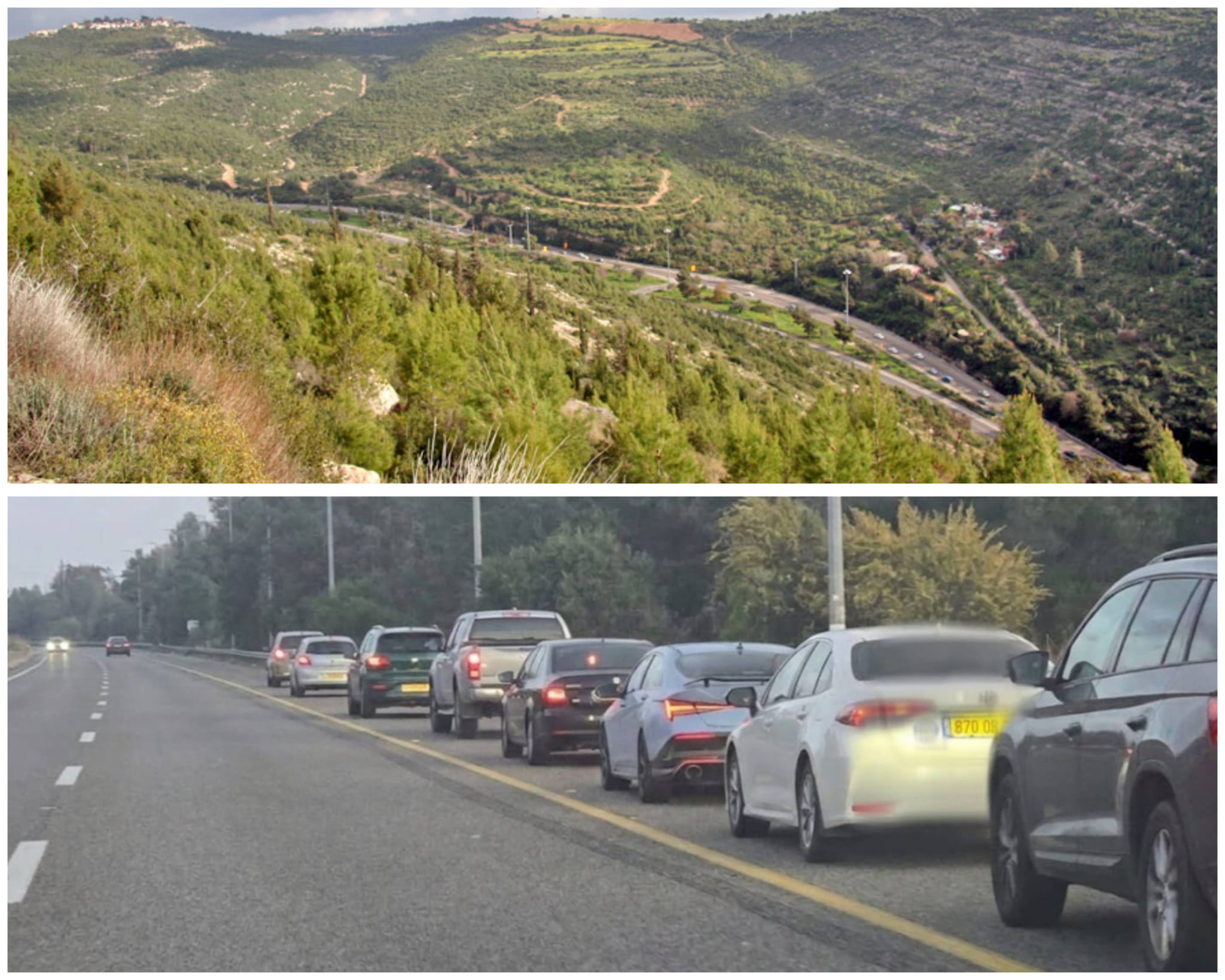
In and around Jerusalem, especially along the main highway climbing from the coast into the city, recent weeks of war with Iran under Operation “Roaring Lion” have created moments when everything suddenly stops. Air-raid sirens sound, drivers brake, doors swing open, and people rush to the roadside in search of immediate cover. These alerts are triggered by incoming missile threats, part of an ongoing escalation that has made such scenes a recurring reality across Israel. At Sha’ar HaGai – a narrow, historic passage on the road to Jerusalem – cars line up as if abandoned, while drivers and passengers scatter, crouching behind rocks, slipping into ditches, or pressing themselves against the nearest tree. Within seconds, instinct takes over. The landscape freezes, and the open sky above feels unusually exposed.
How does Bab al-Wad’s convoy history connect to today’s sirens on the road to Jerusalem?
The scene echoes “Bab al-Wad,” a well-known Hebrew song written by Israeli poet Haim Gouri about the battles for Jerusalem during the 1948 Arab-Israeli War. At that time, the road to Jerusalem was a critical supply route to a city under siege, and convoys transporting food, water, and ammunition were frequently attacked. Sha’ar HaGai – known in Arabic as Bab al-Wad – was one of the most dangerous sections of that road. Today, instead of armored convoys, civilian cars travel the same route. Yet when sirens sound and vehicles stop abruptly, the resemblance is striking. What appears to be a modern emergency scene is layered with history, where past and present collapse into one another. The silence that follows – engines off, wind moving through trees – feels almost symbolic, as if the road itself carries memory.
Why do people hide behind trees during sirens on Israel’s highways?
Amid the urgency, there are also moments of surprising simplicity. People stand behind thin trees, making themselves smaller, as if the tree could truly protect them. In Israel, civilians are instructed to seek any available cover during missile alerts, even minimal, because seconds can make a difference. Beyond the practical, there is something deeply human here – a reflex that blends instinct and emotion. It recalls a familiar children’s story in Israeli culture about characters who believe that if they cannot see danger, it cannot see them. In those seconds, between a racing heartbeat and a narrow trunk, there is a brief illusion of safety. Even in the context of modern warfare, people return to something basic: the need to feel protected, if only for a moment.