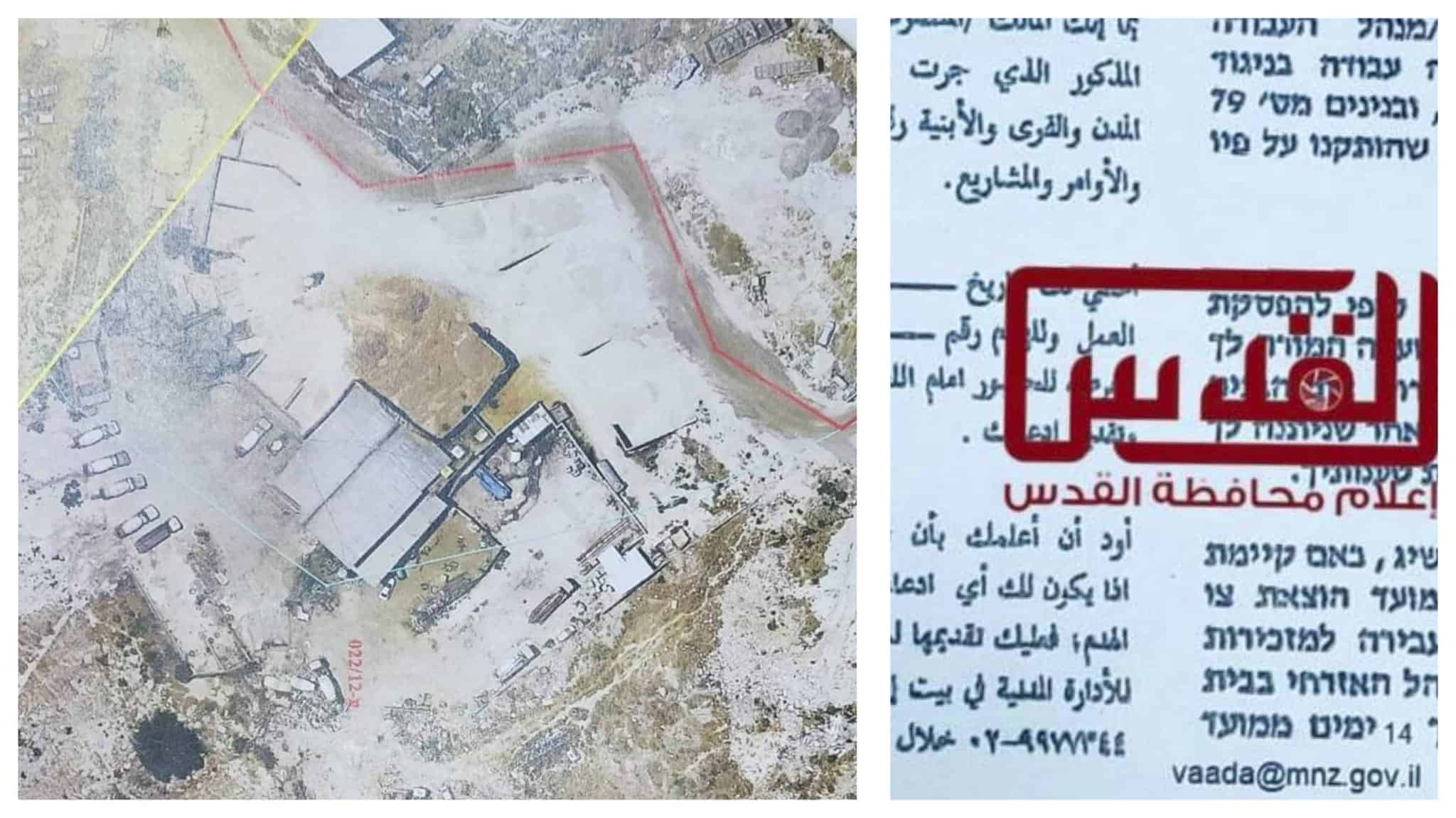
A major transportation project is underway east of Jerusalem, near Ma’ale Adumim. The plan, facing strong Palestinian and international opposition, was launched by Israel’s Civil Administration in Judea and Samaria with the issuance of 40 demolition orders for agricultural and industrial structures in the village of al-Eizariya, on the road between Jerusalem and Ma’ale Adumim. The orders, issued in three phases, target buildings constructed without permits and in violation of planning laws
The road separating Israeli and Palestinian traffic
Named the “Fabric of Life Road,” the project is a strategic transportation initiative aimed at separating Israeli and Palestinian traffic. It will allow Palestinians to travel from the northern to the southern West Bank without using roads designated for Israelis, reducing friction, improving security, and easing congestion on Route 1 between Jerusalem and Ma’ale Adumim
The project is also seen as a step toward reinforcing Israeli sovereignty in the Ma’ale Adumim area and strengthening settlement continuity between Jerusalem and West Bank communities. The route passes south of the E1 area, considered crucial for a future Palestinian state’s territorial continuity
Palestinian and global criticism of the new road
The route has two main components
The “Fabric of Life Road” will link the Palestinian villages of al-Za’im and al-Eizariya via an underground tunnel beneath Route 1, enabling Palestinian movement from cities like Ramallah to Bethlehem without passing Israeli checkpoints or roads
(Jerusalem Honors Nahal Brigade: Memorial Forest Reborn)
The planned “Route 80 Bypass” will connect al-Eizariya to the Good Samaritan Junction, enabling direct Palestinian travel between Bethlehem, Jericho, and the Jordan Valley. It is intended to reduce Route 1 congestion and improve Palestinian transport continuity
Supporters say the project will reduce security risks, citing past attacks such as the February 2024 shooting on Route 1, which killed Matan Elmaliach and injured seven Israelis. It is also expected to improve traffic flow for both Israelis and Palestinians
Funding, timeline, and strategic significance
Funding comes from a special Civil Administration fund, using taxes paid by Palestinians — 335 million NIS for the “Fabric of Life Road” and 10 million NIS for planning “Route 80 Bypass” — without burdening Israel’s state budget
The project was approved in March 2025. Before demolition orders were issued, Defense Minister Israel Katz and Ma’ale Adumim Mayor Guy Yifrah visited the site in early August, calling it a “historic moment” with national priority
(Political Experiment: Jerusalem’s Knesset Museum Changes)
Palestinians call it a “settlement project” designed to link settlements and isolate Palestinian cities around Jerusalem. They label it an “apartheid road” that restricts vehicle access to about 3% of the West Bank, splitting it in two and undermining a two-state solution
International criticism remains, with countries including the US warning it could harm chances for a Palestinian state by reinforcing Israeli control over the E1 area