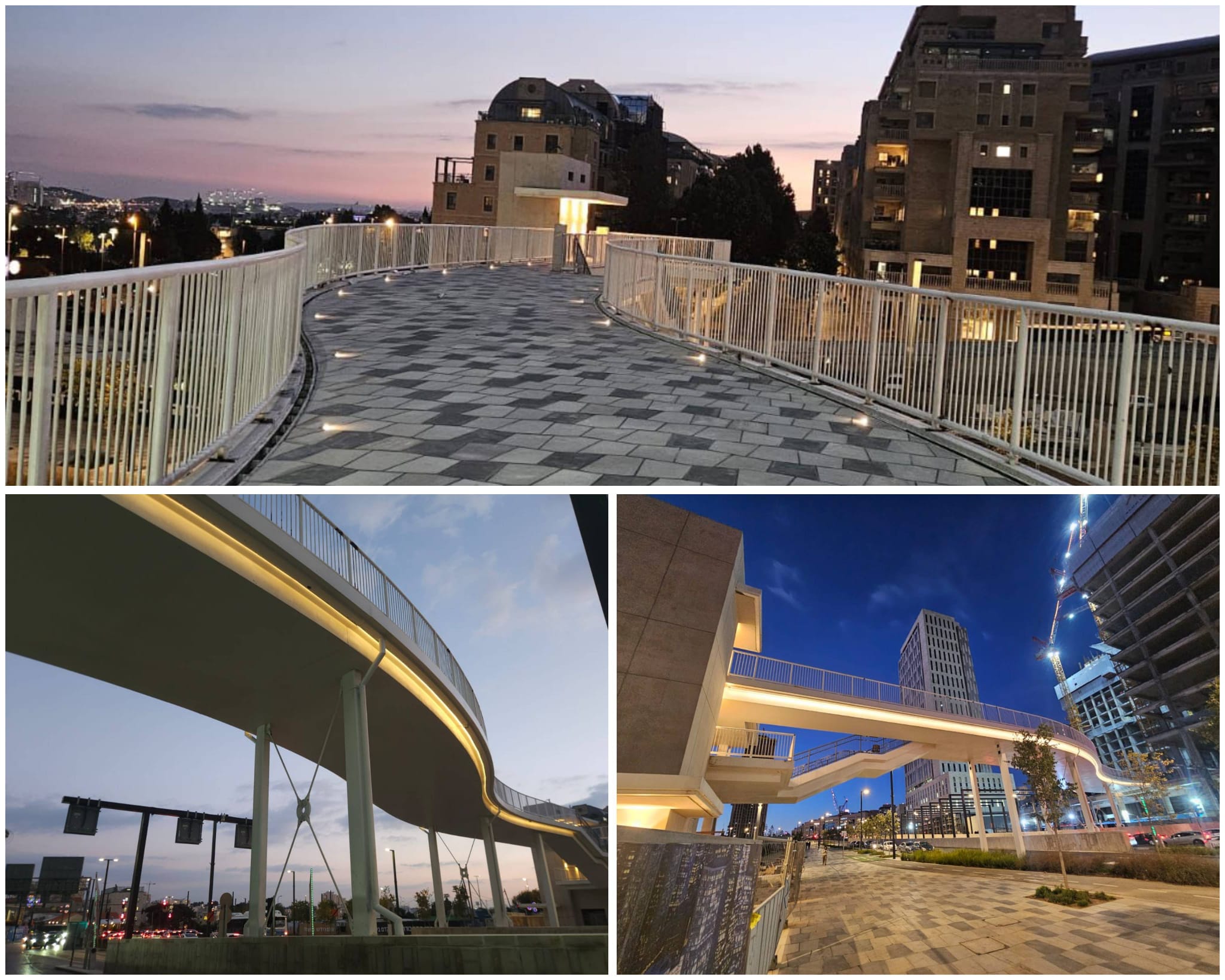
As night falls and the pace of traffic softens, a different layer of Jerusalem emerges at the city’s western gateway. The newly completed lighting of the pedestrian bridge on Shazar Boulevard is not merely a technical upgrade, but a quiet urban statement. Through light, walkability, and human-scale design, Jerusalem is reshaping the experience of arrival.
The bridge connects the Light Rail’s “Haturim” station with the future Justice and State Attorney complex, adjacent to the National Quarter. This direct link between public transportation, government institutions, and a developing civic district reflects a planning approach that places pedestrians at the center. What was once a functional crossing has become a clear, continuous, and safe walking axis, active even after dark.
The new lighting combines decorative elements with dedicated pedestrian illumination, giving the bridge a clean and contemporary presence within the urban landscape. Beyond aesthetics, it delivers a tangible improvement in safety and comfort in an area used daily by thousands. Light defines the structure’s lines, clarifies its boundaries, and creates an orderly, confident walking experience that signals long-term planning and investment.
How does the Shazar Boulevard bridge lighting change the experience of entering Jerusalem?
In recent years, Jerusalem’s western entrance has undergone a broad transformation, including transportation upgrades, new public institutions, and the redesign of open spaces. The bridge lighting integrates into this process as a key layer of a wider urban vision – strengthening connectivity and accessibility without compromising design quality. By emphasizing the pedestrian route, it creates a clear urban sequence linking transit hubs with centers of governance, reinforcing a sense of safety and civic continuity.
Jerusalem Mayor Moshe Lion referred to the project and noted: “Jerusalem’s entrance has been undergoing a deep transformation in recent years, not only in roads and railways, but also in the walking experience and the public realm. The lighting of the Shazar Boulevard bridge is part of a comprehensive urban approach that places pedestrians at the center, strengthens safety, and gives the city’s entrance a modern, illuminated, and carefully designed appearance.”
Quietly and without spectacle, the illuminated pedestrian bridge on Shazar Boulevard joins a series of projects redefining Jerusalem’s urban face. Not as an imitation of another European city, but as a city adopting international standards of planning, accessibility, and aesthetics, and translating them into a local Jerusalem language that is restrained, confident, and unmistakably its own.