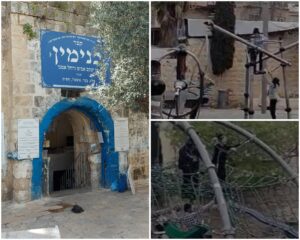
Civil Administration enforcement teams in Judea and Samaria demolished a massive industrial complex on Wednesday morning in the town of Anata, located northeast of Jerusalem, along the planned route of the Life Fabric Road. The road is intended to connect Jerusalem with Ma’ale Adumim and enable Israeli territorial continuity between the two areas.
The complex was built without construction permits and included a two-story industrial structure, a metal-processing plant, and extensive areas used for storing raw materials, including scrap metal and vehicles removed from the road. According to Palestinian claims, millions of shekels were invested in the facility, which served as a source of livelihood for dozens of people.
Is the demolition in Anata accelerating the Life Fabric Road project?
The demolition marks the most significant step so far in implementing the ambitious transportation project east of Jerusalem, leading toward Ma’ale Adumim. The project, which has faced strong Palestinian and international opposition, was launched by the Civil Administration as early as August 2025, with demolition orders issued for structures built without permits in towns located along the route between Jerusalem and Ma’ale Adumim and used for agricultural and industrial purposes.
The project consists of three central components: the Life Fabric Road itself, a new access road connecting the E1 area with Ma’ale Adumim and Jerusalem; upgrades to the Eastern Ring Road serving the settlements of Almon and Giv’at Binyamin; and additional road systems. The road is expected to improve transportation by easing congestion on Route 1, improving traffic flow for Israelis, and allowing smoother movement for Palestinians without passing through checkpoints.
The project also includes the new Olive Interchange, linking Route 1 (Jerusalem to the Dead Sea) with the Mount Scopus Tunnel and enabling direct access to Ma’ale Adumim and the Ben-Zion Netanyahu Interchange. It further incorporates bridges as part of the interchange and road network, including ramps and overpasses designed to separate traffic flows.
Will the Life Fabric Road reduce attacks or deepen the political divide?
Approved by the government last March, the project is designed to reduce friction between Israelis and Palestinians on major roads, thereby lowering the risk of attacks. This follows previous incidents, including a shooting attack in February 2024 in which Matan Elmalih was killed and seven Israelis were wounded on Route 1.
Palestinians describe the project as a “settlement road,” arguing that its purpose is to strengthen links between settlements while isolating Palestinian cities around Jerusalem. They claim the road is part of a broader policy aimed at displacing Palestinians from key areas such as E1, which they consider critical to Palestinian territorial continuity.
Critics further label the project an “apartheid road,” asserting that it will restrict Palestinian vehicle access to approximately three percent of the West Bank, effectively cutting the territory in two. According to them, this undermines the viability of a two-state solution.
Palestinians have also criticized the project’s funding, arguing that it is financed through taxes collected from them while primarily serving Israeli interests.
The project has drawn international criticism as well. In the past, Western countries, including the United States, have opposed the plan over concerns that it could undermine prospects for a future Palestinian state by reinforcing Israeli control in the E1 area.