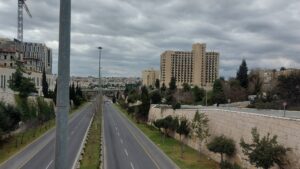
Midday light in Ramot Forest in Jerusalem. From here, the horizon stretches westward toward the neighboring city of Beit Shemesh, which was struck by a direct Iranian missile. One uninterrupted line of sight connects blooming oxalis and green hills to scenes of destruction and death.
What Can Be Seen from Jerusalem’s Ramot Forest Toward the Strike Site in Beit Shemesh?
In the early afternoon hours, oxalis flowers open wide and yellow chrysanthemums glow against the hillside. Cypress and pine trees stand in quiet contrast to the war with Iran unfolding in recent days. From within this steady landscape, Highway 1 descends from Jerusalem toward the lowlands, leading straight to Beit Shemesh. It is difficult to grasp that just beyond the calm horizon, one of the most devastating scenes of the “Roar of the Lion” war unfolded.
A ballistic missile struck a building used as a synagogue that also housed an underground shelter. The roof collapsed onto those inside. Nine people were killed and dozens injured. Homes were destroyed with residents still inside.
Among the dead were a couple and their four children. The family had been preparing costumes and gift baskets for Purim, unaware they would become victims of war. A mother and her paramedic daughter were also killed, trapped beneath the rubble of their home.
How Does Jerusalem’s Landscape Expose the Scale of the Human Loss?
From the forested ridge in Jerusalem, life appears intact. Traffic moves along the highway. The sky remains blue. Wildflowers continue to bloom. Yet the knowledge of what happened just beyond the hills reshapes the view. Nature follows its seasonal rhythm, steady and indifferent. It stands as a silent witness to a war that crossed mountains and highways to reach the capital’s edge.
The protected shelter that was meant to serve as a final line of defense became a structure of concrete and iron that failed those inside. The contrast between resilience in nature and vulnerability in human life is stark.
Anemones, cyclamens and green nettles turn toward the sun as they always have. Between destruction and renewal, between roar and silence, one question lingers: how do people rebuild not only homes, but also a sense of security across a shaken land?