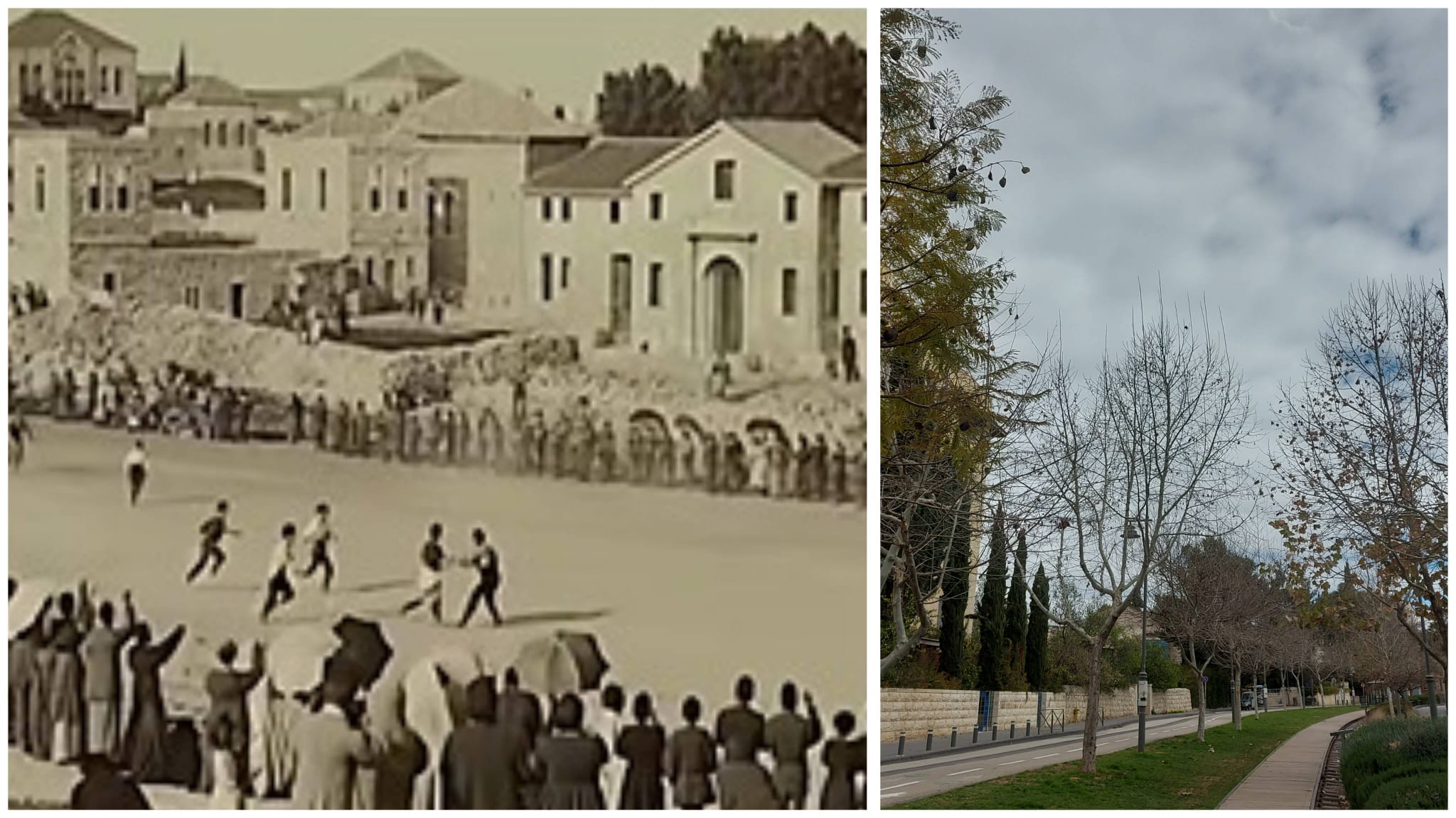
Jerusalem at the beginning of the 20th century had no stadiums and no stands, but it clearly had football. In a visual attributed to 1902, players can be seen on a dirt field, surrounded closely by a standing crowd. There are no barriers, no marked lines, no formal setting – just a game and people gathering around it. It doesn’t look like an organized event, but the essence is familiar: football at the center, and a small crowd drawn to it.
It is hard to say how accurately this scene reflects a specific moment as it actually happened, but it does capture something real about Jerusalem at the time and about football itself. Life in the city moved between routine and tension, and within that, there was space for simple games, for gathering, for a brief pause. The people standing there, almost on the field, suggest something recognizable even today – the need to be part of a football moment, even without a stadium.
Where was football played in Jerusalem in the early 20th century?
This is where the debate begins. There is no clear answer, but several possibilities.
Some believe the scene shows the area that is now Talbiya, back when it was still open land. Others point to Lifta, whose landscape and open spaces could match what is seen. There are also suggestions that it might be near Herod’s Gate, where such a gathering would have been possible.
There may never be a definitive answer. But the effort to place this scene on the map connects different layers of Jerusalem – a city where every location is both history and interpretation.
At a time when football matches are being postponed and leagues disrupted amid the war with Iran, this scene feels different. What usually seems routine – another football match, another weekend – suddenly appears more meaningful. Then, as now, people in Jerusalem gather around a ball not just to see who wins, but to share a moment together.