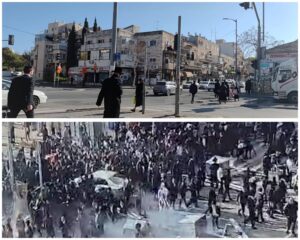
What began on Monday morning as a small protest outside the Beit Hakerem home of Economy Minister Nir Barkat quickly escalated into a telling confrontation. Demonstrators had gathered to demand progress on a deal to return the hostages, but a local resident pushed back, mocking them as “only ten thousand leftists in the whole country” and calling them “people of a hundred.” This reaction underscored a larger truth: Jerusalem has been reshaped into a city where demographics dictate politics, and the balance tilts heavily to the right.
Netanyahu’s bloc dominates Jerusalem
Election results across recent years tell a consistent story: Jerusalem is a fortress of Netanyahu’s bloc. Likud, the ultra-Orthodox parties and Religious Zionism command overwhelming support, while the secular-liberal vote continues to shrink. Outmigration of secular residents and rapid growth of ultra-Orthodox communities have redrawn the city’s political map, turning Jerusalem into a near-certain bastion for the right.
תובנות של ביביסט הבוקר שבא להעליב את המוחים ליד ניר ברקת – ״כולכם זקנים, אתה נראה בן מאה״ pic.twitter.com/WA1kSeUTLB
— לירי בורק שביט (@lirishavit) September 15, 2025
The battle for Jerusalem’s mayoralty
Within this demographic reality, the question of leadership looms large. Reports suggest that MK Meir Porush may once again seek the mayoralty as the candidate of the ultra-Orthodox parties, potentially replacing Moshe Lion – a Religious Zionism figure who is himself far from being identified with the secular public. The very idea illustrates how deeply local politics are aligned with the city’s religious and demographic base.
Jerusalem municipality’s push for normality
At the same time, the municipality continues to invest in cultural projects, public playgrounds and branding campaigns designed to project an image of normality. Yet behind the façade, one fact remains undeniable: the demographic reality. The city is increasingly defined by a right-wing, religious and ultra-Orthodox majority, while the secular-left minority loses further ground in both politics and public life.
Demographics as Jerusalem’s political future
The confrontation in Beit Hakerem is more than a neighborhood dispute; it is a microcosm of a national trend. Demography is already determining who governs Jerusalem and shaping the city’s trajectory. The lingering question is not whether Jerusalem will remain a right-wing stronghold – but who will sit in the mayor’s chair as these demographic forces continue to deepen.