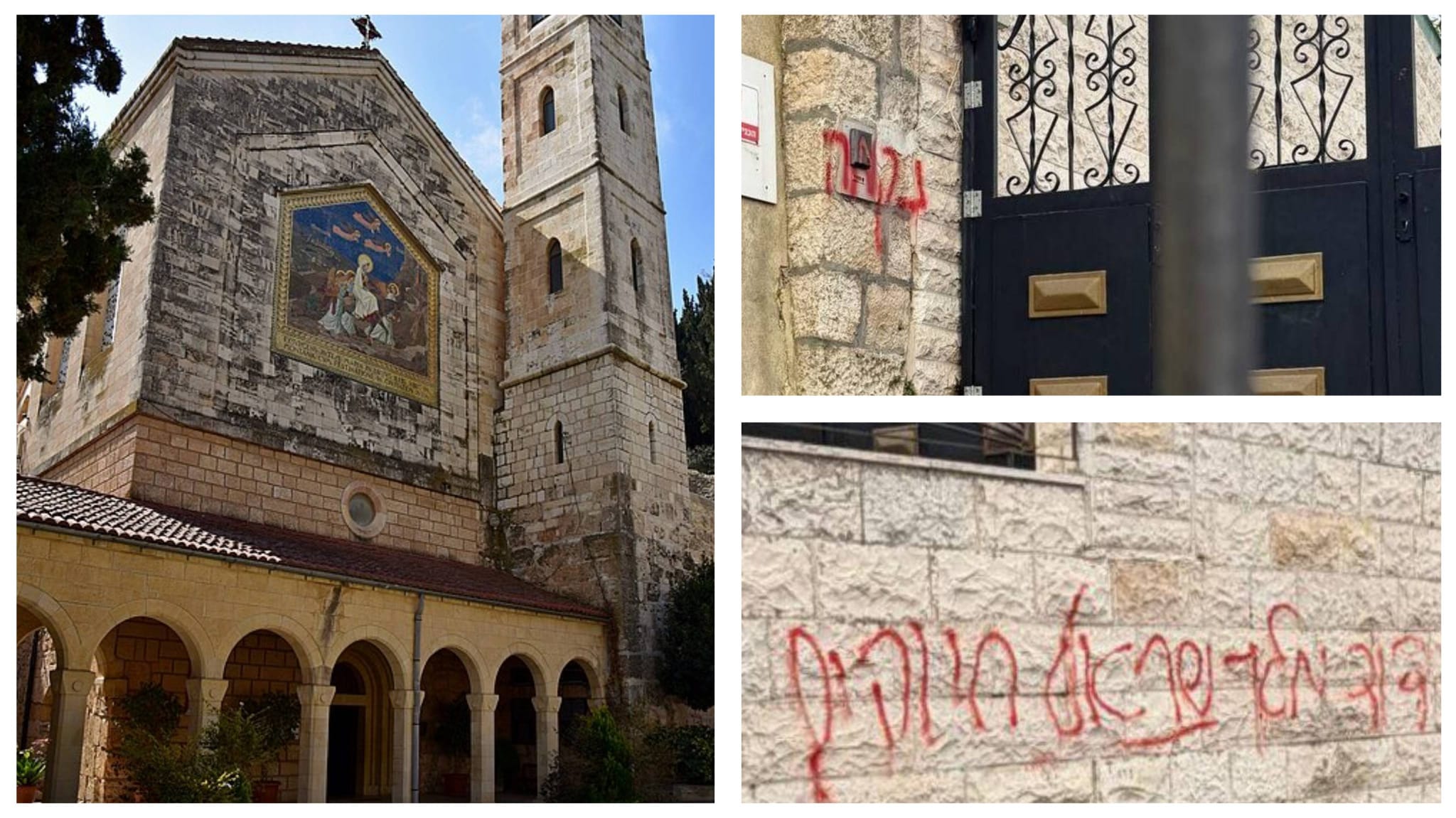
fiti was sprayed overnight between Wednesday and Thursday by unknown individuals on the outer walls of the Church of the Visitation in the Ein Kerem neighborhood of Jerusalem. On one wall, the phrase “David, King of Israel, lives and exists” was written. Near the church’s entrance gate, the word “Revenge” was sprayed, while on a nearby parked car, the words “Messiah (the Jew) is here” appeared.
The Jerusalem District Police opened an investigation into the incident. A statement from the Jerusalem District Police, which launched the investigation, said: “The police are investigating graffiti sprayed at the Church of the Visitation in Ein Kerem. This morning, a report was received regarding messages sprayed on an external wall and on a vehicle near the church complex in the Ein Kerem neighborhood of Jerusalem. Upon receiving the report, Jerusalem District officers arrived at the scene and began operations, including collecting evidence, in order to identify those involved.”
What Is the Church of the Visitation and Why Is It Important in Jerusalem?
The Church of the Visitation is a Catholic church located in the Ein Kerem neighborhood of Jerusalem. It commemorates the visit of Mary, the mother of Jesus, to her cousin Elizabeth, the mother of John the Baptist. The church is built on a site where, according to Christian tradition, the event described in the New Testament — in the Gospel of Luke — took place. The “Visitation” refers to the meeting between Mary, who was pregnant with Jesus, and Elizabeth, who was pregnant with John the Baptist. According to Christian scriptures, when Mary arrived, Elizabeth was filled with the Holy Spirit and the child in her womb leaped with joy. This is a central event in Christian tradition, emphasizing the connection between Jesus and John.
The current church was designed by Italian architect Antonio Barluzzi and was built between 1939 and 1955 on the ruins of earlier churches from the Byzantine and Crusader periods. It belongs to the Franciscan Order, a major Catholic order that maintains many holy sites in the Holy Land. The site includes an upper and lower church, with frescoes, mosaics, and theological texts in various languages on its walls. The structure combines traditional architectural elements and offers a panoramic view of the surrounding hills.