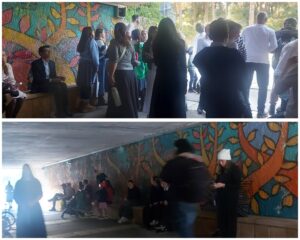
On Aza Street in Jerusalem, just steps away from the Prime Minister’s official residence, an unusual scene has taken shape. Tents spread across the asphalt, folding tables and plastic chairs placed in the middle of the road. Families of the hostages held a Friday night dinner here, sharing food with activists and supporters, declaring their intention to stay not only through Shabbat but also throughout the coming holidays. They hope others will join them – public figures, familiar voices, and ordinary citizens unwilling to normalize a reality in which their loved ones remain trapped in Gaza, hour after hour, day after day.
Hostage protest on Aza Street in Jerusalem
Against the backdrop of the Prime Minister’s residence, where the country’s most critical decisions are made, a routine of protest life has emerged. Families confront the government with their presence: tents pitched side by side, makeshift meals on the pavement, signs bearing the names of those still in captivity. Their physical presence is more than a cry of despair – it is an urgent attempt to force the issue back into the center of national consciousness.
Tents by the Prime Minister’s residence become a symbol
The tents on Aza Street are more than temporary shelters. They have become a symbol – a public marker of pain and defiance. Joining the families are protesters angry at the government, at the stalemate in negotiations, and at the creeping sense that the hostages have been pushed into the background. The street has turned into a living memorial, a place where every passerby is confronted with the unkept promise to “bring them all home.”
Families of hostages confront a society adapting to silence
Here lies the deeper divide: a handful of families refusing to fade into silence, against a broader public that has learned to live with it. Israeli society, numbed by daily headlines of bombardments in Gaza, has chosen to adapt to the unbearable – to continue life while men and women waste away in captivity. But those on Aza Street reject that adaptation. By making the road their home, they remind everyone that nothing about this reality is normal.
(Heartbreaking WhatsApp – outside PM residence in Jerusalem)
Protests in Jerusalem: the last call to bring the hostages home
The protest is growing, shifting from a personal struggle of families to a moral demand addressed to every Israeli: the hostages cannot wait. In Jerusalem, a city where faith intersects with morality and politics, the call gains universal resonance. Each night spent on the asphalt of Aza Street becomes a living reminder that forgetting is not an option – and that the duty to bring the hostages home is absolute.