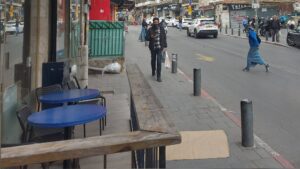
On the eve of Rosh Hashanah, as tables across Israel filled with symbolic holiday dishes, one central road in Jerusalem told a different story. Gaza Street, near the Prime Minister’s official residence, was closed off and turned into a makeshift dining hall. Families of hostages and their supporters sat down not to celebrate, but to mark the holiday with grief, determination, and a demand that their loved ones not be forgotten.
Jerusalem between holiday and protest
The choice of Gaza Street as the site of the encampment was deliberate. Usually a busy thoroughfare connecting the heart of Rehavia, it now became a stage where private sorrow turned into public protest. Folding tables, plastic chairs, and flickering candles replaced the usual traffic. This improvised Rosh Hashanah meal on asphalt, within sight of the Prime Minister’s residence, crystallized Jerusalem’s role as a city where religious rituals and civic defiance intersect.
The protest tent in Jerusalem
The protest tent has been active for days, drawing families, neighbors, and ordinary citizens who refuse to adapt to what many have already normalized – the continued captivity of Israelis in Gaza. While much of the country gathered in dining rooms, here people sat in the street, their presence itself an act of resistance. For them, the holiday meal was not festive but symbolic: an assertion that the fate of the hostages cannot be sidelined, even at the holiest time of year.
Gaza Street and the Prime Minister’s residence
The quiet of the evening, broken only by muted applause or words of encouragement, underscored the contrast. Most Israelis, having grown accustomed to the unbearable reality, went about their celebrations. But in Gaza Street, within meters of the Prime Minister’s residence, the atmosphere was different. A small crowd of determined families and supporters remained – the last who still care enough to insist that the country’s conscience cannot rest.
Jerusalem as a mirror of Israeli society
Jerusalem has often turned its streets into platforms of protest, yet the timing and symbolism of this holiday vigil gave it unusual force. While synagogues filled with prayer and households echoed with songs of the new year, one street offered a counter-image: plastic chairs and paper plates on the pavement, a somber meal instead of a festive one, a protest in place of celebration. In that contrast, Jerusalem once again revealed itself as the mirror of Israeli society – fractured, unsettled, and still struggling to confront the reality of hostages in Gaza.