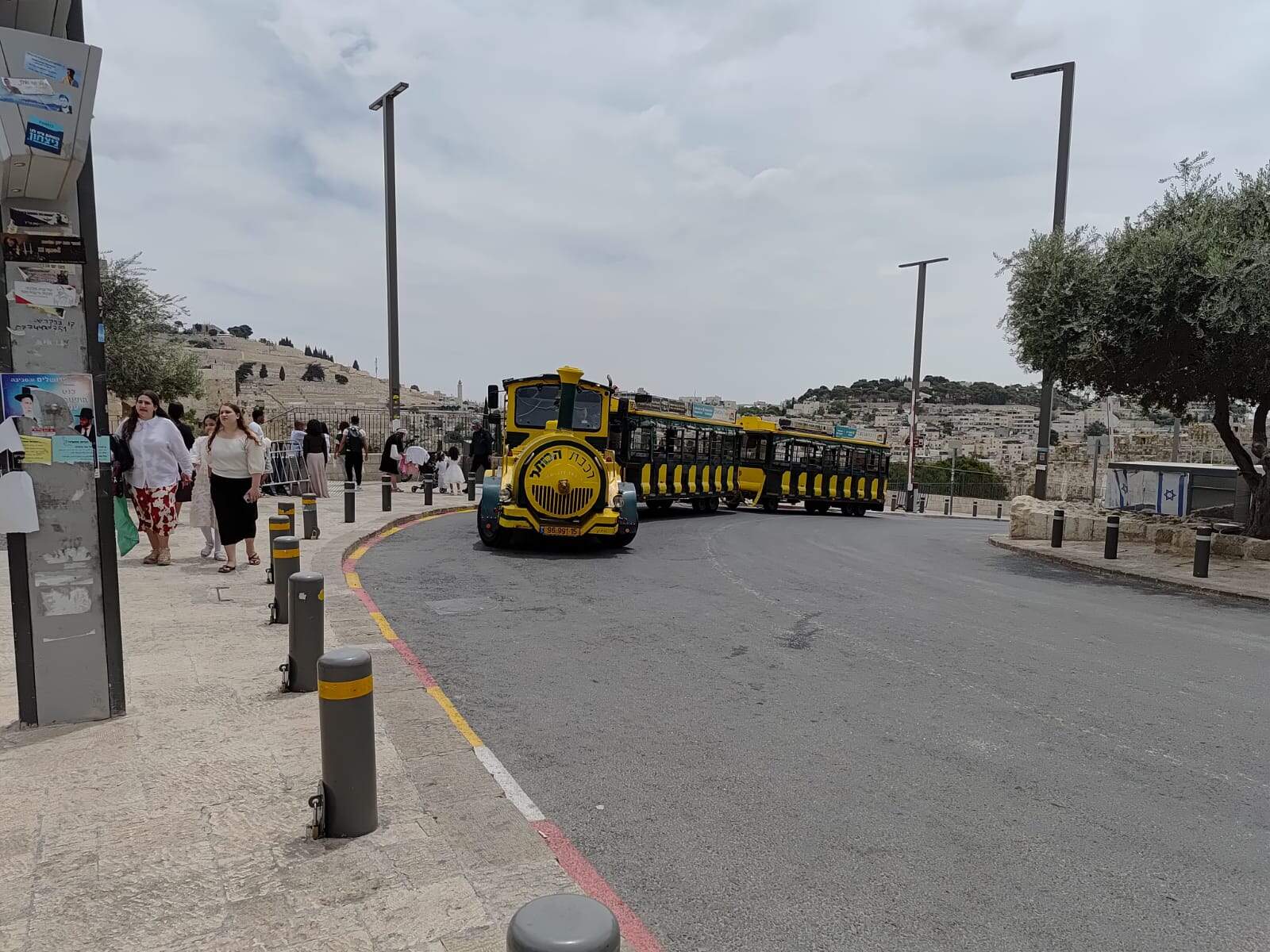
It happens on one of Jerusalem’s most familiar paths: the bright yellow tourist train glides through a curve near the Jewish Quarter. Across the street, a group of ultra-Orthodox women walks steadily in the opposite direction. No one pauses. The driver doesn’t slow down. Neither group acknowledges the other. Two parallel motions, in one crowded city — without overlap
The photo, taken this week in the late afternoon, doesn’t scream for attention. But it says a lot. A city of tourism and tradition, of vehicles and foot traffic, of color and quiet. In this single frame: motion and modesty, sightseeing and routine, tourists in a rush and locals on foot — all existing at once
One City, Two Tempos
The tourist train has become a regular feature in the Old City landscape. It serves visitors, student groups, and weekend tours. The route includes Jaffa Gate, Zion Gate, and the Jewish Quarter, weaving through alleys and plazas. Painted in bright yellow, the tram is designed to stand out — and it does
But the streets it runs through are home to locals, most of them ultra-Orthodox Jews walking to synagogues, errands, or family gatherings. These are parallel rhythms: the visitor’s experience and the resident’s routine. In the photo, the two worlds don’t clash — they simply coexist without eye contact
Whether this is a story about social layers or just another street moment, what’s clear is that it’s not rare. It happens every day in Jerusalem — only this time, someone captured it