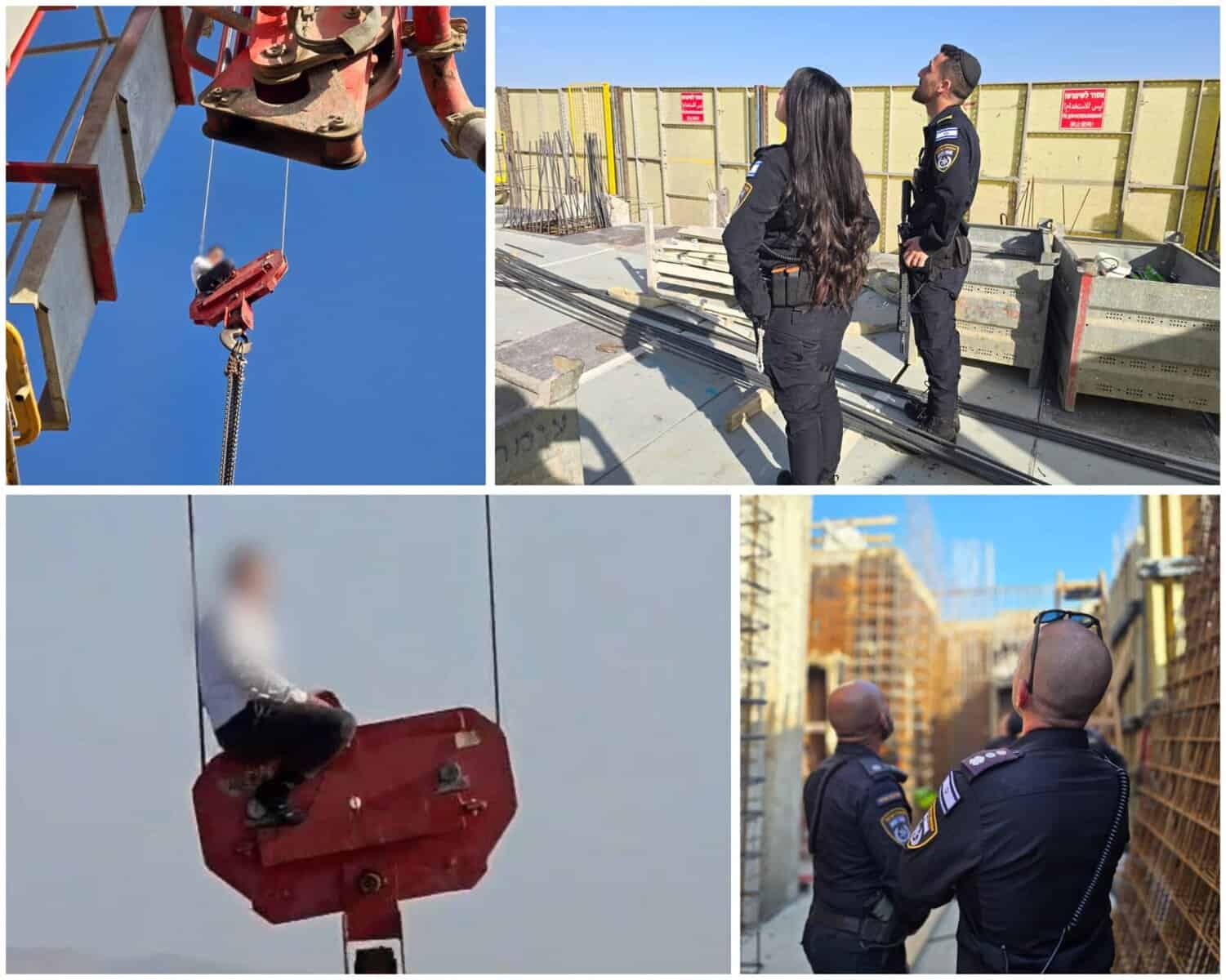
Early yesterday morning, beside the major high rise construction project at Jerusalem’s western entrance and the Central Bus Station, a 15 year old boy was found hanging from a crane cable at a height of 36 floors. Police units, the Fire and Rescue Special Rescue Team, and MDA crews operated at extreme elevation under difficult access conditions until he was brought safely to the ground and evacuated to Hadassah Ein Kerem in stable condition, suffering dehydration signs and abrasions.
MDA paramedic Shira Bel and MDA emergency medic Rivka Or: “After complex and prolonged rescue operations they brought the teen to us conscious, with abrasions and signs of dehydration. We placed him in the intensive care ambulance and began treatment while evacuating him to the hospital in stable condition.”
Commander of the Har HaUma Station and incident commander, Deputy Fire Chief Shay Nehemia: “This is a very complex rescue, both because of the extreme height and because of the difficult and problematic angle of the crane. The firefighters are working with judgment and professionalism to build a rope system that will allow safe access to the teen and his rescue.”
Deputy District Commander of the Jerusalem District, Assistant Fire Commissioner Eyal Cohen: “This morning demonstrated the high operational readiness of the special rescue unit. It is symbolic that only yesterday the unit carried out a complex drill simulating this exact scenario, and today the firefighters were required to apply those abilities in real time. The training and professionalism are what led to the successful end of the event.”
חולץ הנער שאותר על עגורן בגובה 36 קומות בירושלים@VeredPelman pic.twitter.com/oiwVzo92W2
— כאן חדשות (@kann_news) November 24, 2025
Why are construction sites around the Central Bus Station attracting young climbers?
The western entrance to Jerusalem is one of Israel’s busiest and most rapidly changing urban zones. Tower cranes operate just meters from sidewalks, bus platforms and packed pedestrian routes. This proximity creates a dangerous illusion of accessibility, as if these massive machines were viewpoints rather than unpredictable industrial systems.
Special rescue teams report a steady rise in similar cases. High winds, unstable footing, unprotected surfaces and cranes capable of sudden movement turn every climb into a near catastrophe. For teens it may feel like a moment of thrill; for professionals it is a developing disaster zone.
What drives the human attraction to height in a dense city like Jerusalem?
Adolescent psychology highlights a gap between the brain’s caution mechanisms and its reward systems. Excitement, visibility among peers and a sense of uniqueness often overshadow real danger assessment. In Jerusalem, a city defined by constant construction, crowding and noise, height becomes an illusion of control and clarity.
Anthropologically, climbing represents a search for a new vantage point inside a compressed urban fabric. When the ground shifts beneath one’s feet due to construction and rerouted streets, height offers a feeling of order and perspective – even when it is a dangerous illusion.
Jerusalem will continue to rise vertically, and as long as construction sites remain open and tempting, incidents like this will follow the city’s upward growth.