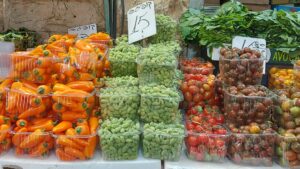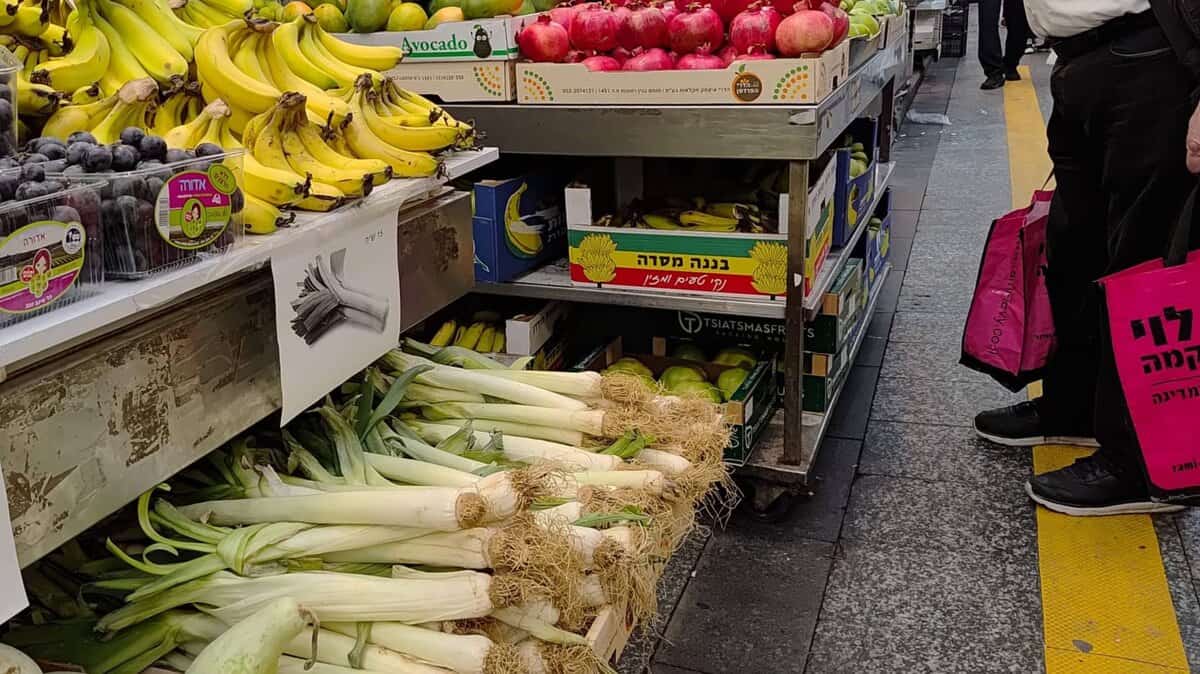
Straight from the colorful stalls of Jerusalem’s Mahane Yehuda market – the story of the leek, known also as prasa, louf or leek. One vegetable with four different names, desired at any price by Jerusalemites ahead of the Jewish New Year. In every alley, like the “Four Species,” and on Etz Haim Street, lies the leek, resembling a giant green onion. Its stems are neatly arranged, radiating their symbolic power – the wish to remove enemies.
The leek in the Jewish New Year blessing
On Rosh Hashanah, the leek is blessed with the words: “May it be Your will, our God and God of our ancestors, that our enemies, haters and those who wish us harm shall be cut off.” For this spiritual charm, people are willing to pay 12–14 shekels per kilo.
Mahane Yehuda as a Jerusalem tradition
My family lived in childhood on Yosef Ben Matityahu Street, descending from Jaffa Street, in the Mekor Baruch neighborhood of Jerusalem. At house number 33, my life unfolded. From here I left for first grade, and from here I built my own family. This was the home from which I rushed to help my mother return from the Mahane Yehuda market, carrying seasonal vegetables that she cooked for lunch and Shabbat.
Childhood memories of the market
The nearby Mahane Yehuda market was not only a shopping destination for us, but a daily way of life. I used to wait at the entrance of our house, trying to catch my mother’s return from Jaffa Street to our street to help her carry the bags. Ahead of Rosh Hashanah, the change in atmosphere was clear – the market filled with pomegranates, dates, squash, apples and leeks.
A family kitchen and a personal symbol
When my father brought home the giant stalk, a sharp onion scent spread through the house. The plans for how to cook it, to make it fit for the holiday blessing, were varied. The conversation went on as if it was our first acquaintance with the vegetable. My mother’s effort paid off. We helped prepare the leek for blanching until soft, and once it surrendered we added spices. Soon in a hot pan, patties danced in oil with a heavenly taste, tasked with the not-so-simple mission – to drive away our enemies. And I thought of the boy who teased me during recess, and of the math teacher I disliked. It turned out the leek revealed what was hidden in us. We understood, in our own way, that this vegetable carried endless meaning – and each of us found a different one.
Layers of Jerusalem in a vegetable
In Jerusalem the leek earned a special status. Not only because of its taste, but because it tells a story of layers. Like the city itself, the leek is built layer upon layer. Peel one leaf, and another appears – soft and moist. The leek can be seen as a living metaphor for Jerusalem, the city of the ancestors, a historic city with many layers.
(Black-Eyed Pea in Jerusalem Market: Tradition and Hope)
Health for body and soul
Beyond tradition, the leek is also a vegetable of health. Rich in vitamins, it helps cleanse the blood and strengthens the immune system. This is its natural connection between spiritual symbol and physical benefit – a vegetable that blesses both body and soul. Residents of Mekor Baruch, near the market, and other Jerusalemites, remove what is unnecessary from the leek, reveal fresh layers promising a cleaner, brighter future, and discover the tender core – a renewed hope each year.