Anyone trying to reach central Jerusalem these days – around Jaffa Street and Shlomzion HaMalka Street – already knows this is no longer a simple trip. You do not really plan your timing anymore, you prepare for delays.
A small slowdown quickly turns into a detour, and often into a short walk between barriers, dust and constant noise. The light rail works are no longer something that is just “passing through” – they have become part of the space itself, reshaping the way the city center feels and functions.
You can see it in the businesses. You do not need official numbers for that. Stand for a few minutes and watch the street. Fewer people step inside, more move past in a hurry. Some have simply stopped coming. For many shop owners, this is no longer just a difficult period, but a daily struggle to keep going.
And then, almost without noticing, your eyes move upward.
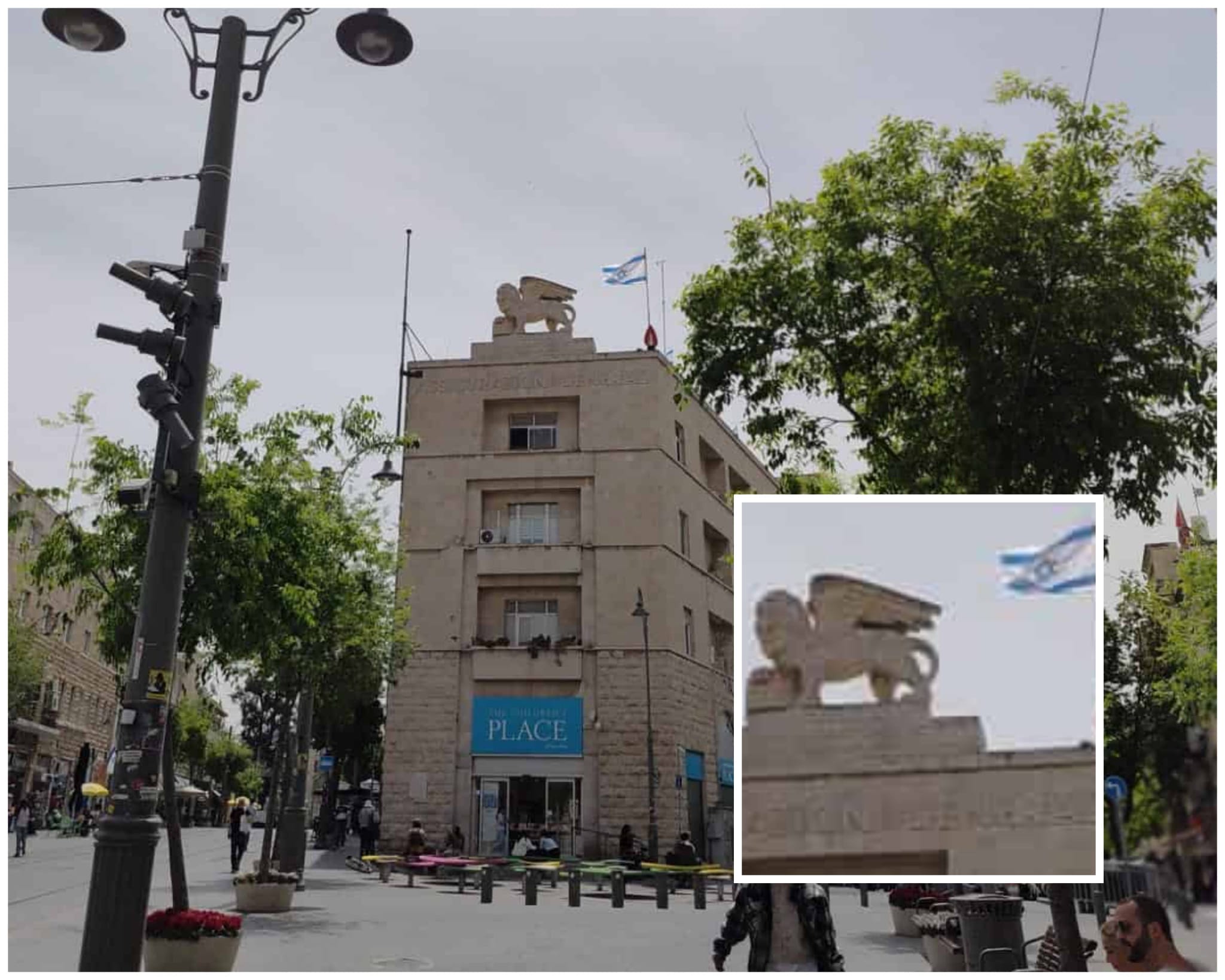
Above the noise and the movement, above the temporary chaos, a stone building stands there with quiet confidence. And on top of it, the lion.
How did the Generali building in Jerusalem become a symbol of the city center?
There are buildings in Jerusalem you recognize even if you never learned their names. The Generali building is one of them.
It stands right where everything moves, yet feels completely still. And above it, the winged lion looks down at the street as if it has seen it all before.
Its story, however, begins far from Jerusalem.
In the 1930s, the Italian insurance company Generali sought a presence in the city, which at the time was an international crossroads of religion, commerce and diplomacy. They commissioned architect Marcello Piacentini, who designed a structure that was meant not only to serve a function, but to project power and stability.
That intention is still visible today. The building does not try to blend in. It stands firm, heavy, self-assured.
The lion itself is the Lion of Saint Mark, a symbol of Venice and of the company. Beneath its paw lies an open book with a Latin inscription. Over time, it stopped being a foreign symbol and became part of Jerusalem’s own visual language.
There is even a small local legend – if the lion ever roars, it means a wise person has passed beneath it.
For now, it remains silent.
How did the building move through war, bombing and changing rule?
History did not leave the building untouched.
During World War II, when Italy became an enemy of Britain, the building was seized and turned into part of a fortified administrative compound. Barbed wire, guards, tension – Jerusalem once again found itself at the center of forces larger than itself.
In March 1947, that tension exploded. Lehi fighters managed to bring a truck bomb into the compound. The blast caused heavy damage and made clear that even the most solid structures – and the powers behind them – were not immune.
It was not only a physical explosion, but a moment that cracked the sense of control.
After the establishment of the State of Israel, the building changed hands again and became government offices. Less drama, more routine. Paperwork, decisions, daily administration. The kind of quiet function that shapes a country over time.
And the lion remained exactly where it was.
How is central Jerusalem coping with light rail construction and congestion?
Today, standing beneath the building, you feel a gap between the pace of the structure and the pace of the street.
The light rail moves through, people rush past, the area is denser and louder than before. The city center is evolving, but that evolution comes with a price.
Some see development. Others feel suffocated by it. For many businesses, this is no longer just a period of adjustment, but a real test of survival.
And above it all, the lion is still there.
Unhurried. Unchanged. Watching.
Maybe that is why it fits Jerusalem so well – a city where everything is constantly shifting, yet something always stays exactly the same.