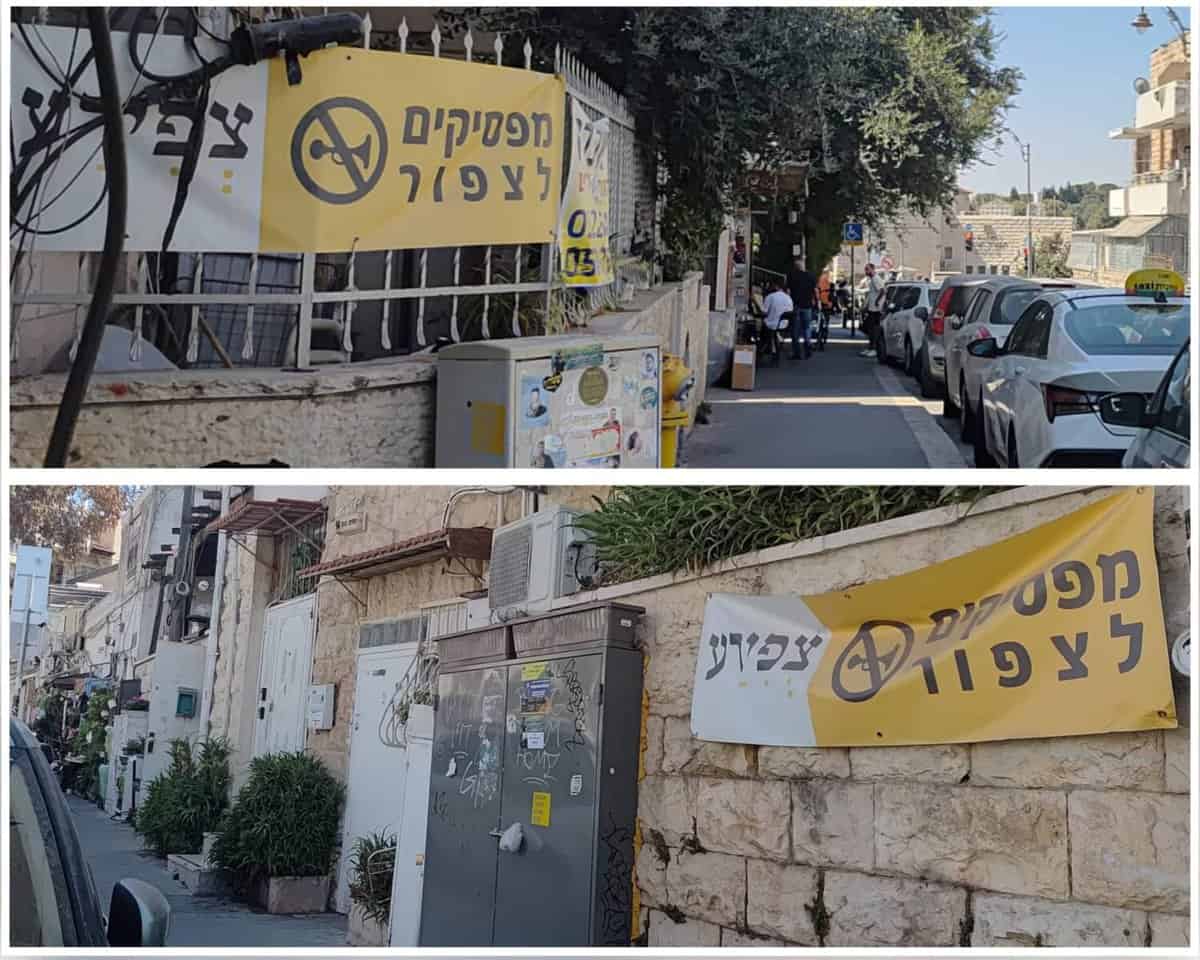
“Stop honking,” “Tzfirah” – these signs in Jerusalem’s Nahlaot neighborhood call for a revolution of silence. On Nissim Behar Street in the city center, residents raise their voices to lower the volume. It is a long street lined with parked cars, low houses, neglected gardens and sewage overflows – yet also home to many synagogues, a Chabad house, and even the burial society offices. Small balconies hang laundry, scooters serve the elderly, and doorways remain worn and modest
Honking signs on Nissim Behar Street Jerusalem
Nissim Behar Street lies near the Mahane Yehuda market, at the very heart of Jerusalem’s Nahlaot. On some of its walls hang curious yellow signs: “Stop honking… Tzfirah.” Tired of the constant car horns along the narrow street, residents acted. The simple signs combine humor, protest, and a plea
The Nahlaot neighborhood of Jerusalem, founded in the late 19th century, is in fact a cluster of small quarters built outside the Old City walls. Nahlaot is a name that binds together Nahalat Achim, Nahalat Yosef, Nahalat Tzion and more. Though modest in means, the community has always been rich in spirit
The history of Nahlaot Jerusalem
The neighborhood became home to immigrants from Yemen, Kurdistan, Iraq, Persia and Urfa. Synagogues were built in dense proximity, each community its own. Shared courtyards tied families together, and the streets still carry the memory of Jerusalem’s early leaders and educators – Eliyahu Salman, Meni, Nissim Behar and others
Nissim Behar Street, named after an educator, is today a main artery of the neighborhood. It begins at Agripas Street and ends at Bezalel Street. Its branches – Gezer, Tekoa, Yarmouk, Yabok and others – hold the spirit of Jerusalem
Orpali synagogue and Hummus Shel HaTchina Jerusalem
A local teacher recalls: “In the 1980s, Nahlaot’s children boarded buses each morning to attend Paula Ben-Gurion school together with kids from Neve Shaanan and Nayot. It was part of the municipality’s integration program – and believe me, these were soulful children, it was a success.”
Maayan, a resident, proudly adds: “My husband and I celebrated our son’s bar mitzvah at the Orpali synagogue not long ago. It is an old and precious place, and we truly love this neighborhood.”
Nahlaot is not only a place, but a collection of stories. And in those stories you breathe the aroma of hummus cooking at “Hummus Shel HaTchina,” the family restaurant of Kith and Aviva Sigal – former hostages freed from Gaza. There, in the heart of Jerusalem life, you are reminded of the other hostages who are still not with us.
(Seculars Left – East Jerusalem Youth Racing in the Empty Lot)
Sacher Park Jerusalem and community life
Nearby Sacher Park attracts residents every Shabbat and holiday. In its wide green space, the aspiration for simple life finds expression. Families bring cholent pots, backgammon boards, coffee and ma’amoul pastries. Friends and relatives crack sunflower and watermelon seeds late into the night. Children play soccer, ride bicycles, and people recharge with joy and simplicity
And maybe that is the essence: one sign shouting for silence
In a neighborhood where walls speak ceaselessly of past generations, the demand for quiet is no less than a call for preservation – the preservation of daily life, identity, and sanity in Jerusalem