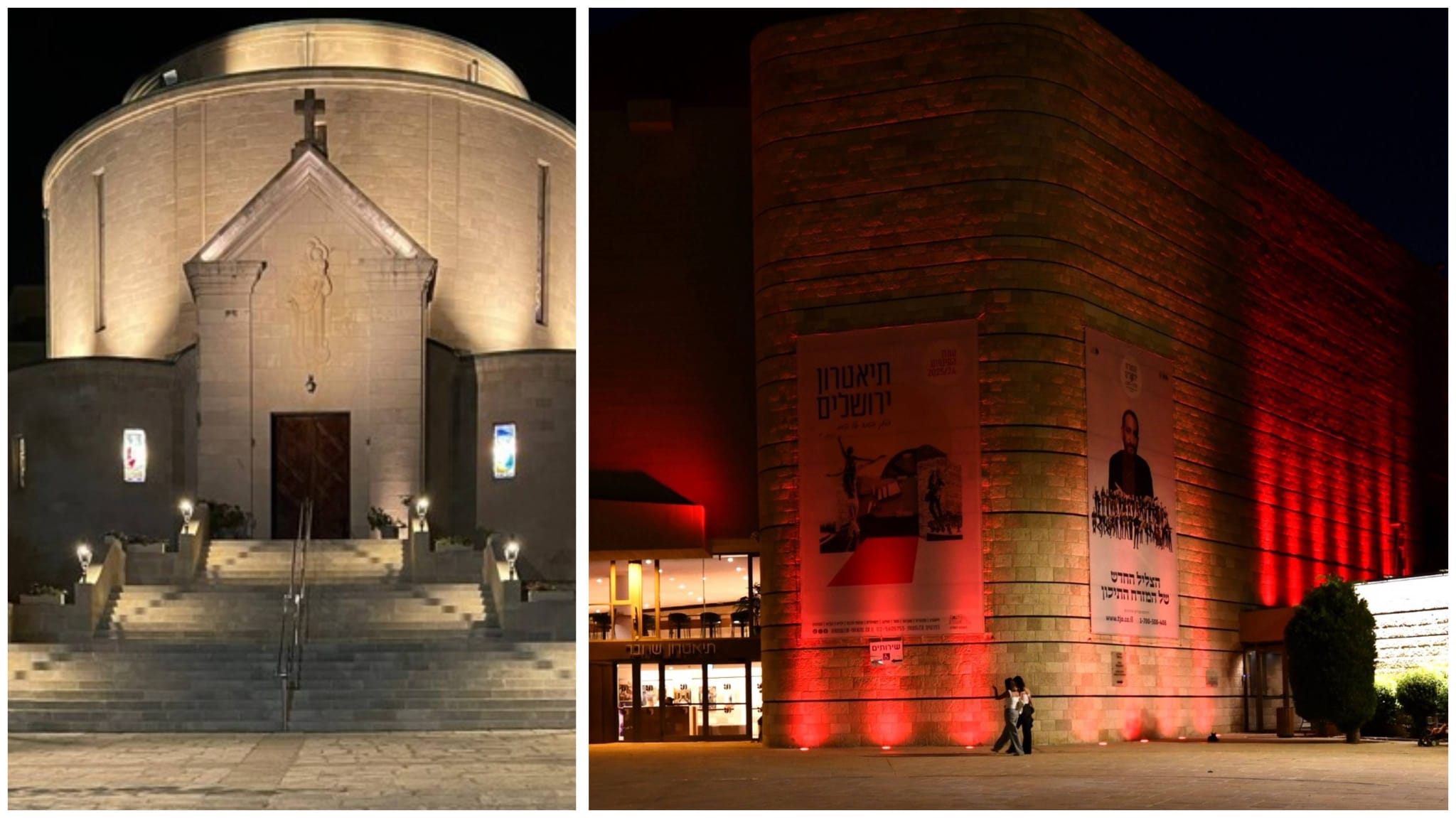
After dark, Jerusalem’s stonework, history, and layered identity come into sharper focus. The Monuments Lighting Project continues to expand, offering a renewed way to experience the city not only by day, but through carefully designed light at night.
In recent weeks, lighting work has been completed on the façade of the Jerusalem Theater in the Talbiya neighborhood and the Sisters of the Rosary Convent on Agron Street. The new illumination gives both sites a restored nighttime presence, revealing architectural details, stone lines, and historical depth that once faded into darkness.
How does the Monuments Lighting Project reshape Jerusalem at night?
Jerusalem Mayor Moshe Lion notes that “Jerusalem is a city of light, culture, and thousands of years of history,” adding that the project is part of a broader vision to turn the city into a compelling destination after dark. He says the initiative highlights the unique architectural and historical character of landmark buildings while deepening the visitor experience at night.
Which Jerusalem monuments have already been illuminated?
Lighting has so far been installed at around 20 major sites across the city, including the Scottish Church, Beit Rothschild, Holy Trinity, the Great Synagogue, San Salvador, St. Louis, Mary Magdalene, the Russian Compound, the Redeemer, John the Baptist, the Windmill, YMCA, Absalom’s Tomb, Sergei Courtyard, the Ophel, Augusta Victoria, and the Seven Arches. Each site uses precise lighting to emphasize its architectural features and historical identity.
Who leads the Jerusalem Monuments Lighting Project?
The project is led by the Jerusalem Municipality, in partnership with the Ministry of Jerusalem and Heritage and the Ministry of Tourism, through the Jerusalem Development Authority, and executed by PAMI – East Jerusalem Development Company.
Tzahi Namir, CEO of the Jerusalem Development Authority, says, “We continue to illuminate Jerusalem’s stories,” adding that every new site reveals another layer of the city’s historical and architectural depth.
What is the role of the Ministry of Jerusalem and Heritage?
Shimon Alboum, CEO of the Ministry of Jerusalem and Heritage, emphasizes that “Jerusalem is the light of the world,” saying the project is advancing rapidly, promoting high-quality tourism and connecting past and present, local and international dimensions of the city.
Which sites will be illuminated next?
Additional monuments are now in planning or execution stages, including Heichal Shlomo, the water tower in Kiryat Moshe, the Ministry of Education building at the Italian Hospital, Gorny Monastery in Ein Kerem, the Rockefeller Museum, the First Station–Ramban complex, Khan Theater, the Schneller Compound–Clock Building, Beit Mashiach in Bukharim, the Sephardic Synagogues, the American Colony Hotel, and Terra Sancta at Paris Square.