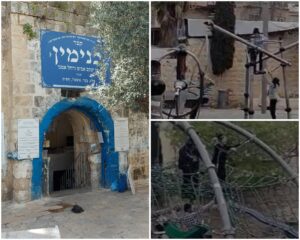
Shmuel HaNavi Street in Jerusalem, in the Shmuel HaNavi neighborhood, is a distinctly Jerusalem artery, a main traffic route running through a living, breathing community that has also become a planned protest zone over the military draft. Between Sanhedria, Ramat Eshkol and eastern Jerusalem lies the Shmuel HaNavi neighborhood, where everyday life unfolds only to be repeatedly brought to a halt. The entire area is used as a national pressure point.
Local residents and daily commuters live in a constant swing between freedom of movement and total lockdown, as life-stopping protests, wildly disproportionate in scale and indifferent to everyone else, erupt again and again.
How do ultra-Orthodox protests on Shmuel HaNavi Street paralyze Jerusalem?
On an ordinary day, the street functions as a central transportation artery. Packed buses, private cars, pedestrians and neighborhood commerce fill the road. Traffic flows from the heart of Jerusalem toward Sanhedria and Ramat in the west, Ramat Eshkol and Neve Yaakov in the north, and eastward toward the Old City.
But within minutes, that flow can collapse. Hundreds and sometimes thousands of ultra-Orthodox protesters block the route. Buses grind to a halt, massive traffic jams spread outward, garbage bins are set on fire and all of Jerusalem gets stuck. One single blockage at the intersection of Shmuel HaNavi and Yehezkel Streets is enough to throw the routine of the entire city into chaos.
This is a connective artery pierced by key feeder streets such as Yehezkel, Pituchei Chotem, Fishel and Tedehar, forming a decisive linear transportation network. Dozens of bus lines converge here and then disperse across every part of Jerusalem, reaching the light rail stations and the central bus station. A blockage at this junction creates a transportation bottleneck that radiates across wide areas of the city.
And so, Jerusalem bus drivers ask passengers to get off in the middle of nowhere because they cannot continue the route. An absurd and exhausting пешestrian journey begins.
How do ultra-Orthodox protests in Jerusalem damage livelihoods and daily life?
This is a street that serves as a traffic artery but also provides basic livelihood and local economy: grocery stores, butcher shops, printing houses, marble stores, wine shops, tailors and cobblers. Professions that have survived here against broader urban trends. Alongside them operate kindergartens, Torah institutions, yeshivas and kollels that sustain a permanent population living in the area. The old buildings and local commerce reflect a relatively low socio-economic status and a daily dependence on neighborhood shopping centers.
When a protest erupts, everything shuts down. Metal shutters come down, jobs are canceled, customers do not arrive and the economic damage piles up without compensation. All that is missing is a dash to a public bomb shelter.
The protests by ultra-Orthodox factions in Jerusalem take place at the Shmuel HaNavi-Yehezkel intersection due to opposition to military conscription, to the arrest of draft evaders and, more recently, to autopsies and what is perceived as outside interference in the ultra-Orthodox way of life. The organizers of the disturbances know this all too well. This is the spot where protest turns into paralysis. The police are present, but faced with a large, uniform crowd disciplined to its leaders, they struggle to disperse it, and the street remains closed for long hours. A whole capital city is brought to a standstill.
In recent weeks, Shmuel HaNavi has turned into a battlefield over the interests of Jerusalem’s ultra-Orthodox factions. The protests spill over with violence and destructive disorder into the nearby Bar Ilan Street as well. A street designed to connect becomes a divider.
Between transportation, employment and protest, Jerusalem discovers how easy it is to stop an entire city at one precise point. And what does the prophet not reveal? Simply this: when will the protest end, and how many casualties will it demand?