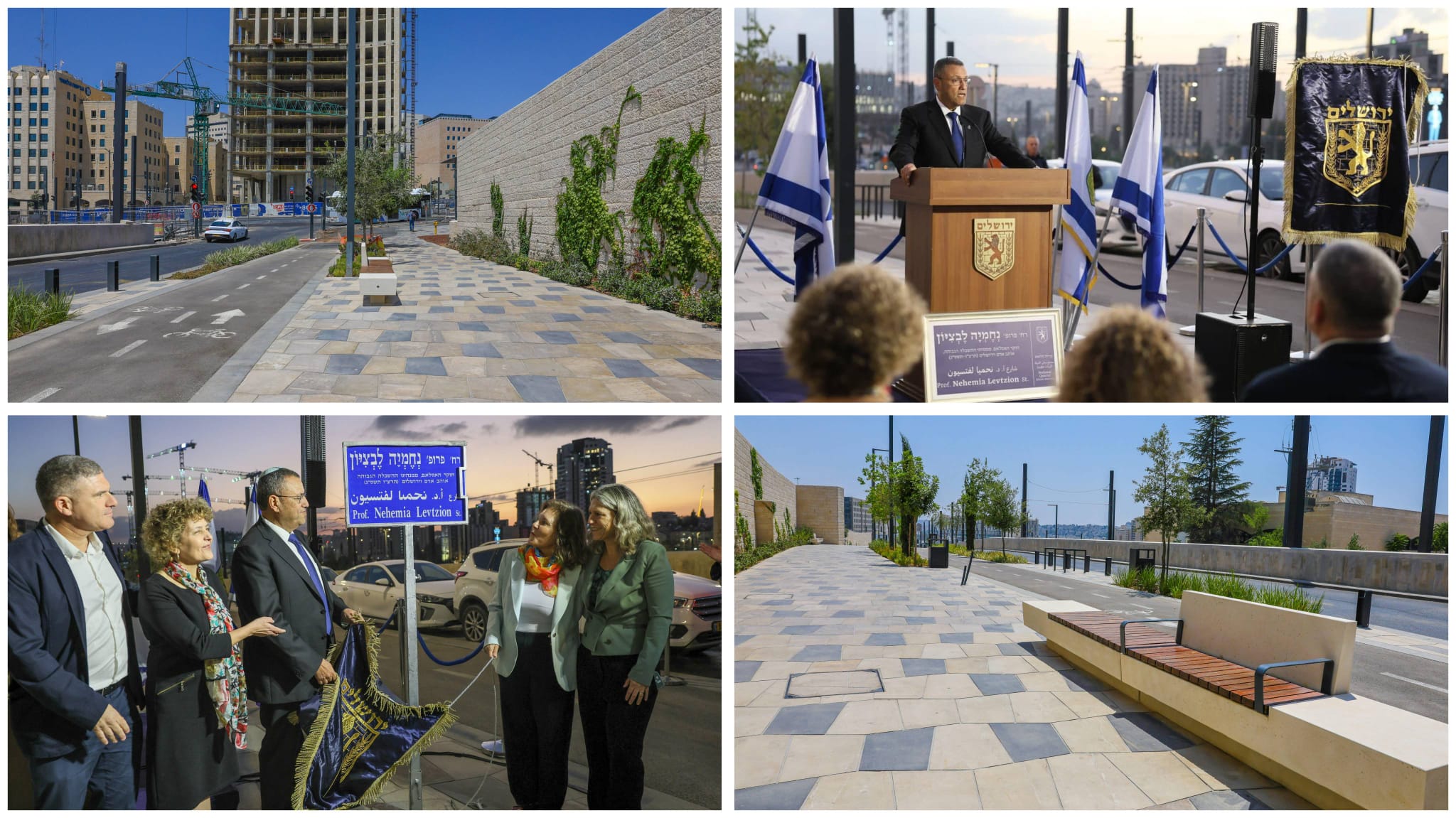
Jerusalem often defines itself through moments of tension, politics, or grand construction projects. Yet at times, its deepest statements are made quietly, through decisions embedded in the everyday urban landscape. This week, near the busy Yitzhak Navon railway station, the city inaugurated a new street named after Prof. Nehemia Levtzion z”ל – a globally respected scholar whose influence extended far beyond academic research.
At first glance, the naming of a street may seem like a routine municipal gesture. In Jerusalem, however, it functions as a declaration of values. By choosing to commemorate Levtzion in one of the city’s key transportation corridors, the municipality connects memory with movement, scholarship with society, and historical legacy with contemporary challenges facing Israel today.
Why does naming a street in Jerusalem carry public meaning?
Street names in Jerusalem are never neutral. They shape collective memory and determine which figures become part of the city’s daily vocabulary. Prof. Nehemia Levtzion was not a politician or public official. He was a pioneering researcher of Islam in West Africa and of religion-state relations, whose work was widely recognized in international academic circles.
Yet his most lasting impact was not confined to scholarly journals. Levtzion believed that research carried social responsibility. His academic leadership translated theory into action, particularly in areas where education intersected with identity and opportunity.
During the ceremony, Jerusalem mayor Moshe Lion emphasized this point, saying: “Prof. Levtzion did not only study cultures – he shaped the future of entire communities in Israel. His vision, and the actions that followed, opened the gates of higher education to thousands of ultra-Orthodox men and women, giving families a real chance for a different future.”
Why has higher education for the ultra-Orthodox become a central issue in Israel?
One of Levtzion’s most influential contributions was his role in advancing access to higher education for the Haredi community. At a time when the idea was widely viewed as unrealistic or socially explosive, he understood that academic inclusion could succeed only through cultural sensitivity and trust, not coercion.
This approach helped create pathways for thousands of ultra-Orthodox students, allowing academic study without erasing religious identity. Today, as Israel continues to debate employment, social integration, and economic sustainability, higher education for the Haredi sector remains a key national issue – and Levtzion’s model is frequently cited as a foundation.
Adina Bar-Yosef, former dean of the Jerusalem College for the Ultra-Orthodox, captured this legacy during the ceremony: “Prof. Levtzion fulfilled the highest level of charity as defined by Maimonides – helping a person stand on their own so they no longer depend on others.” The quote places his work squarely within a broader moral framework, beyond policy or statistics.
How does a Jerusalem street connect to a global education debate?
Levtzion’s legacy resonates far beyond Israel. Cities worldwide are grappling with similar questions: how to make higher education accessible without erasing cultural identity, how to integrate conservative communities into modern economies, and how to reduce inequality through knowledge rather than force.
In this sense, a single street in Jerusalem reflects a global conversation about education, identity, and social mobility. Its location near a major transit hub adds a layer of symbolism – a daily crossing point for thousands, now linked to a man whose life’s work was about building bridges rather than walls.
The street named after Prof. Nehemia Levtzion is more than an addition to the city map. It is a quiet reminder that education can be a tool of connection, that cities shape values through memory, and that global ideas often take root in very local spaces.