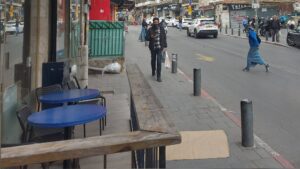
This week, what began as an ordinary evening of leisure in Mahane Yehuda turned into a scene of collective panic. Thousands filled the bars and restaurants, music echoed loudly through the alleys, and the scents of food and spices created a vibrant Jerusalem atmosphere. Suddenly, repeated cries of “terror attack” pierced the air. On Thursday night, within just one instant, the festive mood collapsed. Witnesses recall how laughter was replaced by screams, people burst into tears, others dropped to the ground seeking cover, and armed civilians instinctively drew their weapons. Some even climbed onto rooftops of nearby businesses in a desperate attempt to escape the frightened crowd
Mass panic in Jerusalem’s Mahane Yehuda market
Amid this chaos, the truth slowly surfaced: there was no terror attack at all, but rather a local brawl that escalated. Yet the very mention of “terror” triggered an almost mechanical response among the crowd. In Jerusalem, a city scarred by decades of violence, a collective reflex has formed: what locals describe as an unofficial “terror protocol”. Within seconds, people bolted in every direction, weapons were cocked in the middle of a packed market, and panic spread like wildfire. Some observers compared it to a Pavlovian reaction – an automatic reflex in which one shouted word unleashes a tidal wave of fear, even before facts are known. The sense was that Jerusalem itself has become a living alarm system, where a single sound can instantly transform nightlife into chaos
Jerusalem terror reality and the automatic reaction
In this sense, the Mahane Yehuda scene fits research on how communities respond to trauma. Social psychologists describe a phenomenon called “collective trauma”: a condition where large groups respond to new events through the memory of past pain. In Jerusalem, accustomed to years of terror threats, fear operates on autopilot – one small trigger can unleash survival instincts across an entire crowd
(One Centimeter Clash in Jerusalem’s Mahane Yehuda Market)
Researchers compare it to a cycle of chronic anxiety, where every unusual sound is interpreted as a direct threat. Often, such anxiety spreads quickly between people, almost like emotional contagion. The collective memory of terror passes between generations, creating a constant undercurrent of fear. In Jerusalem, more than in most cities, the government’s policy of distributing weapons to civilians further intensifies the potential for catastrophe. When armed citizens must make split-second decisions in a crowded public space, the risk of tragedy multiplies. The Mahane Yehuda panic was a reminder of this fragility: how quickly Jerusalem can shift from routine nightlife to existential fear