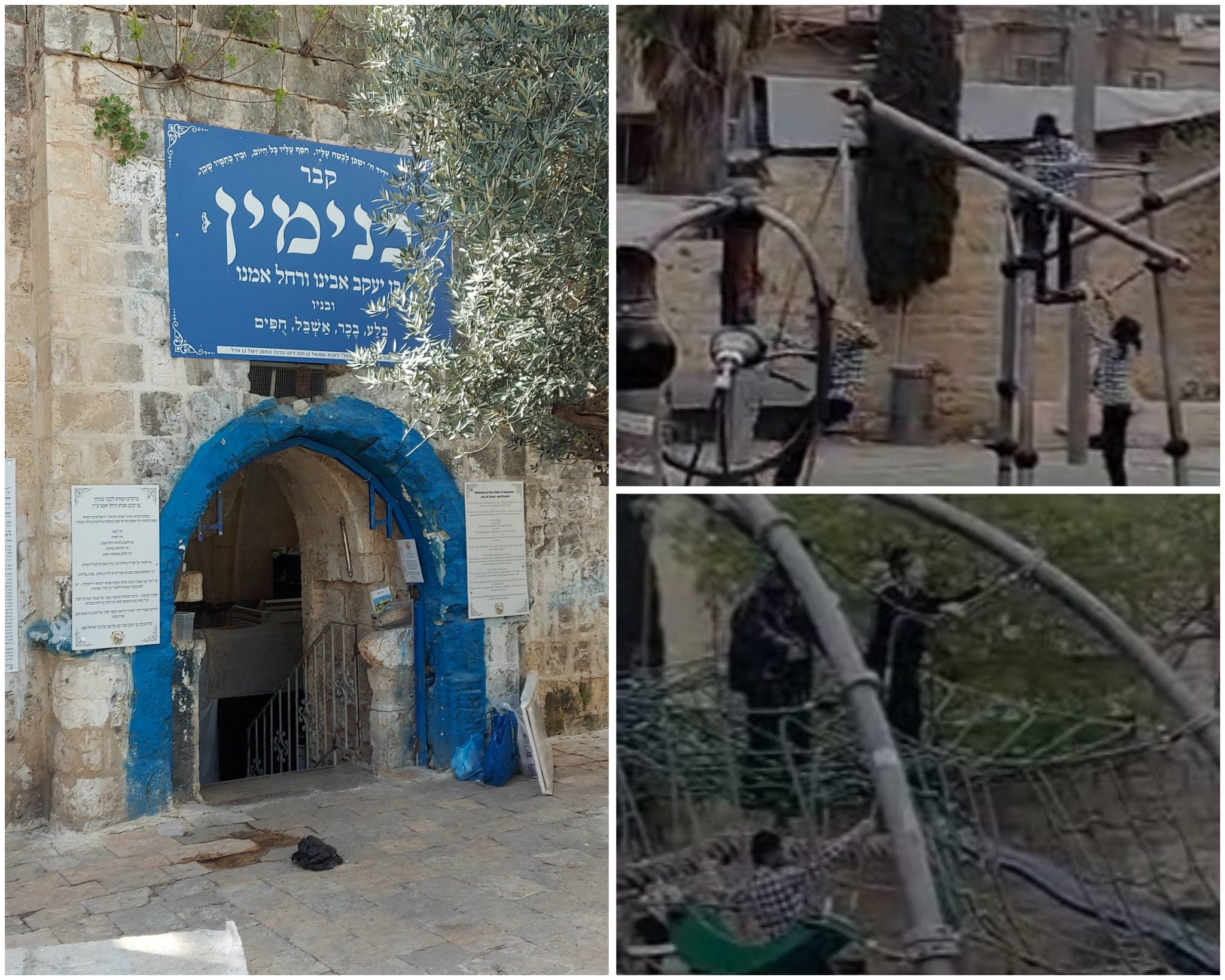
As Passover approaches, yeshiva students from nearby kollels and from the Geula neighborhood in Jerusalem will arrive at Benjamin’s Tomb, the burial place of the biblical son of Jacob and Rachel, to clean leavened food remnants from the prayer compound on Strauss Street. The modest, cave-like stone structure opens as early as 05:00 in the morning, revealing another side of preparation for the Festival of Freedom: an intense effort to remove the year’s remaining chametz.
The small plaza beside the tomb is lively every day. Children from nearby homes and ultra-Orthodox kindergartens come to play and spend their childhood afternoons on swings and playground equipment. They run around and scatter the surface of the compound with countless empty snack bags. Not far away, newly observant worshippers sit with a small cup of tea and cinnamon cookies – the last chametz before Passover – and divide tasks for preparing the site.
One of the worshippers responsible for the place said that next week young yeshiva students from nearby kollels on David Yellin and Bnei Brith streets and from the Geula neighborhood will arrive to clean, repaint and complete the preparation of the Benjamin’s Tomb compound for Passover.
How do you prepare an active prayer site for Passover?
During the year, Benjamin’s Tomb in Jerusalem serves not only as a place of prayer, but also as a meeting point for worshippers. Torah lessons, Talmud study and Mishnah learning take place there. Until midnight, visitors refresh themselves with stimulating coffee, a small cookie and perhaps a hot falafel portion from the nearby kiosk. Therefore, before Passover the place must undergo a thorough cleaning, just like any Jewish home.
The Passover Seder is not held next to the tomb, yet the prayers never stop. Still, it is difficult to ignore the strange meeting of times taking place here.
On one side stands the burial place of the son of Jacob and Rachel, from whom the biblical Tribe of Benjamin emerged. On the other side is contemporary Jerusalem reality. Construction of the light rail that will carry Jerusalem residents and visitors across the city, preservation and development of historic buildings such as the Bikur Cholim Hospital building and more. The entire present and future of Jerusalem in 2026 and beyond stands opposite the deep faith and prayers absorbed in Benjamin’s tomb – a story that began in the 17th and 18th centuries BCE.
What if there had been a playground here thousands of years ago?
It is difficult not to imagine a moment in another reality. If the playground next to the compound had existed thousands of years ago, perhaps Benjamin’s children would also have climbed the equipment there. “Ashbel, Becher, Huphim… come home,” one could imagine the voice of Benjamin’s wife calling. And the familiar children’s reply – the pleading “just a little longer.” The imagination continues with “Naaman, Ahiram, Gera” and the other sons of Benjamin heading to read in the Workers’ Library that once operated in the Histadrut building next door, immersing themselves in Robinson Crusoe, another dweller of caves.
This is what real Jerusalem looks like – a city where a biblical tribal inheritance, young yeshiva students, children with a ball and morning prayers all meet at the same street corner. Here every crumb of chametz that is removed joins an ancient story of place and people who seem almost to live among us. A reminder that the past still struggles to remain present.