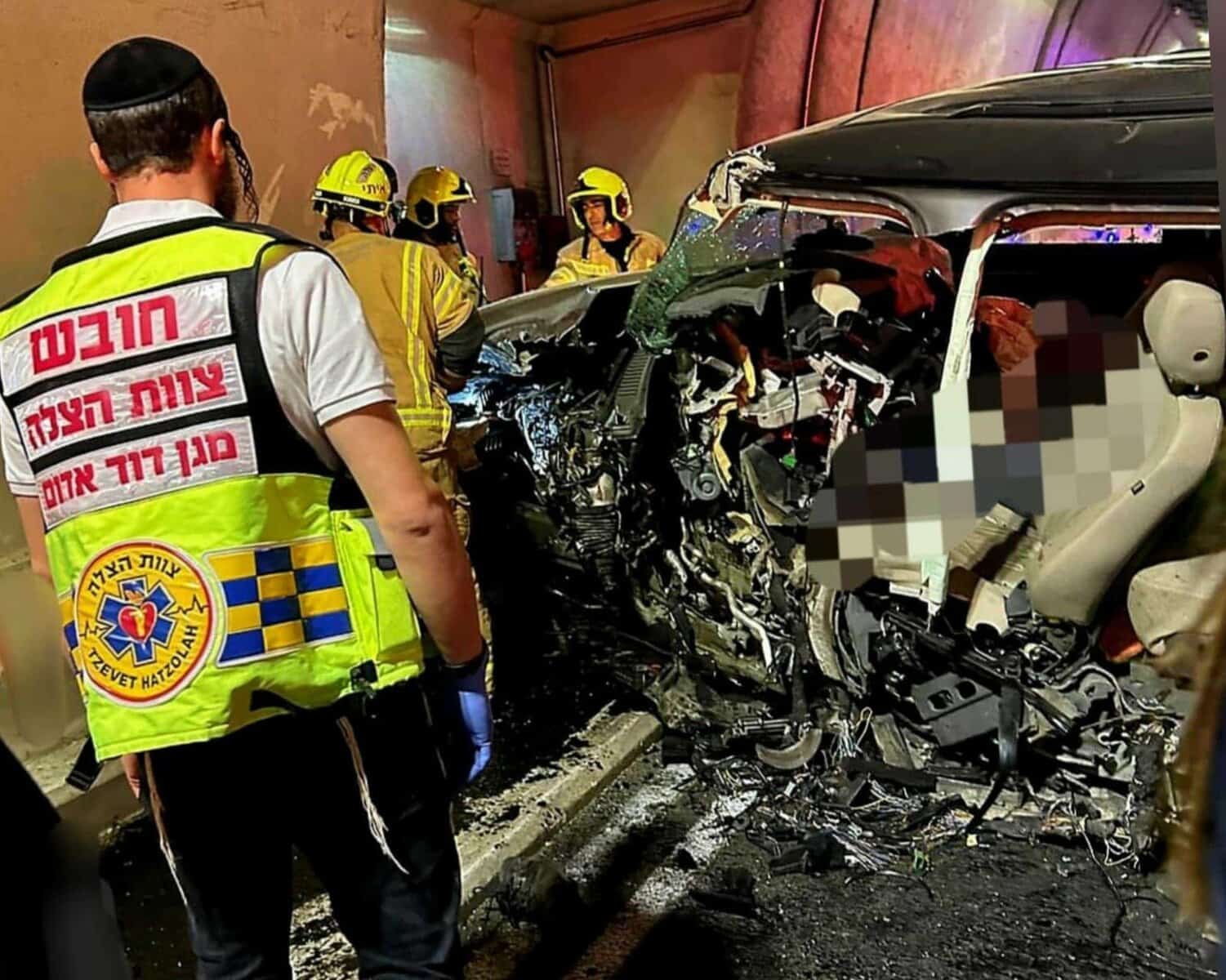
A violent crash inside a tunnel on Jerusalem’s Highway 16 has once again exposed a frightening safety concern: how does a modern vehicle, equipped with crumple zones and advanced protection systems, still end up as a destroyed block of metal after hitting a tunnel wall?
On Tuesday morning, a 60-year-old driver was evacuated in critical condition after his car slammed into the concrete wall near the Ravida interchange. Paramedics from MDA and Tzevet Hatzalah performed advanced CPR and transported him to Shaare Zedek Medical Center’s trauma unit.
Paramedic Zohar Maman and EMTs Tzviki Shezlinger and Yossi Marciano said: “We found the driver unconscious, without a pulse or breathing, after he apparently crashed into the tunnel wall. We performed CPR and evacuated him in critical condition.”
Tunnel accidents in Jerusalem – why a wall crash causes total collapse
Highway 16, one of Jerusalem’s newest entrance routes, connects the Motza interchange to Shaare Zedek. It shortens travel time, but its tunnels create risk points: sudden lighting changes, sharp curves, and drivers who treat it like a fast urban highway.
Safety specialists explain that a tunnel wall does not absorb impact. It does not bend or collapse. The force rebounds inward, crushing the car’s front end toward the driver. Even modern vehicles struggle to protect passengers in a head-on collision with a rigid concrete surface.
The Jerusalem District Police said: “An investigation has been opened into the circumstances of the crash, in which a vehicle struck the tunnel wall near the Bayit interchange.”
Police stress that slowing down before entering tunnels could prevent similar tragedies. A few kilometers per hour less can be the difference between a damaged car and a deadly collapse.