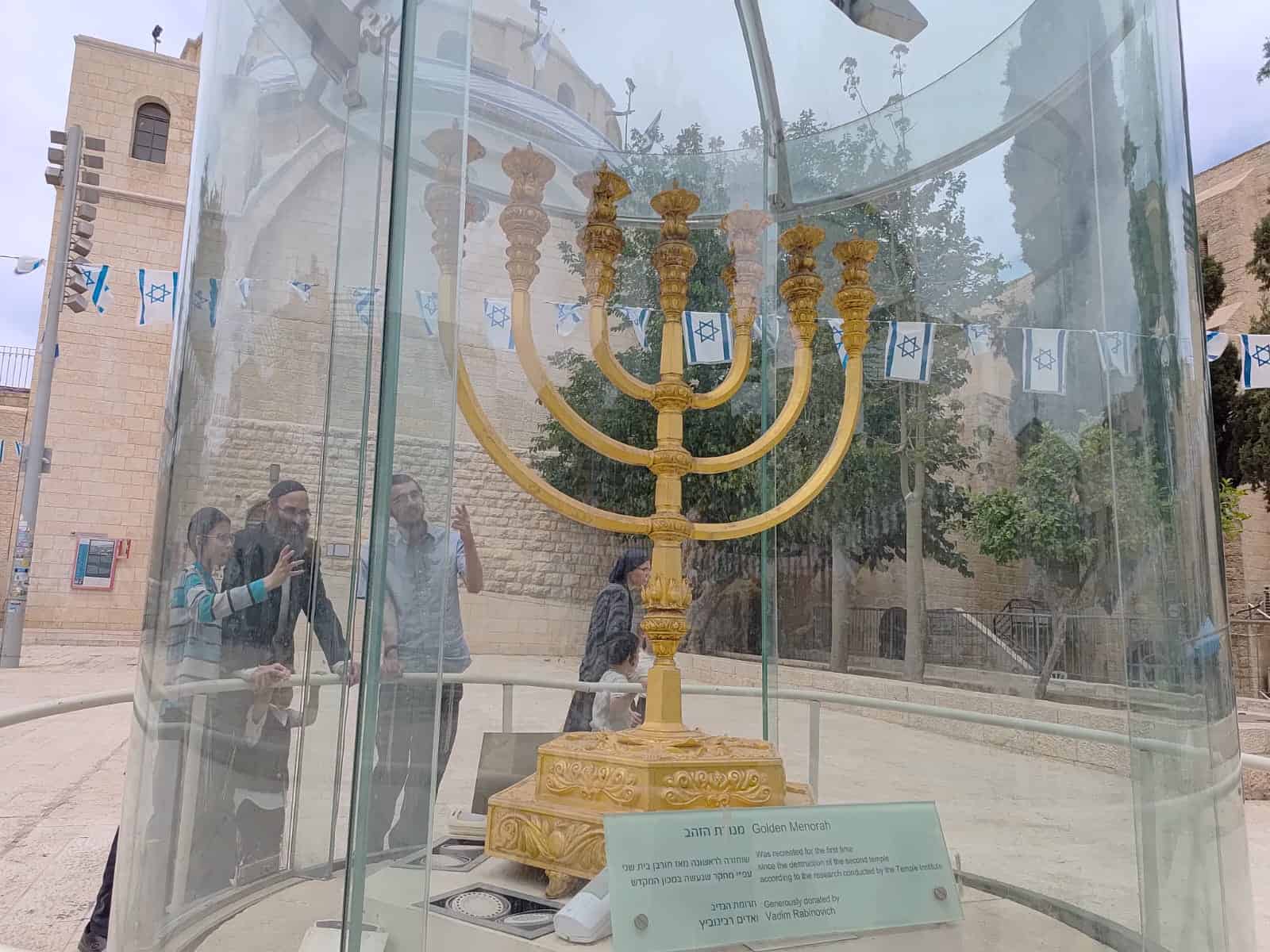
In the Hurva Square of Jerusalem’s Jewish Quarter, a massive golden menorah stands behind a rounded glass enclosure. Small Israeli flags are placed nearby. Families stop to take photos. But this isn’t just a display — it carries a layered message
The menorah was reconstructed by the Temple Institute based on Biblical and historical sources, with the declared intent of one day using it in a Third Temple. For now, it stands as a permanent installation in the public square, often photographed, sometimes debated
The photo taken this week (May 15) shows more than just the artifact — it captures how people interact with it. A family points, poses, documents. The object draws attention as a tourist site, but for many, it symbolizes a national vision, religious aspiration, and even political controversy
Between Tourism and Theological Vision
Its location — beside the rebuilt Hurva Synagogue — is no coincidence. This is a core stop on many religious tours of the Old City, and also a deeply charged cultural icon. According to the Temple Institute, the menorah is made of pure gold, weighs nearly half a ton, and is worth millions of shekels. Its creators emphasize: this is not a sculpture — it’s a ritual object, ready for use
The menorah was first installed in 2007 and is one of the most precise reconstructions of Temple vessels ever made, based on rabbinic sources, Talmudic diagrams, and the writings of Josephus. Weighing 43 kilograms, it includes arches, cups, and knobs based on Exodus specifications. The glass casing is made of reinforced material, designed to protect the artifact from weather and vandalism, while integrating aesthetically into the surrounding square
To some, it’s a tourist attraction. To others, it’s a statement. For now, the city flows quietly around it — children pointing, visitors photographing — as if it had always been there