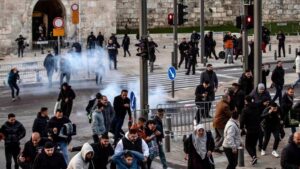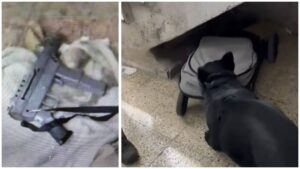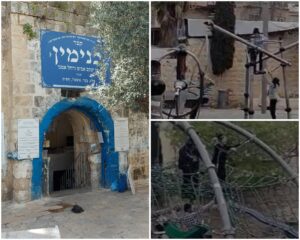
On Tuesday this week, eight Jewish youths were detained on the Temple Mount in Jerusalem after entering via the Lions’ Gate, a passage designated solely for Muslims making their way to the Al Aqsa Mosque. The eight were stopped by Waqf guards, who noticed the group and handed them over to officers from the Jerusalem District Police.
One of the young men was wearing tefillin, and another was carrying a goat. According to the Waqf guards, the group also had three pigeons in their possession. The eight made their way toward the Gate of Mercy (Bab al Rahma) before being caught after a short chase. According to the guards, their intention was to sacrifice the animals at the Gate of Mercy. Right wing activists later reported that the driver who transported the group to the Temple Mount was detained shortly afterward at the Hemed Interchange.
This afternoon, eight Israeli settlers stormed Al-Aqsa Mosque carrying a goat and three pigeons to perform rituals before the mosque guards intercepted them and they were arrested by the Israeli police. pic.twitter.com/QD8qnQFuFb
— PALESTINE ONLINE 🇵🇸 (@OnlinePalEng) November 18, 2025
Will the arrests shift the rules of worship on the Temple Mount?
The incident has reignited the long running struggle over the identity of the Temple Mount: is it a sacred space where only Muslims are allowed to worship, and Jews are limited to visiting only, as established by Moshe Dayan immediately after the Six Day War? Or should Jews also be permitted to hold religious rituals within the compound?
The turning point, for many, was Tisha B’Av 2024. Until then, Jerusalem District Police enforced a strict ban on any sign of Jewish prayer. Even someone seen silently murmuring a prayer was removed from the Mount and later summoned to a hearing that could result in a six month ban.
But on that Tisha B’Av in 2024, around 2,000 Jews ascended the Mount, led by National Security Minister Itamar Ben Gvir. In full view of the minister, hundreds prayed, bowed, and even sang the Israeli national anthem, “Hatikva”, with no intervention from police present at the scene.
Since then, public prayer and bowing have become almost routine. Still, police continue to prevent Jews from entering the Mount wrapped in a tallit or wearing tefillin. Attempts by young Jews to bring goats before Passover or lulavs during Sukkot are blocked by police.
للمرة الثالثة خلال عام واحد.. المستوطنون يتمكنون من إدخال حيوان ماعز إلى المسجد الأقصى من باب الأسباط pic.twitter.com/lQFxZVCTiR
— القسطل الإخباري (@AlQastalps) November 18, 2025
How do both sides interpret the Temple Mount incident, and does it bring a religious flashpoint closer?
Both sides have interpreted this week’s incident as another step in the battle over the Temple Mount’s identity. The movement “Returning to the Mount” wrote in a post that “the barrier of fear has broken! Several Jews stormed the Mount today through the Lions’ Gate wearing tefillin and carrying a lamb intended for sacrifice. Sadly, Israel Police arrested them violently.” Other right wing activists, however, have been more cautious, avoiding direct reference to the action itself, which many of them view as a blatant provocation, and instead choosing to condemn what they describe as police violence.
On the Palestinian side, the reaction has also been intense, marked by condemnation and anger. The incident is seen as another phase in an ongoing attempt to “Judaize” the Al Aqsa Mosque. For many, it represents yet another erosion of the status quo, a dangerous shift that could spark a religious confrontation centered on the Temple Mount.