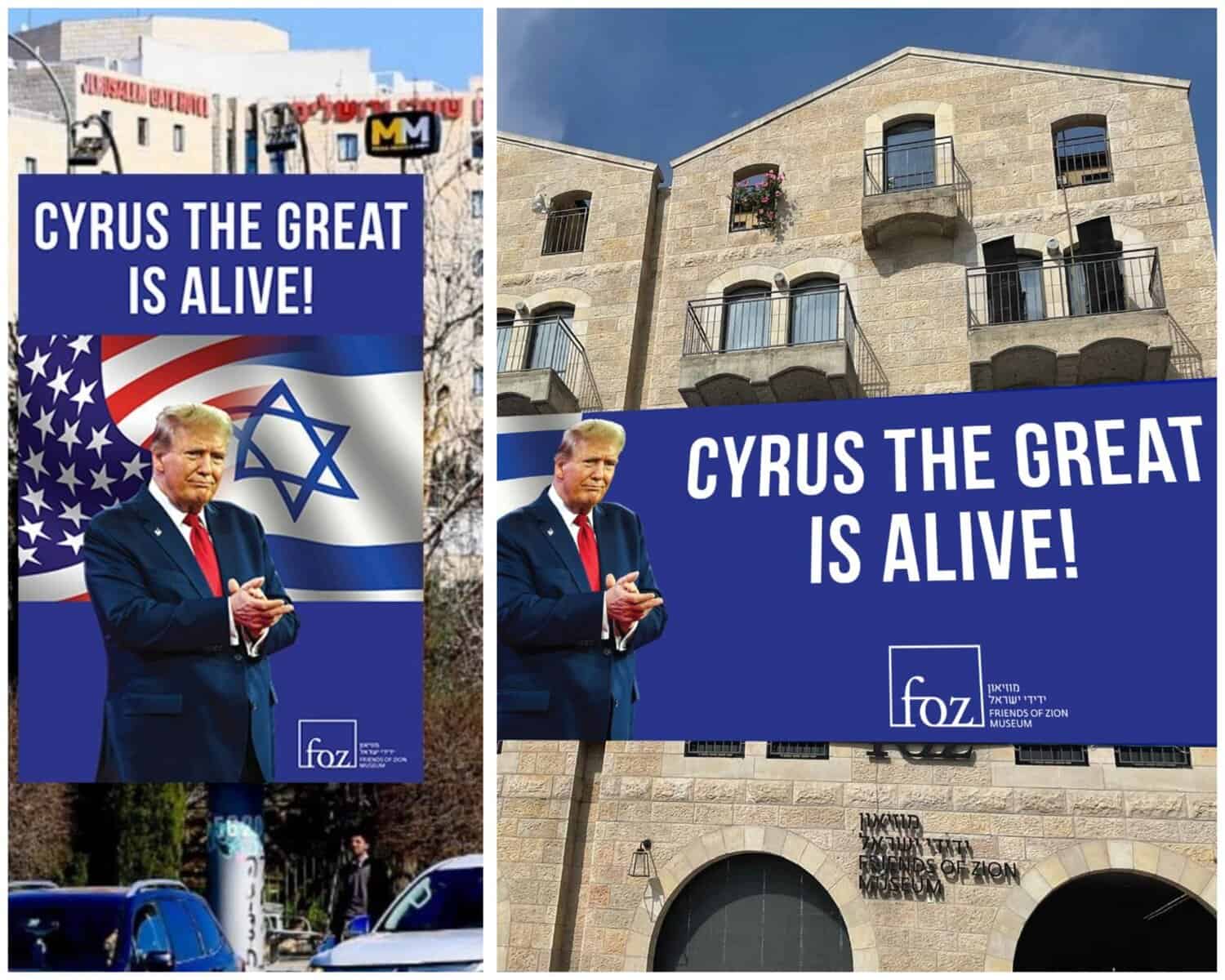
Amid the hostage deal, Jerusalem once again becomes the stage for religious and political symbolism. Billboards in Jerusalem and across Israel present U.S. President Donald Trump as “Cyrus the Great.” Against a backdrop of Israeli and American flags, his portrait appears beneath the bold message: “Cyrus the Great is Alive!” The choice of Cyrus, the ancient Persian king who allowed the Jews to return to their land after the Babylonian exile, places Trump at the center of a biblical-modern narrative that seeks to charge present politics with historic depth.
Trump and the Evangelical Communities
Behind the initiative stands Dr. Mike Evans, founder of the Friends of Zion Heritage Center in Jerusalem, advisor to President Trump and nominee for the Nobel Peace Prize. Evans notes: “President Trump is the greatest friend the State of Israel has ever had in the White House. There is no doubt that his moral clarity, courage, and decisive leadership changed the course of history in the Middle East. President Trump is the only person in the world who could have brought about an agreement between Israel and Hamas and the return of Israeli hostages, and he is indeed Cyrus the Great. Trump has always stood with Israel not out of politics but out of faith and values. I am sure no one will forget the courage of a man who kept his promises to the Jewish people and to the God of Abraham.”
Evangelical Solidarity in the U.S.
In recent days, Evans united evangelical community leaders representing more than 250 million believers in the United States and worldwide. They gathered for rallies and solidarity events marking the second anniversary of the October 7 attack. At Evans’ invitation, church leaders recorded and shared messages reaffirming their long-term commitment to stand with Israel and condemning the rise of antisemitism. Among them were Jack Graham, Clint Pressley, Doug Clay, Skip Heitzig, Max Lucado, Dr. Jay Strack, Erick Stakelbeck, Mat Staver, and Ralph Reed.
(Jerusalem lit in US flag colors – thanks to Trump)
Cyrus the Great as a Contemporary Frame
The comparison of Trump to Cyrus is more than symbolic. For the campaign’s initiators, it represents a theological-political language: just as Cyrus, a foreign king, granted the Jewish people their freedom, Trump is seen as the leader who drove landmark decisions – from moving the U.S. Embassy to Jerusalem to adopting a firm stance against Israel’s adversaries. Placing such a message on billboards in Jerusalem and central intersections across Israel highlights the tension between biblical memory and contemporary politics, giving the campaign resonance that continues to stir public debate.