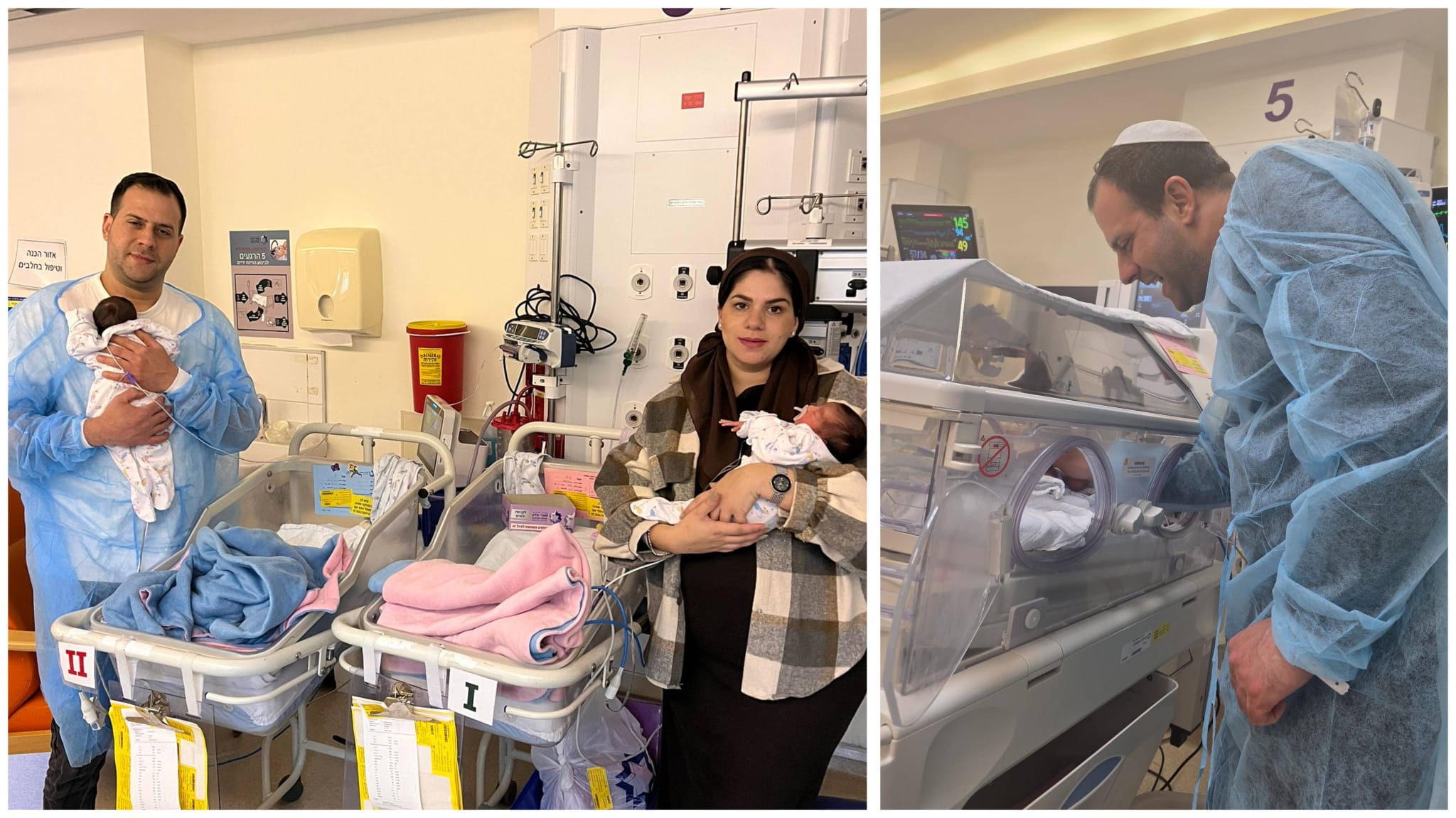
On days when sirens repeatedly echo across Jerusalem amid the war with Iran and Operation “Roaring Lion”, moments still emerge that remind residents that life continues. For Tehila and Aviatar from Jerusalem, those moments are unfolding inside the neonatal unit at Shaare Zedek Medical Center, where their premature twins are receiving care.
Tehila arrived at the hospital during her 32nd week of pregnancy after a routine checkup at a Clalit clinic revealed she was already in active labor. “I arrived at Shaare Zedek after a routine visit where they discovered I was already in labor with a 4.5-centimeter dilation”, she recalls. “Aviatar and I came expecting a natural delivery, but when labor did not progress and the doctors noticed fetal distress, they decided we needed an urgent cesarean section”.
The surgery went smoothly. First a baby girl was born, weighing 1.750 kilograms, and she was quickly given the name Yael. Shortly afterward her twin brother was born weighing 1.650 kilograms. “We have not chosen a name for him yet because we have not held the circumcision due to his medical condition”, the parents explain.
Yael and her brother have been in the neonatal ward for more than two weeks, cared for by the medical staff. Then on Saturday morning, when Operation “Roaring Lion” began, the reality shifted. Sirens began sounding repeatedly across Jerusalem – even while the parents were at the hospital.
How do parents of premature twins cope with sirens in Jerusalem?
According to Tehila, the neonatal ward itself was not the main concern. “When the sirens began we were not afraid for ourselves or for the twins because the ward is fully protected”, she says. “Our first thought was about our four children who were at home with a babysitter”.
The couple quickly arranged for the children to move to their grandparents’ home so they could stay in a familiar and supportive environment while the parents remained at the hospital.
Aviatar says he never considered leaving. “We share both our life and our business together”, he explains. “It was clear to me that I would not leave Tehila and the twins for a moment, even during a war, and that I would stay with her until the twins are discharged”.
How does Jerusalem’s protected neonatal ward operate during war?
Dr. Yaron Naveh, director of the neonatal unit at Shaare Zedek Medical Center, says the department is fully prepared for emergencies. “The neonatal unit at Shaare Zedek, the largest in Israel, is fully protected so that premature babies and their parents can remain here without needing to move elsewhere”, he says.
He adds that the medical, nursing and paramedical teams have become highly experienced in operating under emergency conditions. “Over the past two and a half years our teams have trained extensively for emergency situations, and nothing diverts our attention from our mission – providing the best possible care for every premature baby and offering personal, sensitive support to every parent”.
With the launch of Operation “Roaring Lion”, the hospital’s maternity services were also moved into protected areas. Delivery rooms were relocated to a fortified complex, and additional private delivery rooms were recently added to improve conditions for mothers.
Bat Ami Israel, head nurse of the maternity division, says the teams remain fully dedicated despite the security situation. “We surround every mother with care from the moment she arrives at the delivery rooms until she is discharged, ensuring maximum calm and comfort”, she says. “It is our privilege to be part of bringing life into the world, and especially in times like these we are committed to this mission with great dedication”.
Tehila sums up the experience with gratitude. “The teams in the delivery rooms and in the neonatal ward are simply amazing. They create a warm, supportive atmosphere despite the security situation and provide the best medical care”, she says. “We are waiting for the twins to grow stronger so we can return home and hold the circumcision – and hopefully by then the war will also be over with good results”.