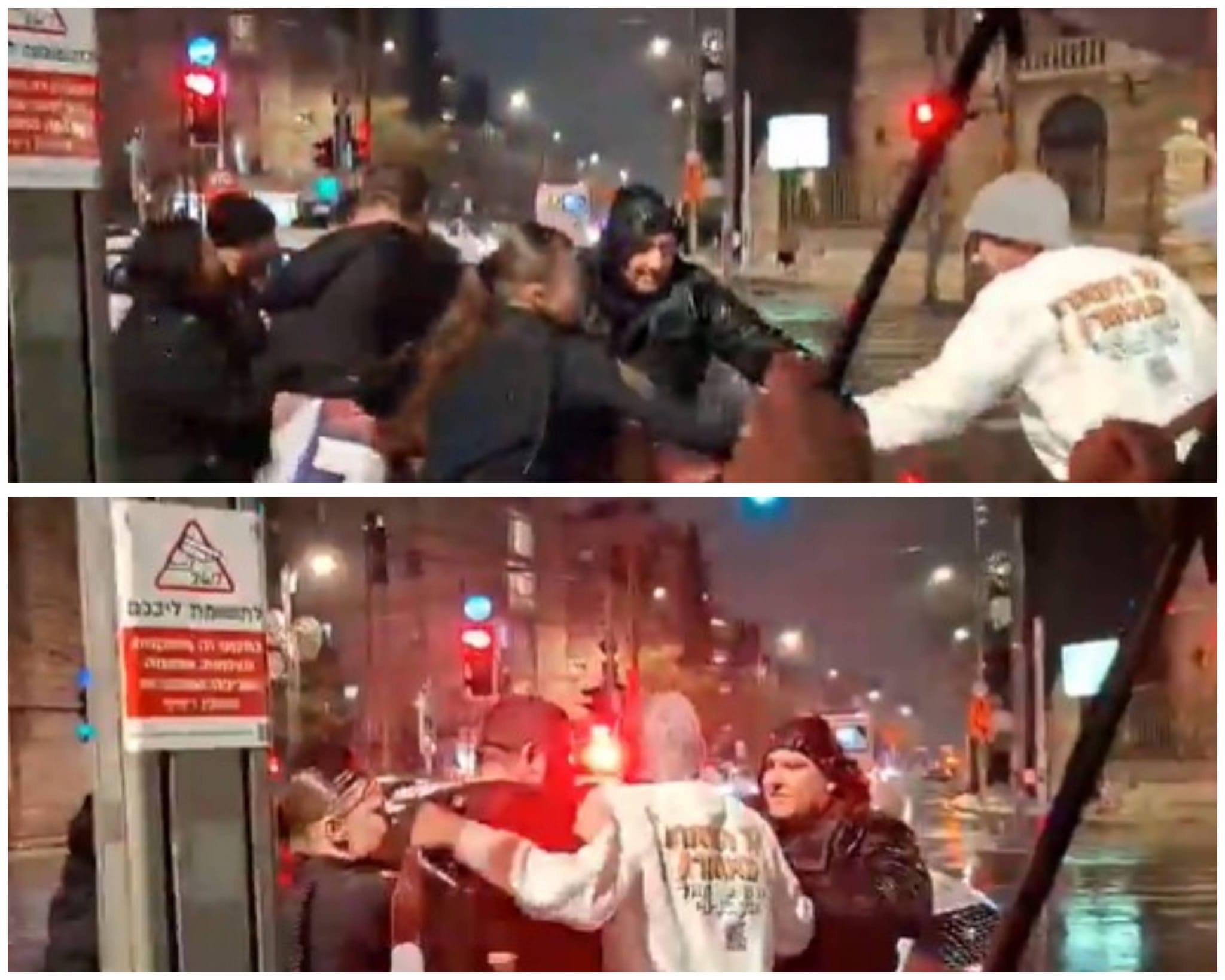
The wet streets of Jerusalem on Saturday night reflected a complex reality: on one hand, sirens, interceptions and falling debris across the city linked to missile fire from Iran; on the other, dozens of protesters gathered at Paris Square, some opposing the government and others calling for Prime Minister Benjamin Netanyahu to step down. With a severe incident in Arad leaving around 100 injured, some in serious condition, the atmosphere felt tense not only in security terms, but also socially and psychologically.
Alongside the protest, police activity was also reported. The Jerusalem District Police said: “Jerusalem District forces, including riot police units, operated at the protest held at Paris Square. During the protest, individuals began blocking traffic lanes and disrupting movement in the area. A police officer declared the protest unlawful and gave reasonable time for dispersal. After participants refused to comply, forces acted to disperse them in order to restore public order. Two individuals were detained.”
What is unfolding in Jerusalem is not just a political or security story. It reflects a broader picture of a society coping with prolonged pressure, where fear, anxiety and uncertainty seep into daily life and reshape relationships between people.
How does the war with Iran affect mental health and social cohesion in Jerusalem?
Sociological and psychological research points to a dual phenomenon: war can strengthen solidarity and a sense of shared fate, but it can also deepen existing divisions and intensify disagreements. When stress persists over time, different groups in society tend to interpret reality in different – sometimes opposing – ways.
In Jerusalem, a city already shaped by diverse identities – religious and secular, Jewish and Arab – security pressure does not exist in a vacuum. It intersects with existing tensions and can sharpen them. Protests like the one seen at Paris Square are one expression of this dynamic: not only political dissent, but also a release of accumulated tension.
At the same time, for some residents, the sense of threat creates a stronger bond with their community and surroundings. This is the same mechanism that helps societies endure extreme situations – but it does not operate uniformly, nor does it affect everyone in the same way.
Is political protest during wartime a common global phenomenon?
History offers many examples of societies stretched to their limits under sustained security pressure. In London during the Blitz in World War II, for example, a strong sense of unity initially emerged – but over time, social tensions and inequalities also became more visible.
In the United States after the September 11 attacks, there was early national cohesion, but political and social divisions later intensified around security policy, wars in the Middle East and civil liberties.
In other regions facing prolonged conflict or internal strife, such as Spain during ETA activity or Lebanon during periods of internal conflict, a similar pattern appeared: sustained pressure does not only unite – it also exposes deep fault lines.
Jerusalem, with its unique political, religious and historical sensitivity, serves as a microcosm of these processes. What appears as a localized protest at Paris Square may be part of a broader story – a society trying to process a complex reality in real time, under continuous threat.