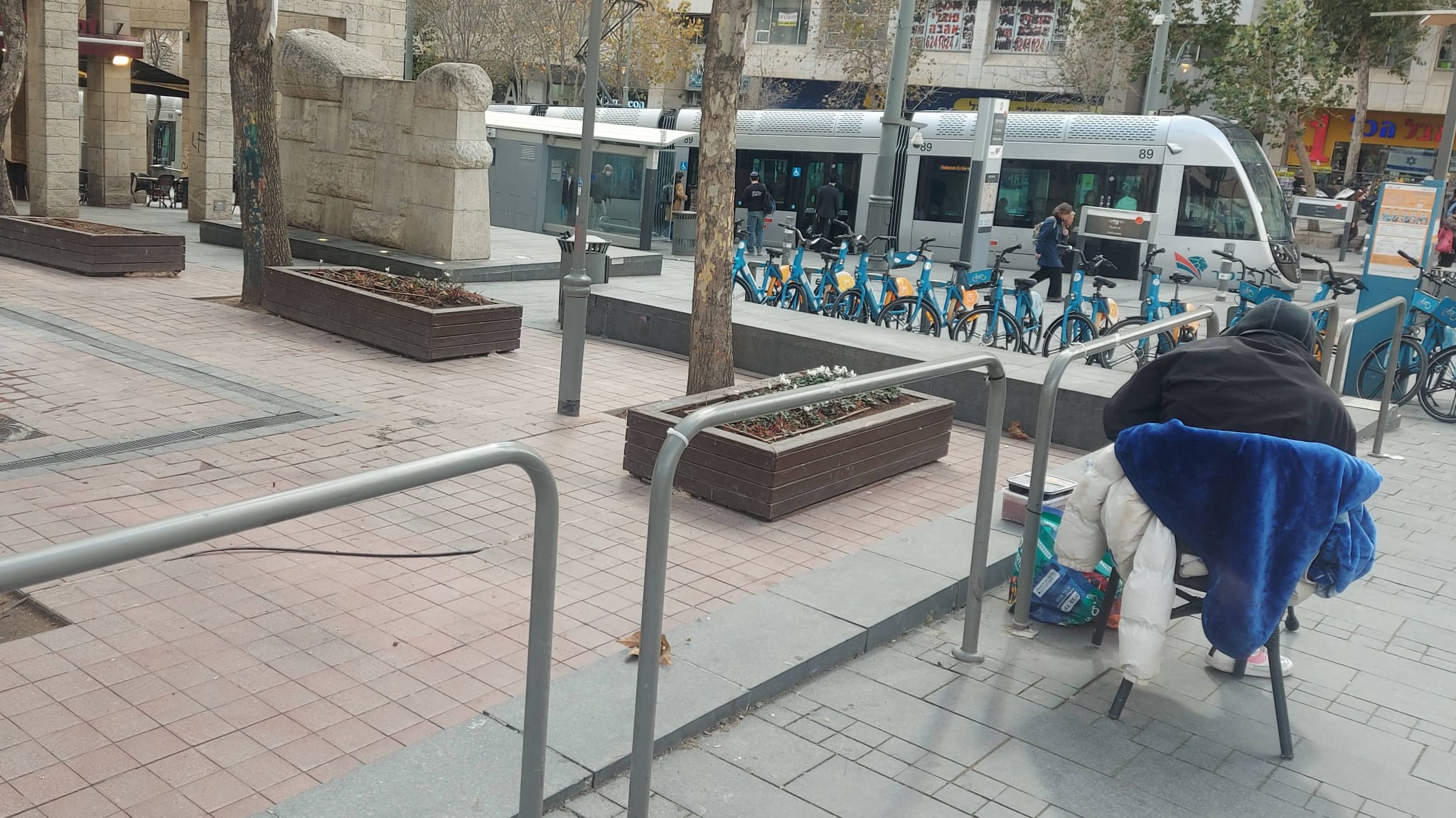
In Davidka Square, one of the busiest and most visible junctions in central Jerusalem, a small group of homeless people had gathered for years on the stone and wooden benches scattered across the plaza. For them, the benches were more than a place to rest. They were an anchor: a place to sleep, eat, sit, talk, and feel connected to the city around them.
Beyond being a physical spot, the square also served as a social space. People met there, shared information, exchanged food, and sometimes simply sat together in silence. For many, it was one of the few places in Jerusalem where they did not feel invisible.
In recent weeks, the benches were removed as part of maintenance and renovation works. The area was cleared, opened up, and redesigned. For homeless residents, however, the meaning was clear: the disappearance of the only place where they could stay. Some now wander between nearby streets, others sit on improvised chairs or on sidewalks, and some have disappeared from the area altogether.
For many of them, turning to shelters is not a simple solution. After months or years of homelessness, entering a closed framework can trigger anxiety. The loss of control, fear of unfamiliar surroundings, and discomfort around strangers often make shelters feel overwhelming. Some feel safer in street environments they know, where risks are familiar and routines are self-managed. Others struggle to believe that long-term support is really possible and prefer to remain in spaces they understand.
How do cities deal with homelessness in Jerusalem and around the world?
Cities around the world have adopted different approaches to homelessness in recent years. In New York, temporary housing and personal caseworkers are widely used. In London, open day centers provide food, showers, and support services. Berlin combines welfare assistance with long-term housing programs. In Helsinki, a “housing first” model prioritizes permanent shelter before rehabilitation. In Tokyo, specialized employment frameworks help homeless people reintegrate into the workforce.
In Jerusalem, where public space is limited and social complexity is high, the challenge is particularly difficult. For homeless residents, even small physical changes, such as the removal of benches, directly affect daily routines, personal safety, and the ability to remain in familiar surroundings.
Between Davidka Square and other central locations, many now move constantly from place to place, without a stable anchor or long-term solution. For them, the street is not just a physical location. It is a living space. When it is taken away, they are left without territory and without a clear place in the city they call home.