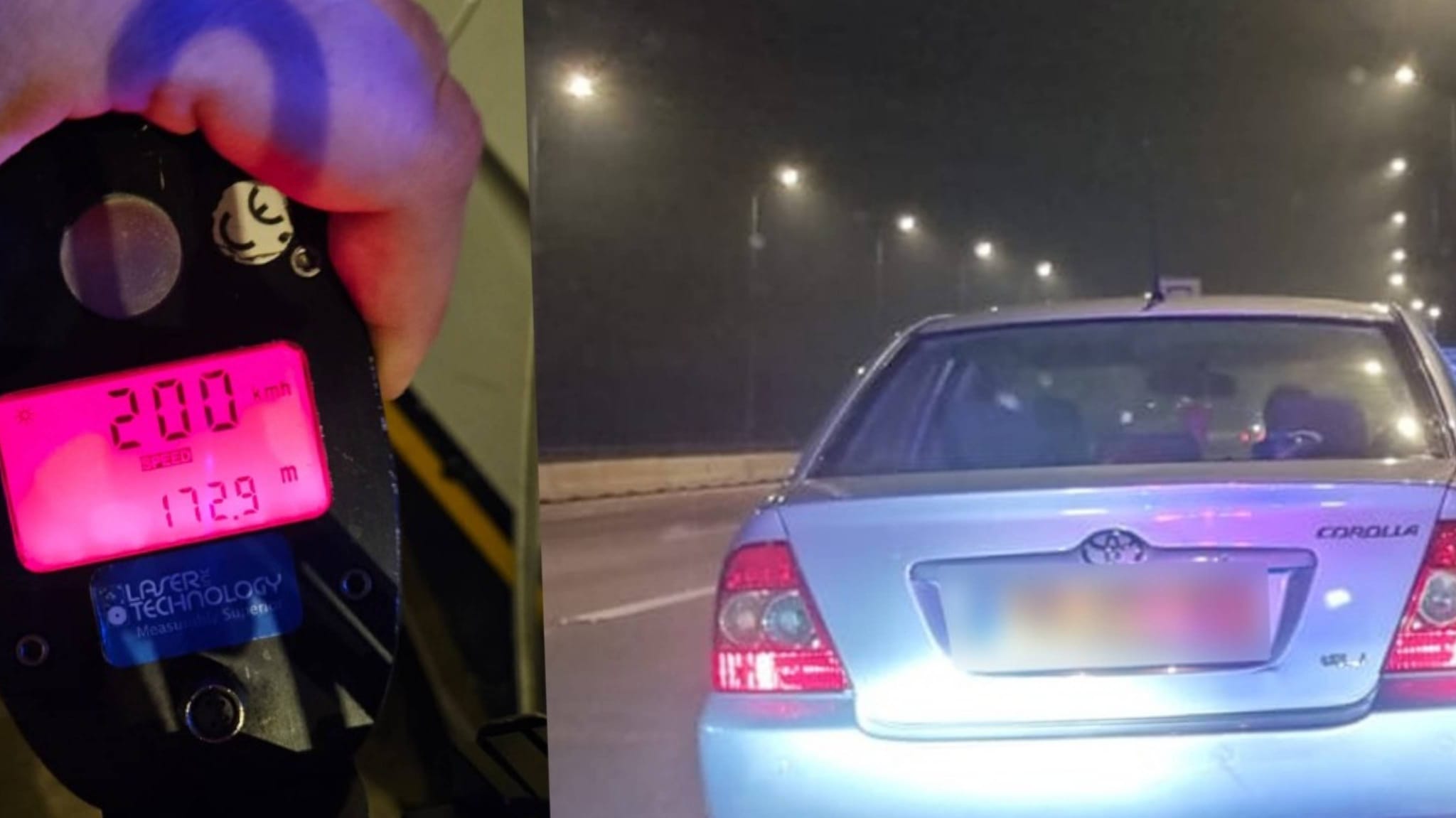
A car traveling at 200 km/h was caught this week on Route 1 in the area of the Motza interchange near Jerusalem, on a stretch of road where the speed limit is 90 km/h. The driver, a 24-year-old resident of East Jerusalem, was stopped during a police enforcement operation. Beyond the extreme speed itself, the case raises broader questions about excessive speeding, risk-taking and driving culture on one of the main arteries leading to Jerusalem.
Excessive speeding on Route 1 – what happened near the Motza interchange?
According to the police, during a speed enforcement operation on Route 1 in the area of the Motza interchange near Jerusalem, officers identified a vehicle traveling at an extreme speed of 200 km/h. The driver was detained and questioned by a senior traffic officer, his driving license was suspended for 30 days, and he was placed under five days of house arrest. In a statement, the police said the incident involved “reckless and irresponsible behavior that endangers lives and could lead to loss of control, a fatal crash and severe injuries – not only to those inside the vehicle but to all road users”.
Why do drivers engage in extreme speeding – what does research say?
Research in the psychology of risk behavior suggests that excessive speeding is rarely a simple mistake. For some drivers, particularly young men, high speed provides a sense of power, control and thrill. Criminological studies describe this as the normalization of risk: when traffic violations become routine, legal boundaries blur and the law is perceived as a guideline rather than a firm limit.
At extreme speeds, the illusion of control collides with basic physics. Reaction time shrinks, braking distance increases dramatically, and even a minor change in road conditions can result in loss of control. Traffic researchers note that this is precisely the moment when drivers feel most confident, while actual danger is at its peak.
The contrast becomes clearer when compared with mountainous roads around the world. On routes such as the Stelvio Pass in the Italian Alps, the Grimsel Pass in Switzerland, the Rocky Mountains highways in Colorado, or the Pyrenees passes between France and Spain, drivers instinctively slow down. Sharp bends and steep terrain constantly signal danger. On wide, fast roads like Route 1 leading to Jerusalem, that natural warning system weakens, allowing speed to feel acceptable – until it becomes a real threat.