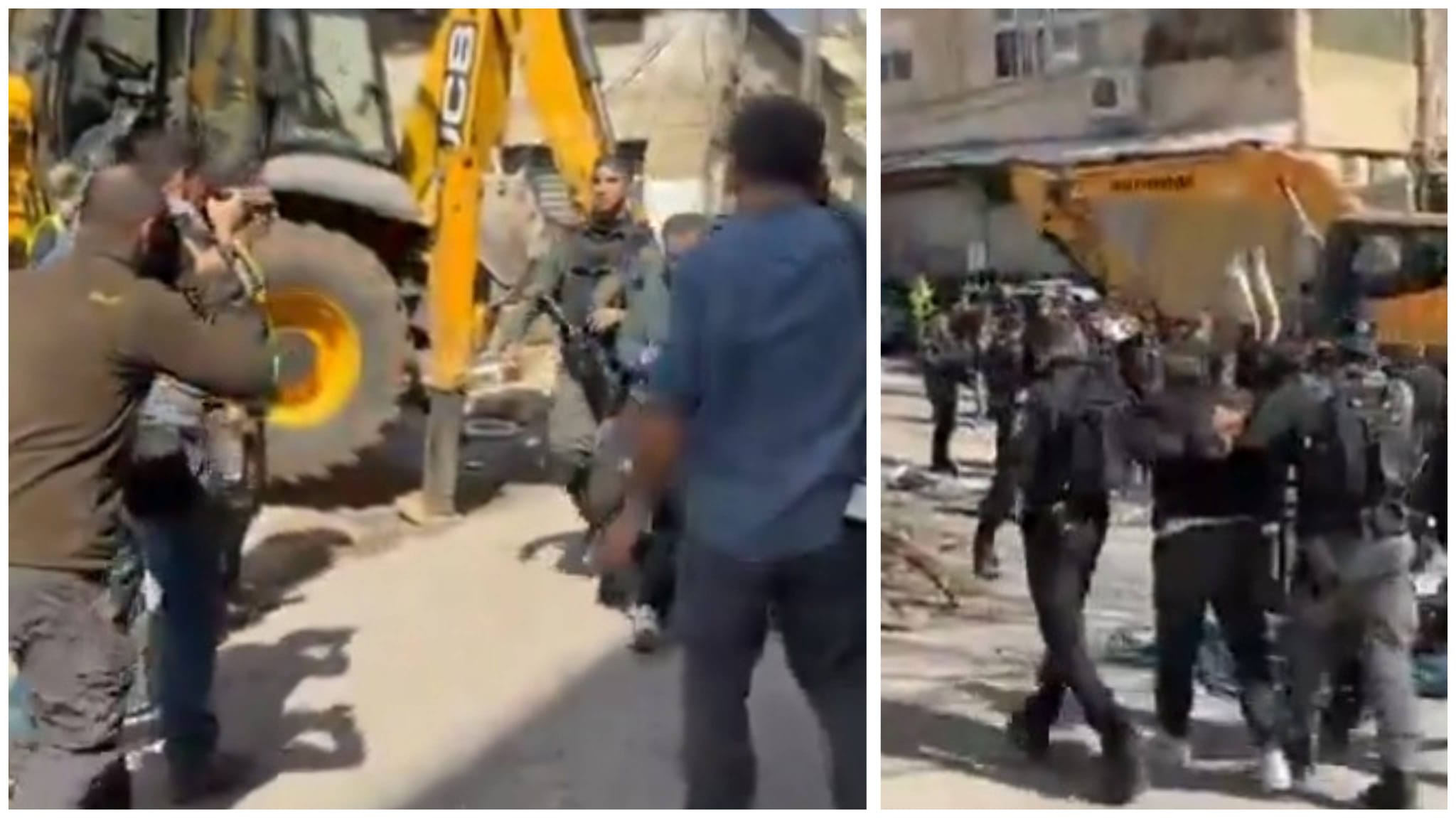
Large teams from the Jerusalem Municipality, accompanied by security forces from the Jerusalem District Police, arrived on Tuesday morning in the al-Bustan neighborhood of Silwan, south of the Temple Mount compound in Jerusalem. The teams began demolishing, using heavy engineering equipment including four bulldozers, commercial structures, fences, walls, sheds, and metal roofs that had been erected illegally and without permits.
During the operations, local youths disrupted the demolition work, and clashes erupted between them and Jerusalem District Police forces. According to Palestinian reports, two of those involved in the disturbances were arrested by police, while two others were lightly injured and required medical treatment.
While the demolition teams were working, attorney Ziad Qawar, representing local residents, obtained a court order from the Jerusalem District Court to halt the demolitions. As a result, the operation was stopped before it was completed. The land on which the partially demolished structures stand is designated for the “King’s Garden” project, a tourism and archaeological initiative led by the Jerusalem Municipality.
What Is the “King’s Garden” Project and What Is Behind It?
The “King’s Garden” project is an urban plan by the Jerusalem Municipality to establish an archaeological, tourist, and public park in Silwan. The plan seeks to recreate the biblical gardens of the Kings of Judah in the al-Bustan area, based on traditional identification of the site as the “King’s Garden” mentioned in the Books of Nehemiah and Kings. However, many archaeologists note that there is no conclusive evidence regarding the garden’s exact location in this area.
The project aims to create a “tourism ring” around Jerusalem’s Old City, linking the City of David site, managed by the Elad Foundation, with other areas in Silwan, the Hinnom Valley, the Kidron Valley, the Mount of Olives, and the Armon Hanatziv Promenade. The plan includes open spaces, orchards, restaurants, commercial areas, and workshops for traditional crafts.
Since the Six-Day War in 1967, the area has been designated as open land under Outline Plan 9, preventing Palestinians from obtaining building permits there. Residents argue that this designation is politically motivated and intended to block neighborhood expansion. As a result, many Palestinians view the project as an attempt at “Judaization” and the creation of a settlement corridor that would isolate Palestinian neighborhoods and alter the character of the area. Efforts to reach agreements between the municipality and residents have been ongoing since 2010, but both sides have repeatedly rejected each other’s proposals. Today, dozens of structures in the area, including residential buildings, are slated for demolition.
عاجل | قوات الاحتلال تعتقل الشاب "ياسر دويك" من بلدة سلوان في القدس المحتلة. pic.twitter.com/8Hdh92aItr
— شبكة قدس الإخبارية (@qudsn) February 10, 2026
عاجل | قوات الاحتلال تعتقل الشاب "ياسر دويك" من بلدة سلوان في القدس المحتلة. pic.twitter.com/8Hdh92aItr
— شبكة قدس الإخبارية (@qudsn) February 10, 2026