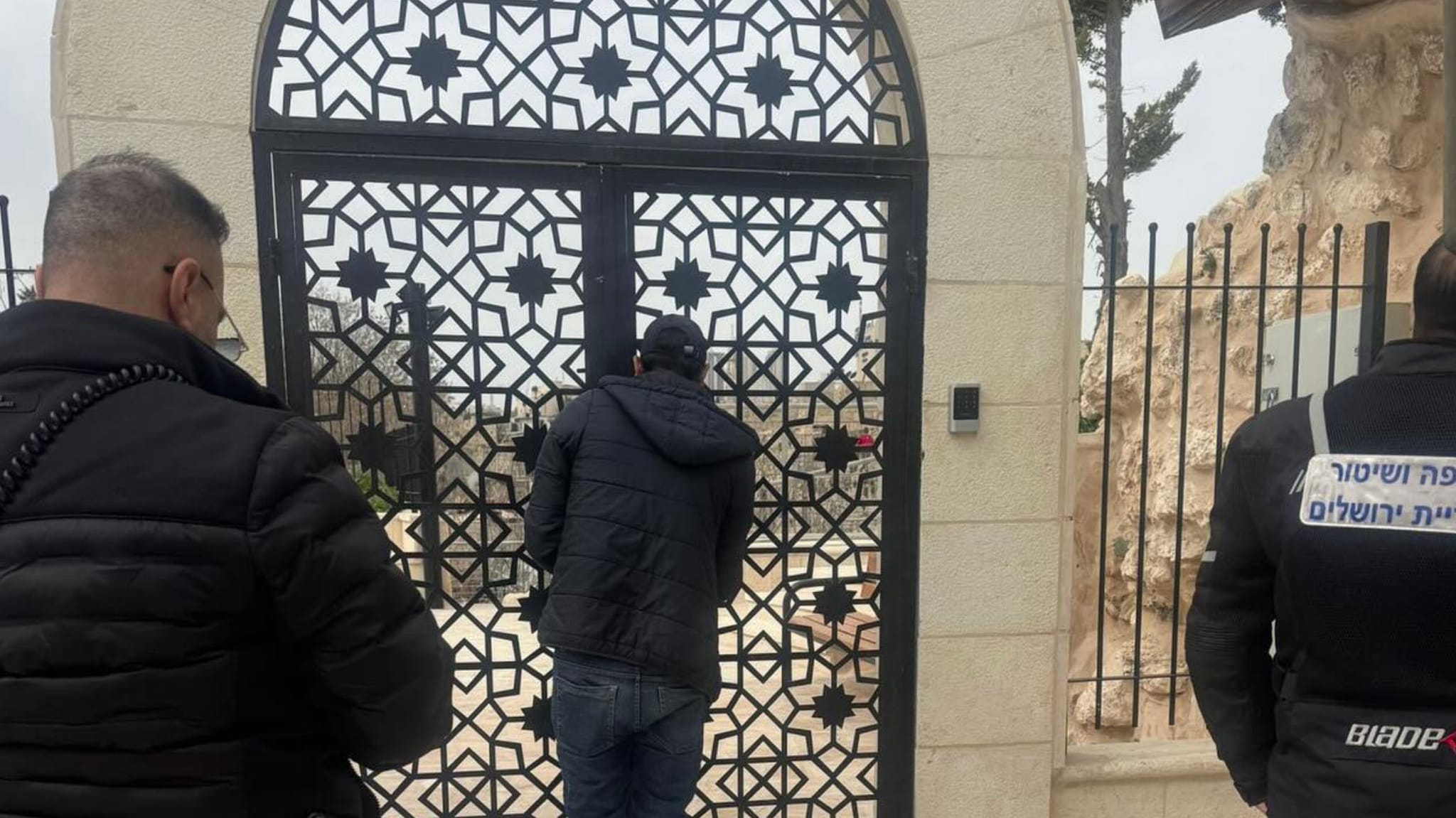
A Jerusalem District Police force, accompanied by a team of metal workers, arrived early Tuesday morning this week at the Palestinian community center “Burj al-Laqlaq” (Stork Tower), located in the Old City, adjacent to the wall near Herod’s Gate. After officers posted an official closure order at the entrance, signed by National Security Minister Itamar Ben Gvir, the gates were sealed. As a result, the center was closed to all activities, except for a kindergarten operating on the premises, for the next six months. During the operation, Palestinian residents gathered at the site, confronted police forces, and were removed from the area.
Does Activity at the “Stork Tower” Center Violate a 1994 Law?
The basis for the closure is alleged activity that violates the “Interim Agreement Implementation Law (1994),” enacted following the Oslo Accords. The law prohibits the Palestinian Authority from carrying out governmental activities, directly or indirectly, within the territory of the State of Israel, including Jerusalem. According to information held by security authorities, such activity indeed took place at the site.
The organization operating the center was founded in 1991 by residents of the Muslim Quarter. Its declared goal was to establish a community and sports center serving local residents. However, the initiative was also intended, primarily, to prevent the implementation of plans to establish a Jewish neighborhood at this strategic location – the Ma’aleh HaZeitim neighborhood.
The center covers approximately nine dunams and includes sports fields, kindergartens, and open public spaces. For local Palestinian residents, it is one of the few green and public areas within the densely populated Old City. The site is named after “Stork Tower” (Burj al-Laqlaq), an ancient Mamluk watchtower located at the northeastern corner of the Old City wall.
On the surface, the center hosts seemingly innocent activities. Football and basketball courts operate on site, alongside training sessions and various sports competitions. A kindergarten, library, vocational skills development center (such as ceramics), and first aid courses are also active. However, according to security authorities, the reality is different.
For example, the center runs a program that trains students to guide tours at historical and tourist sites under the name “Ambassadors in Jerusalem.” While the center claims the goal is to present the “Palestinian narrative” of the events of 1948, Israeli authorities view this as incitement or the promotion of an ideology that denies Israeli sovereignty in the city. In addition, women’s empowerment groups, programs for at-risk youth, and leisure activities are held at the center with the support and funding of the Palestinian Authority.