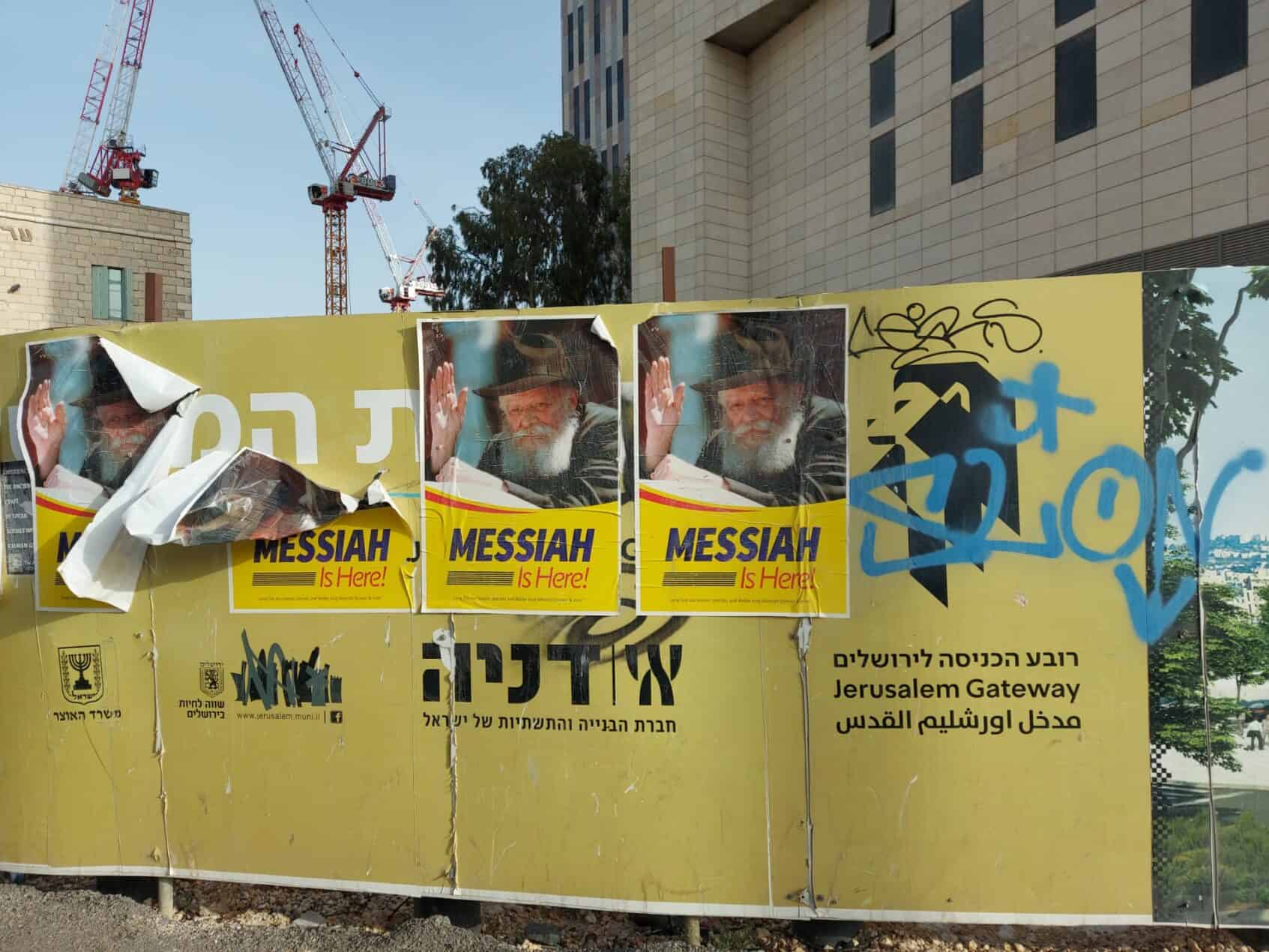
A concrete wall near the western entrance to Jerusalem bears a message that says more than any government report ever could. Amid cranes and construction dust, a large sticker shows the face of the Lubavitcher Rebbe with the words “Messiah Is Here.” Torn, faded, surrounded by graffiti – but still clearly visible. No campaign, no headline. Just presence
This isn’t just about Chabad outreach. In Jerusalem 2025, the public space itself seems to be participating in a religious transformation — and it’s happening without laws or official declarations. It’s happening through walls, light poles, billboards, and bus stops. And no one seems to be stopping it
A City That Educates by Itself?
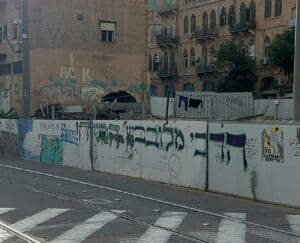
Across the city, visual religious messaging is multiplying: mystic slogans, Kabbalistic posters, messianic declarations, and rabbinic images fill every inch of the urban fabric. Cultural urbanism scholars have compared it to 1970s Tehran or ultra-Orthodox Brooklyn – where space is not neutral but actively ideological
Jerusalem, it seems, is not just becoming more religious demographically – it’s becoming a city that teaches religion by walking down the street
A prominent public space researcher from a Jerusalem-based think tank told Jerusalem Online: “People usually think religious influence comes through education or politics. But here, it comes from the sidewalk. The street itself sends a message. If all the messages are religious, the city becomes a tool of religious identity. It’s not just a demographic shift. It’s geography becoming ideology.”
The Numbers Behind the Feeling
According to Israel’s Central Bureau of Statistics, Jerusalem is undergoing an accelerated demographic shift: secular families are leaving, while ultra-Orthodox and religious communities are moving in from cities like Beitar Illit, Elad, and Modi’in Illit. In the last municipal election, religious and Haredi lists won nearly 70% of the vote
For visitors, it may still feel like a city of history and culture. But for residents walking to work, the environment increasingly resembles a religious landscape: public signs that echo spiritual themes, advertisements that assume observance, and entire areas that feel designed with one worldview in mind
Jerusalem 2025: Still Shared?
The question now is not political, but existential. Can a city remain shared when the physical space subtly promotes one identity? Can public streets stay public when every image reminds you who should be walking them?
In Jerusalem 2025, the Messiah isn’t just declared on posters. He’s already moved into the architecture