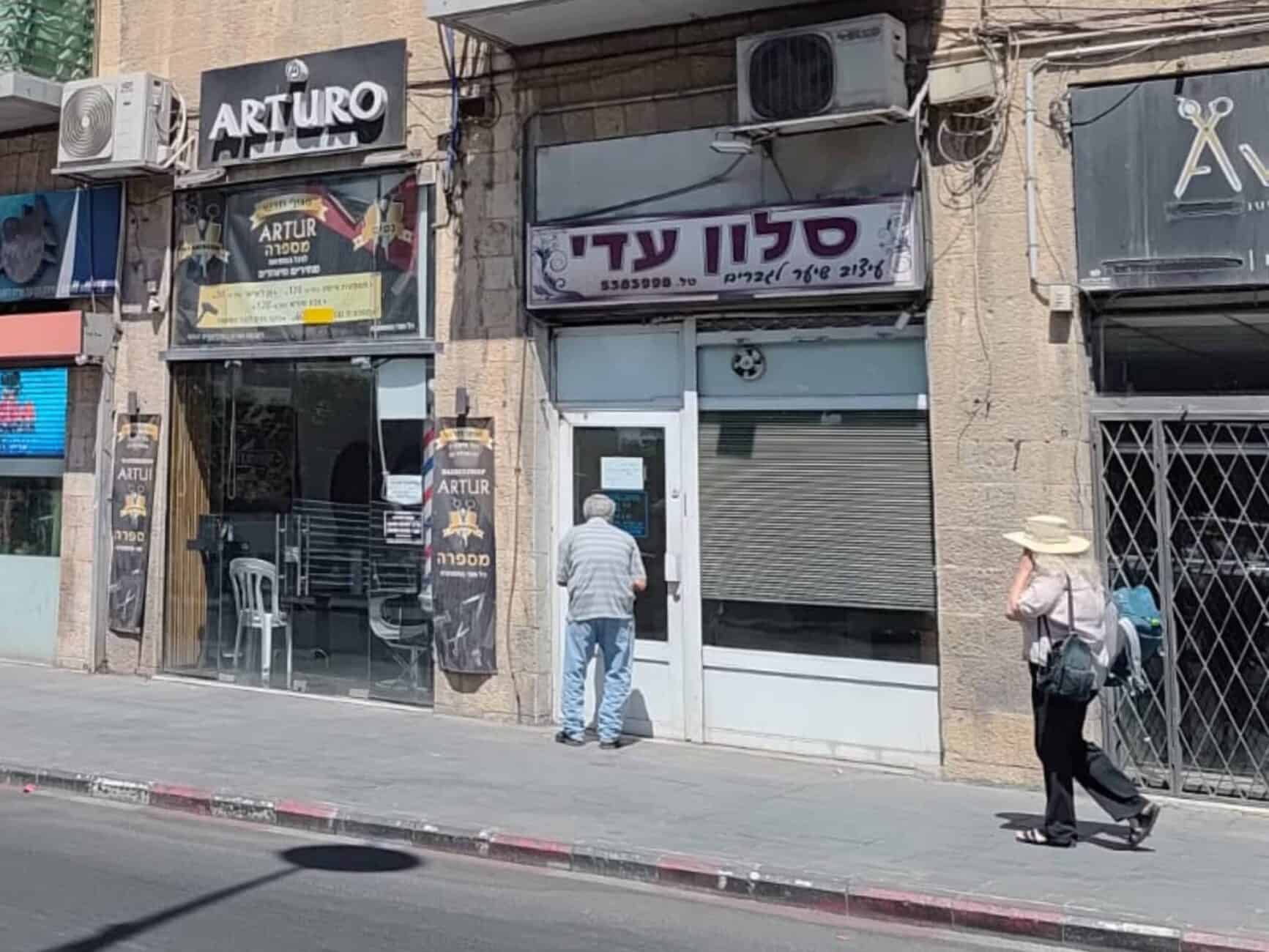
Jerusalem is changing hands. A closed barbershop, a shuttered fish store, an old shoemaker who’s no longer there — and something new quietly takes their place. On Pines Street, across from Davidka Square, the farewell is not loud. A locked door, a drawn curtain. Passersby pause and glance inside at what used to be “Salon Adi,” a traditional barbershop that served Jerusalem men for about 50 years
A barbershop with a city’s soul
There’s silence now where scissors once clicked. The tools are gone, the lights are off. Adi the barber — beloved by generations — has retired. One more Jerusalem landmark disappears, one more era folds into memory
“I came here with my son since he was little,” says Pini, a lifelong customer who happened to pass by. “If Adi is done, I guess I’ve grown old too
(Jerusalem’s Urban Shift: 1,300 New Homes Reshape the City)
The shop stood beside a laundromat and an aquarium supply store, offering more than haircuts. It was a quiet male enclave near the market, where stories were exchanged as frequently as fades. Boys climbed into the spinning chair, men loosened their ties. They walked out clean-shaven, freshly trimmed, and full of banter — as if they’d stepped out of a library of city legends
A wave of closures, a shift in rhythm
Adi’s retirement marks more than the end of one shop. It reflects a wider trend across Jerusalem. The famous Hamawi brothers’ butcher shop in the Machane Yehuda market has shut down. Uri’s pickle shop was handed to his sons. The legendary “Hatzot” steakhouse on Agripas Street was bought by younger owners — same spices, but a faster beat and an Instagram-savvy brand
Craft and memory: what remains
Those who remember the “Amal” wicker and cane shop on David Yellin Street might recall its blind artisans, Yonah and Yaakov Gil. From darkness, they created beauty. Today, their daughter Nurit continues the legacy with handcrafted chairs that blend tradition with artistry — ancient and modern, with Jerusalem in every fiber
Like an olive tree, Jerusalem doesn’t forget
The signs have changed: the blacksmith, glasscutter and watchmaker have given way to cellphone repairs, herbal medicine and SIM card stands
But Jerusalem is like an old olive tree — never dry, always sprouting new shoots
(Shock in Jerusalem: “Holocaust in Gaza” Painted at Station)
The next generation doesn’t erase what came before. It stands on its shoulders. And when we say goodbye to the city’s barbers, cobblers, carpenters and merchants, we part not just from people — but from sounds, smells and a shared memory
Yet not all is lost
Sometimes, the young rebuild
Sometimes, they remember — and surprise us