What would Johann Ludwig Schneller, the German missionary who arrived in Jerusalem in 1860 and founded a Christian orphanage for the orphans of the massacres in Lebanon and Syria, say today? Indeed, what would he say about the transformations the place he established has undergone through the generations
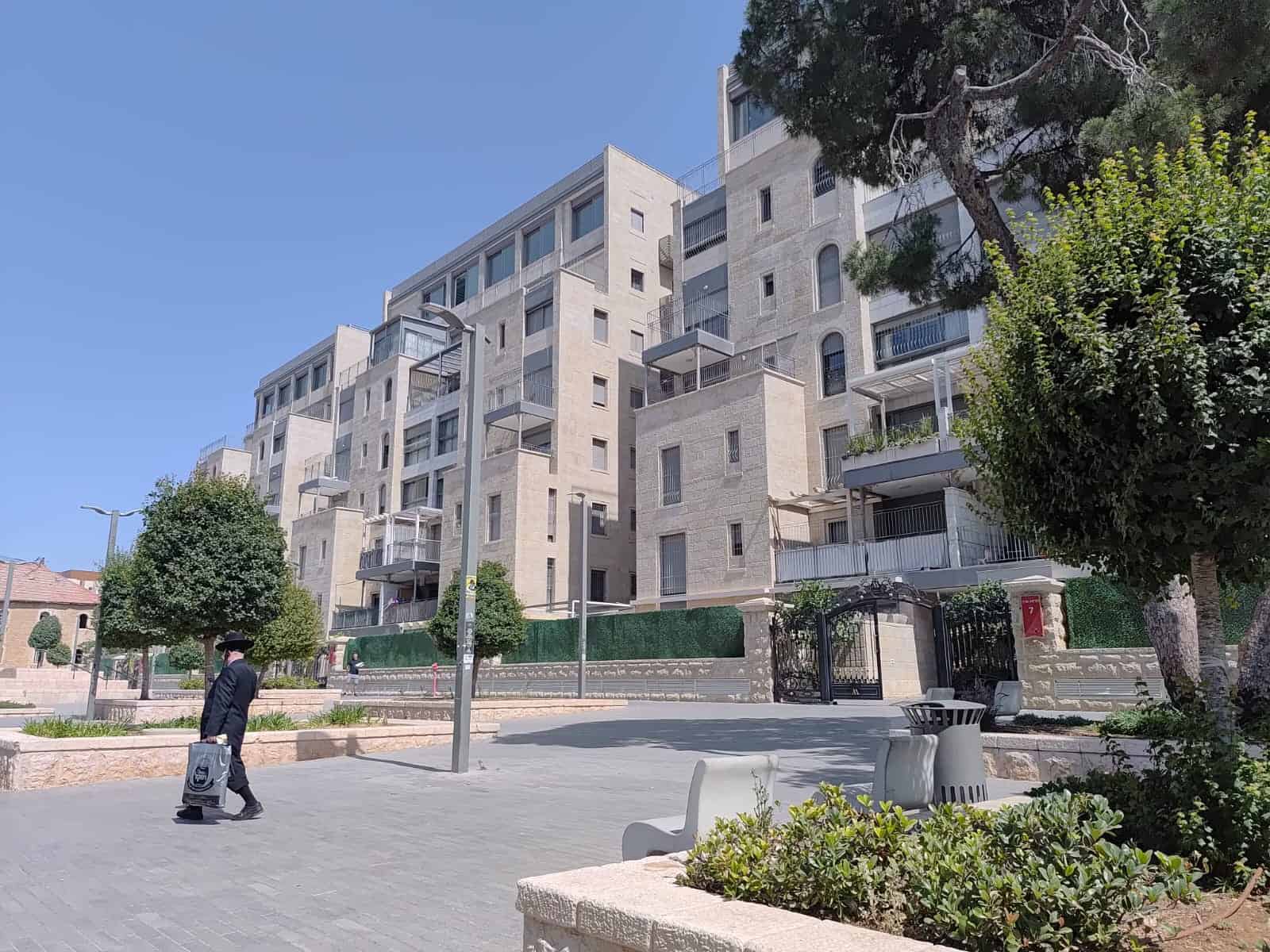
Long years of struggles over the Conscription Law, a coalition fighting for its survival, and the law of exemption and evasion from IDF service – all these dominate our headlines, yet none prevented the acquisition of land and funds for building a luxurious Haredi residential neighborhood on the grounds of a former military camp. Ladies and gentlemen, a revolution – once IDF, today exemption. On Malkhei Israel Street, the transformation occurred. The former “Schneller Camp” military base shed its khaki uniform and ranks, disarmed, and became a place utterly different from its past self. From an IDF camp – to an upscale Haredi neighborhood
Former Schneller Camp: From military base to luxury Haredi neighborhood in Jerusalem (Photo: Jerusalem Online – Barry Shahar)
Imagine a desolate military area, where discipline reigned, “roll call!” echoed, and a military base life was in full swing, suddenly transforming into a vibrant urban oasis with manicured gardens. This is the astonishing story of an IDF camp, where new recruits, including from the Haredi sector, were supposed to arrive. Imagine them undergoing induction and conscription as required, training and defending Zion, the Holy City in the Land of Israel. Instead, the place became a gilded palace with gates and entrances to legendary residential homes. The hand of the magic-maker – leaves room for guesswork
From Khaki Uniforms to Penthouse Views: The Urban Transformation
How did uniforms turn into penthouses? Behind this transformation lies a story of urban planning, real estate interests, and capital-government ties, which repeatedly manage to remove strategic assets in the heart of the capital from public ownership
“Schneller,” originally built in the 19th century as a German Protestant institution, served as a military camp after the establishment of the State of Israel. Despite its location in the heart of Haredi neighborhoods, it remained a complex detached from its urban surroundings. However, once the IDF evacuated, instead of leveraging the complex for community, educational, and public needs – the option was chosen to allow the construction of a luxurious residential neighborhood with a price tag of many millions of Shekels per apartment
Luxury Apartments – For Holders of Foreign Passports and The Price of Progress
The Haredi public living in the adjacent neighborhoods in peeling, old, and crowded buildings does not dream of moving to such an elevated place. Residents of Geula, Mea Shearim, and even Shmuel HaNavi and Bar Ilan, do not even imagine looking for an apartment in this gated and guarded palace reserved for a select few. They understand that this is the domain of modern Haredim, some holding foreign passports, making smart investments, and likely having a strong presence in planning committee discussions
“Schneller” is much more than a residential complex – it is a mirror, reflecting Jerusalem as it is: a city of disparities: wealth and quiet, alongside noisy and crowded poverty. In the past, soldiers served in the complex and from there went out to defend the state. Today, it is inhabited by capitalists, serving themselves
I remember how at the end of the Six-Day War, we went out to cheer in our street near “Schneller,” for the soldiers who returned from the battle on tanks to the base. The excitement of seeing them return from the fight was thrilling. Every soldier and fighter was considered in our hearts a Judah Maccabee, a Bar Kochba, and a man of Israel. Today, “Schneller Camp” leaves behind a few buildings, serving as historical facts. From within them bursts a fascinating past of an IDF base, crying out against “collective amnesia.” Remnants of structures whose walls cry out for memory and hope