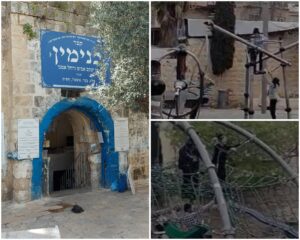
The journey from Jerusalem to the Cave of the Patriarchs in Hebron begins at Jerusalem’s central bus station, on Route 383. The announcement promises a safe ride, yet the heart, as it often does on this road, tightens slightly. Worn seats, tired windows, and the familiar Jerusalem landscape slowly gives way. The city’s southern neighborhoods, including Gilo, followed by places such as Beitar Illit and Tzur Hadassah, unfold hills and valleys. Autumn leaves in vineyards, olive groves, and winter puddles resting in the lowlands.
What does the end of Genesis represent in today’s Jerusalem?
Last Sabbath, synagogues in Jerusalem completed the reading of the Book of Genesis. The book concludes with Jacob’s death and his burial in the Cave of the Patriarchs in Hebron.
This is the same burial estate Abraham purchased from Ephron the Hittite. In what appears to be an almost technical biblical episode lies a brilliant strategic act: a legal, public purchase, paid in full, of a piece of land beyond dispute. Abraham seems to understand that memory, sovereignty, and rootedness must begin with a documented claim.
What does the road from Jerusalem to Hebron reveal about the land?
The road from Jerusalem to Hebron reinforces this idea. Bus stops carry biblical names: Nofei Mamre, Kiryat Arba, Kalev ben Yefune Boulevard, David, Joshua. Alongside them appear Halhul, Beit Ummar, Yatta, and Dahariya. The map itself tells a dual story. So does the view from the window: red-tiled roofs, gardens, and air conditioners opposite flat rooftops and black water tanks. Two peoples, and two interpretations of the same space.
Along the route stand yeshivas and religious schools, waystations of a younger generation. Then, nearing the destination, abandoned businesses emerge, places where economic hope has worn thin and livelihoods have eroded.
What happens upon entering the Cave of the Patriarchs?
And when one finally reaches the Cave of the Patriarchs from Jerusalem, the breath catches. The call of the muezzin competes with Hasidic melodies. Countless steps lead into a vast enclosure. Here lie Abraham and Sarah, Isaac and Rebecca, Jacob and Leah. Esau is buried here as well, but without a dignified marker, almost as a footnote.
The absurdity is stark: two peoples, sons of the same father, sharing one sacred site, yet unable to share a future. The tombs are covered with ancient carpets, Arabic signs, sealed green doors. Holiness is carefully maintained, yet tightly strained.
The journey from Jerusalem to the Cave of the Patriarchs is not merely geographical. It is a movement through layers of time. Between Teddy Stadium and the first burial estate in human history runs a direct line of memory, faith, and struggle. Here the patriarchs and matriarchs were laid to rest, and here their descendants continue to argue over the meaning of the inheritance.
Abraham, through his precise and documented purchase, sought to establish a fact, a deep root in the soil, one not dependent on force but on agreement. Thousands of years later, the same site, sacred to two religions, reflects just how elusive agreement remains. Perhaps this is why the journey from Jerusalem to Hebron does not end when one steps off the bus. It continues with the question that follows the return to the city: can a shared life ever grow out of a shared tomb, or will all who pass through remain silent witnesses to a history that refuses to settle?