In Jerusalem, a city where almost every community custom carries layers of identity, family, religion and public space, a wedding convoy is not just a drive from one place to another. For many Muslim families in East Jerusalem and nearby neighborhoods, the convoy is an inseparable part of the wedding: decorated cars, relatives and friends driving together, honking, short stops and a public procession that signals to the community that a new household is being formed and that the family is celebrating.
But the same tradition that expresses joy, belonging and family honor repeatedly becomes a sharp point of friction on Jerusalem’s roads. When such a convoy grows long, slows down traffic, blocks lanes, makes sudden stops or turns into reckless driving, it is no longer only a social ritual. It becomes a traffic hazard, and sometimes a real threat to life.
What is a wedding convoy in East Jerusalem?
A wedding convoy is a communal rite of passage that moves between the home, the bride’s house, the groom’s house and the wedding hall. In a social space where the extended family and the neighborhood still play a central role, the public visibility of the wedding is considered part of the celebration. The decorated cars, flowers, honking and group driving express participation that is wider than the event inside the hall.
In that sense, this is a social tradition, not merely a traffic issue. Yet Jerusalem today is also a crowded and tense city, filled with infrastructure works, traffic jams, narrow roads and impatient drivers. In that reality, even an event that begins as family happiness can quickly be seen as a takeover of the public road.
When does a wedding convoy become a danger on Jerusalem’s roads?
The line is crossed when the celebration harms other road users. Reckless driving, blocking routes, dangerous overtaking, delaying buses and emergency vehicles, or creating unexpected congestion on key roads turn the event from a community matter into a public problem. In Jerusalem, where even a small disruption can develop within minutes into a major traffic jam, the impact is felt immediately.
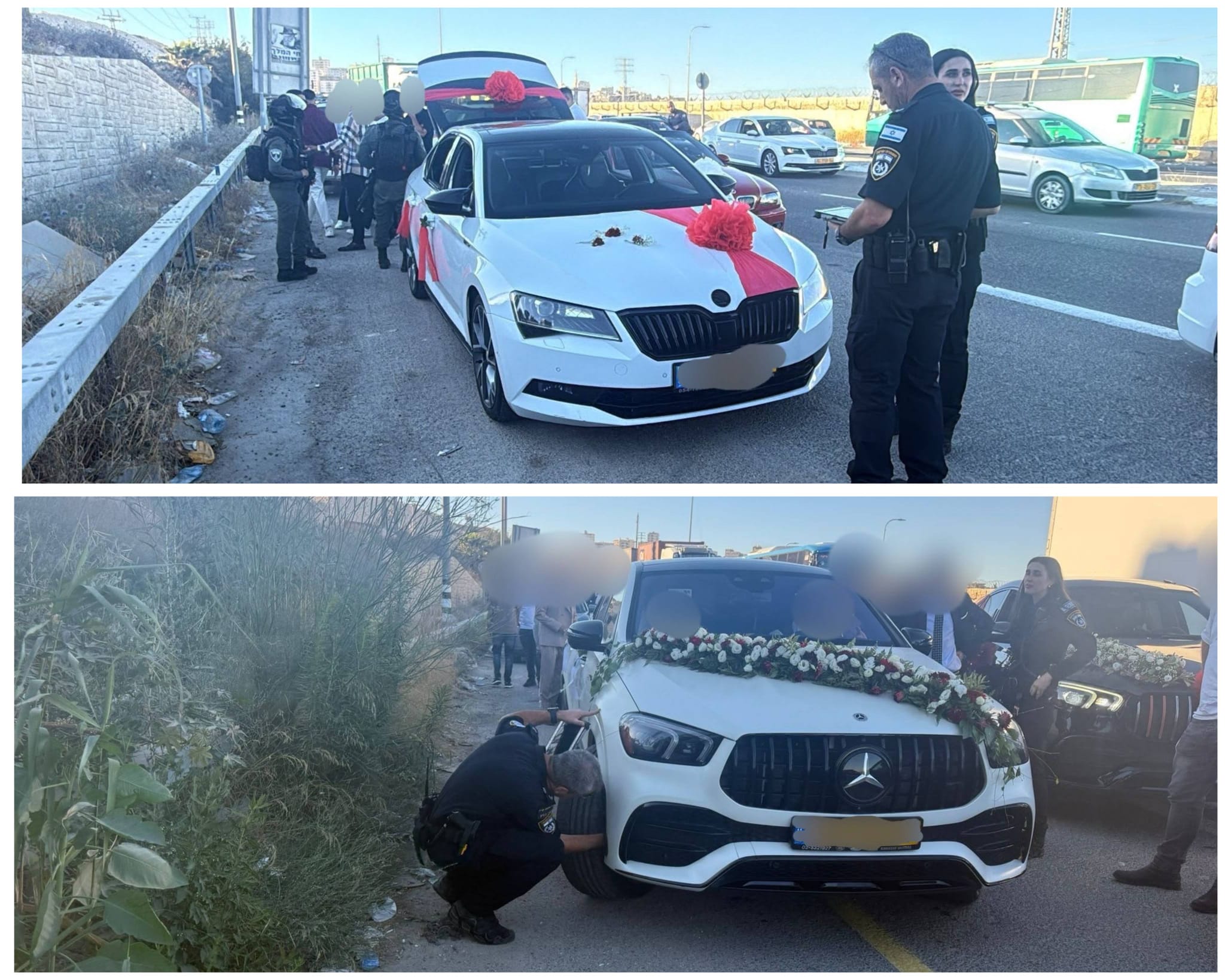
For example, in recent days, according to the Jerusalem District Police, observers at the district control center identified a wedding convoy leaving the neighborhood of Issawiya. According to police, the convoy was driving wildly, endangering road users and disrupting traffic flow. The report was passed to officers in the field, and officers from the Shalem station, together with Border Police fighters, located the convoy, blocked its route and stopped its progress.
How does Jerusalem Police handle wedding convoys?
In that incident, the vehicles were stopped and 15 cars that took part in the convoy were searched. During the operation, three traffic tickets were issued for offenses including environmental violations, an expired license and vehicle defects. The groom himself was detained and taken to the police station for further handling and examination of the circumstances.
The Jerusalem District Police stated: “Celebrations and happy events belong in wedding halls only, not on the roads. The police will continue to act with zero tolerance against road bullying and life-threatening driving, and will use all legal means available to protect public safety and security.”
This story is not just another traffic incident. It reflects one of Jerusalem’s most delicate conflicts: between a community tradition that wants to be seen and heard, and a crowded city where the road is a limited, dangerous and highly charged public resource.