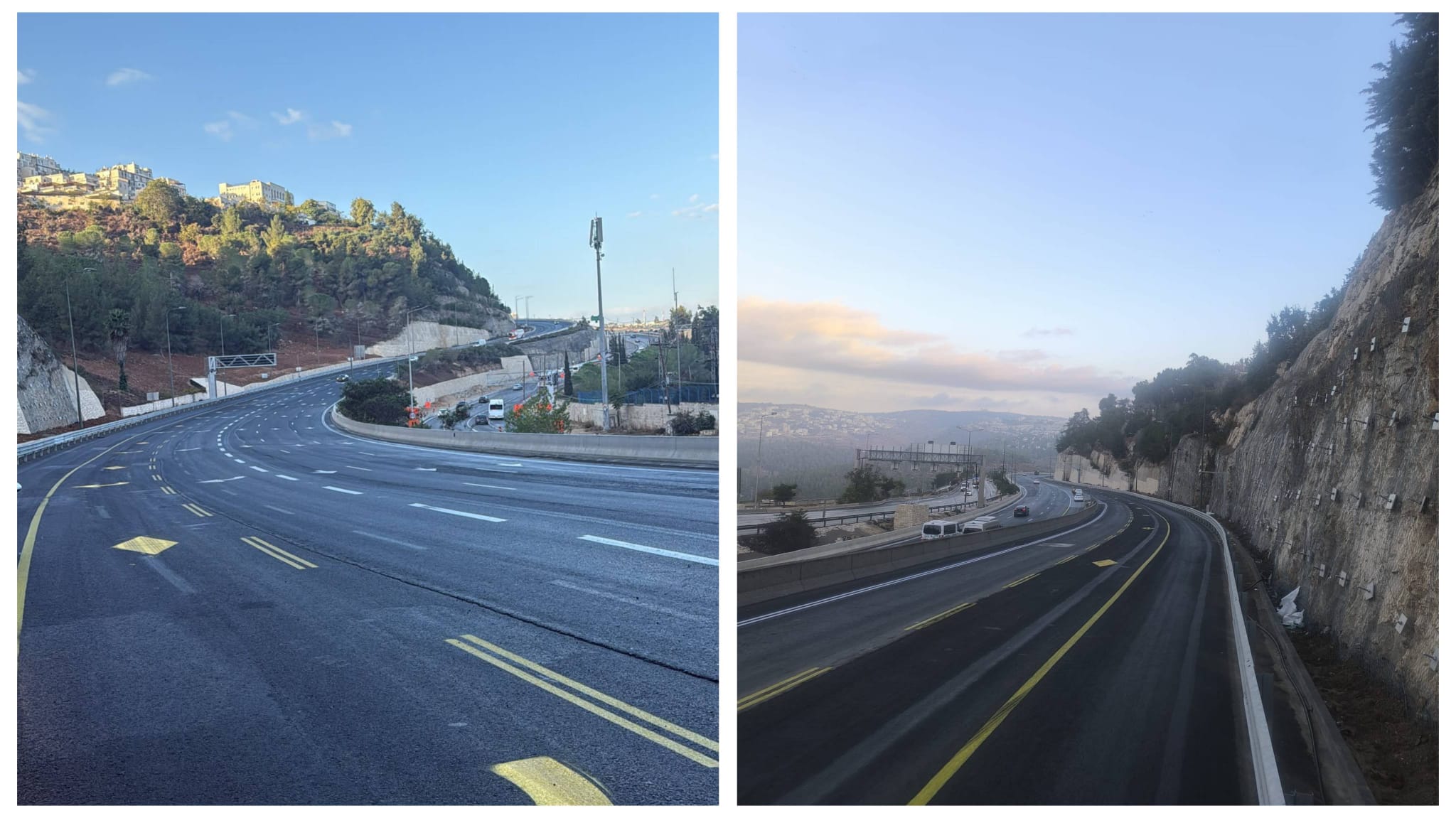
The highway is wider, the asphalt is fresh, and the new road markings stand out. For a moment, it seems that one of Jerusalem’s busiest transportation arteries might finally escape the traffic jams that have become an unavoidable part of daily life. Yet the opening of a new public transportation lane on Begin Highway this week raises a much bigger question: Can adding infrastructure solve Jerusalem’s traffic problems, or is this simply another temporary improvement in a transportation network struggling with deeper structural challenges?
This week, a new dedicated bus lane opened between the Lifta Tunnels and Har Hotzvim, as part of a project led by the Ministry of Transport and Jerusalem Municipality through the Moriah development company. The highway has been expanded from three lanes to four, with the additional right-hand lane reserved for public transportation. In January 2027, the corresponding lane in the opposite direction is expected to open, completing a continuous public transportation corridor stretching more than two kilometers between the Golda Meir Interchange, the Lifta Tunnels, and the exit toward Givat Shaul.
Does Widening Roads in Jerusalem Actually Reduce Traffic Jams?
Transportation research identifies a well-established phenomenon known as “induced demand.” According to this theory, expanding road capacity may initially reduce congestion, but as driving becomes easier, more people choose to use the road. Traffic volumes gradually increase, potentially eroding much of the original improvement. Research suggests that the scale of this effect depends on road conditions, the wider transportation network, and the availability of alternatives.
However, Jerusalem’s latest project differs from conventional highway widening. The new lane is not intended for private cars but for buses. This introduces another principle of transportation planning: Rather than measuring how many vehicles pass through a road, planners should consider how many people the road can transport.
A bus carrying dozens of passengers can move considerably more people than private cars occupying the same amount of road space. A properly functioning dedicated bus lane can therefore increase the highway’s passenger capacity without immediately reducing the number of cars.
But there is another complication. If buses travel quickly through the new lane only to encounter congestion a few hundred meters later, much of the advantage may disappear. Transportation engineers describe this as the bottleneck problem, in which the capacity of an entire network is constrained by its weakest point.
Can a Dedicated Bus Lane Change Commuting Habits?
Behavioral approaches to transportation planning suggest that commuters do not choose how to travel solely according to average journey times. Reliability, frequency, accessibility, and convenience also influence their decisions. A bus that consistently arrives on schedule may be more attractive than one that is occasionally fast but frequently delayed.
This is where the new Begin Highway lane could make a meaningful difference. If passengers can reliably predict their travel times, and if services are frequent and convenient, public transportation may become a more appealing alternative to driving.
Nevertheless, a single bus lane cannot transform commuting habits on its own. Effective neighborhood connections, accessible stops, short waiting times, and enforcement against unauthorized vehicles entering the lane are also essential.
The project also includes a new bridge for public transportation, a bicycle path, and a pedestrian walkway overlooking western Jerusalem. These features reflect an approach designed to reduce dependence on private cars, although their effectiveness will depend on how well they connect to the broader urban transportation network.
Jerusalem Mayor Moshe Lion described the lane’s opening as part of a wider transformation of the city’s transportation infrastructure, emphasizing shorter journeys, reduced congestion, and improved connections between neighborhoods.
Yet the real test will not be the number of lanes added or the length of newly paved asphalt. It will be far more practical and measurable: How many minutes will bus passengers save during rush hour? Will arrival times become more reliable? And what will happen to congestion at nearby interchanges?
The results may be positive for public transportation passengers while remaining much more limited for private motorists. The lane may also demonstrate its full benefits only after the opposite-direction section is completed.
In any case, its opening does not guarantee the end of Jerusalem’s traffic jams. Instead, it offers an opportunity to examine whether the city is beginning to manage transportation according to the number of people it moves, rather than simply the number of cars its roads can accommodate.