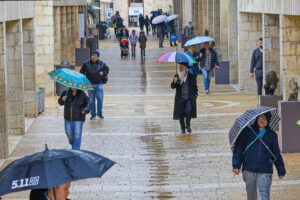
The crowd pressed forward, phones rose into the air, hands reached out, and excited voices echoed through the market. Prime Minister Benjamin Netanyahu’s visit to Mahane Yehuda Market in Jerusalem on Thursday evening, just days before the Knesset elections, looked at times less like an encounter between a politician and citizens and more like a ritual of adoration. In a city where everyday life is far from perfect, some of those gathered appeared to see Netanyahu not as a politician seeking their votes, but as a figure whose status transcends almost any political question.
The enthusiasm was hardly accidental. For years, Jerusalem has delivered enormous electoral strength to Likud and the ultra-Orthodox parties, even as Israel’s national political landscape has experienced repeated upheavals. In the 2022 elections, United Torah Judaism received 23.8% of the city’s votes, Likud 19.11%, and Shas 18.3%. Together, these three parties secured more than 61% of the vote, even before counting additional right-wing parties.
Why Does Benjamin Netanyahu Command Such Deep Loyalty in Jerusalem?
One explanation lies in the psychology of social identity. For some Netanyahu supporters, backing him is no longer simply a political position. It has become part of their personal, family, and communal identity. When criticism of a leader is perceived as an attack on the entire group, a defensive response can follow. The more intense the criticism, the stronger the loyalty may become.
Another factor is cognitive dissonance. Acknowledging the failures of a leader whom someone has defended for years may require a painful reassessment of their own choices. It can feel easier to attribute those failures to political enemies, hostile media, or external circumstances.
Jerusalem also has a deeper sociological dimension. Families, synagogues, neighborhoods, educational institutions, and religious communities can reinforce political affiliations passed down through generations. In such environments, changing one’s vote may be perceived not merely as an individual political decision, but as distancing oneself from the community to which one belongs.
Will Jerusalem Be the Last City in Israel to Change Politically?
It is entirely possible. Jerusalem is far from politically homogeneous. It has a liberal population, a large Arab community, and significant centers of opposition to Netanyahu. Nevertheless, the electoral weight of ultra-Orthodox and conservative communities gives the city an unusually stable political character.
The figures also point to a long-term demographic transformation. According to the Israel Democracy Institute, the combined share of votes for United Torah Judaism and Shas in Jerusalem rose from 22% in 1992 to approximately 42% in 2022. This suggests that the pattern is not simply a political preference that can be overturned by a successful election campaign, but also reflects changes in the composition of the electorate.
Israel may undergo crises, reconsider its priorities, and challenge long-established political assumptions. In Jerusalem, however, the combined forces of identity, demographics, and communal loyalty may significantly slow that process.
And the scene at Mahane Yehuda leaves one particularly uncomfortable question: When a political leader becomes a symbol that cannot be challenged, is the voter still judging those in power, or has the voter become merely another member of the leader’s fan club?