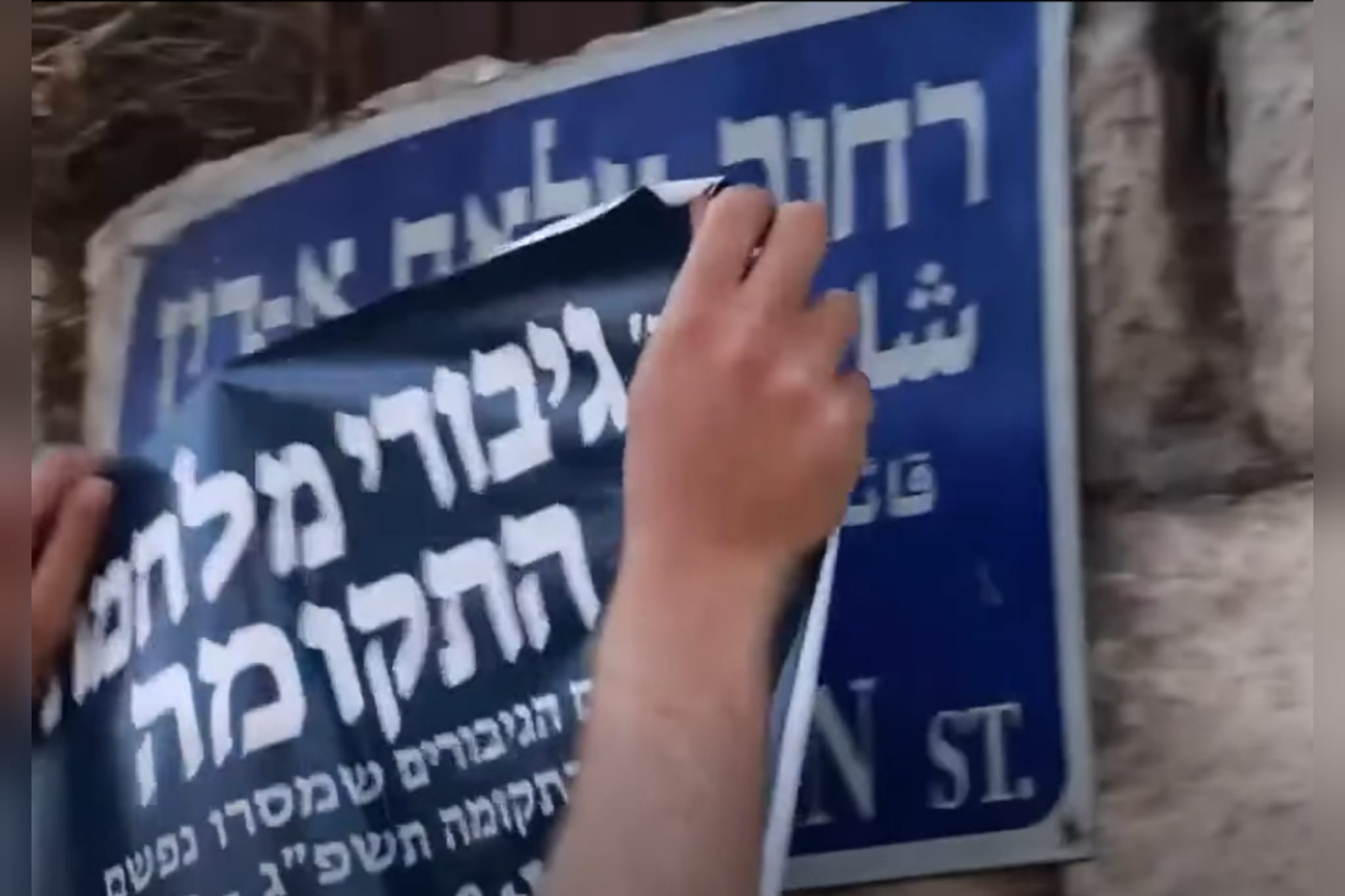
As Israel’s Knesset elections approach, Jerusalem is once again becoming a symbolic battleground over identity and historical narratives. Just days ago, Eliyahu Liebman, a parliamentary candidate for the Noam LeIsrael party and father of Elyakim Liebman, who was murdered at the Nova music festival on October 7, 2023, arrived with approximately 20 supporters on Salah al-Din Street in East Jerusalem. Their action coincided with the 839th anniversary of Saladin’s conquest of Jerusalem. In a symbolic attempt to reshape the historical narrative, the group effectively “renamed” the street by covering its official sign with another bearing the words “Heroes of the War of Revival Street.”
Liebman explained the move in uncompromising terms: “Today marks the anniversary of the beginning of the Muslim occupation of Jerusalem. There is no better opportunity to uproot this memory and put an end to the hope of an invented people to establish an invented state here.”
He continued: “Anyone who commemorates the conqueror admits that the conquest succeeded. Eighty years into the existence of our state, a sign still stands in the heart of our capital telling the enemy: You have reason to hope. Today, we took it down.”
According to Liebman, the objective was to “remove the commemoration of the man who conquered Jerusalem and replace it with a tribute to Israel’s heroes who fell for the people and the state,” including his son.
Liebman also cited a precedent from Haifa in 1951, when the city’s late mayor, Abba Hushi, changed the name of a street to “Heroes Street.”
Knesset member Avi Maoz, who heads the party’s electoral list, also appealed to Jerusalem Mayor Moshe Lion, demanding that the proposed name change be brought before the municipal street-naming committee. The Jerusalem Municipality rejected the request, stating: “We have no intention of changing street names in general, and the name of Salah al-Din Street in particular.”
Why Has Salah al-Din Street in Jerusalem Become a Battleground Over History and Identity?
Saladin, formally known as Salah al-Din al-Ayyubi, was the ruler of the Ayyubid dynasty who defeated the Crusaders at the Battle of Hattin in July 1187. Following a brief siege, he conquered Jerusalem on October 2 of that year. He allowed the Crusaders to leave in exchange for ransom, restored the mosques and returned the city to Muslim rule.
In Palestinian and broader Arab historical memory, Saladin is regarded as a major national hero, symbolizing Muslim unity, the liberation of Jerusalem from “foreign invaders” and the hope of an eventual return. His name appears on streets and institutions and features prominently in narratives of resistance, closely associated with the collective memory of the struggle over the holy city.
On the Palestinian side, the incident has received extensive coverage. The Palestinian Authority’s Jerusalem Governorate described it as part of efforts to “obliterate the Arab and Islamic historical characteristics” of the city and change its street names.
Palestinian media have characterized the action as an “attack on memory” and an “attempt at symbolic ethnic cleansing.”
In Jerusalem, where every street sign carries historical and political significance, particularly during a tense election campaign, Israeli war heroes and a medieval Muslim commander have become opposing symbols in a single struggle over the identity and collective memory of the capital.