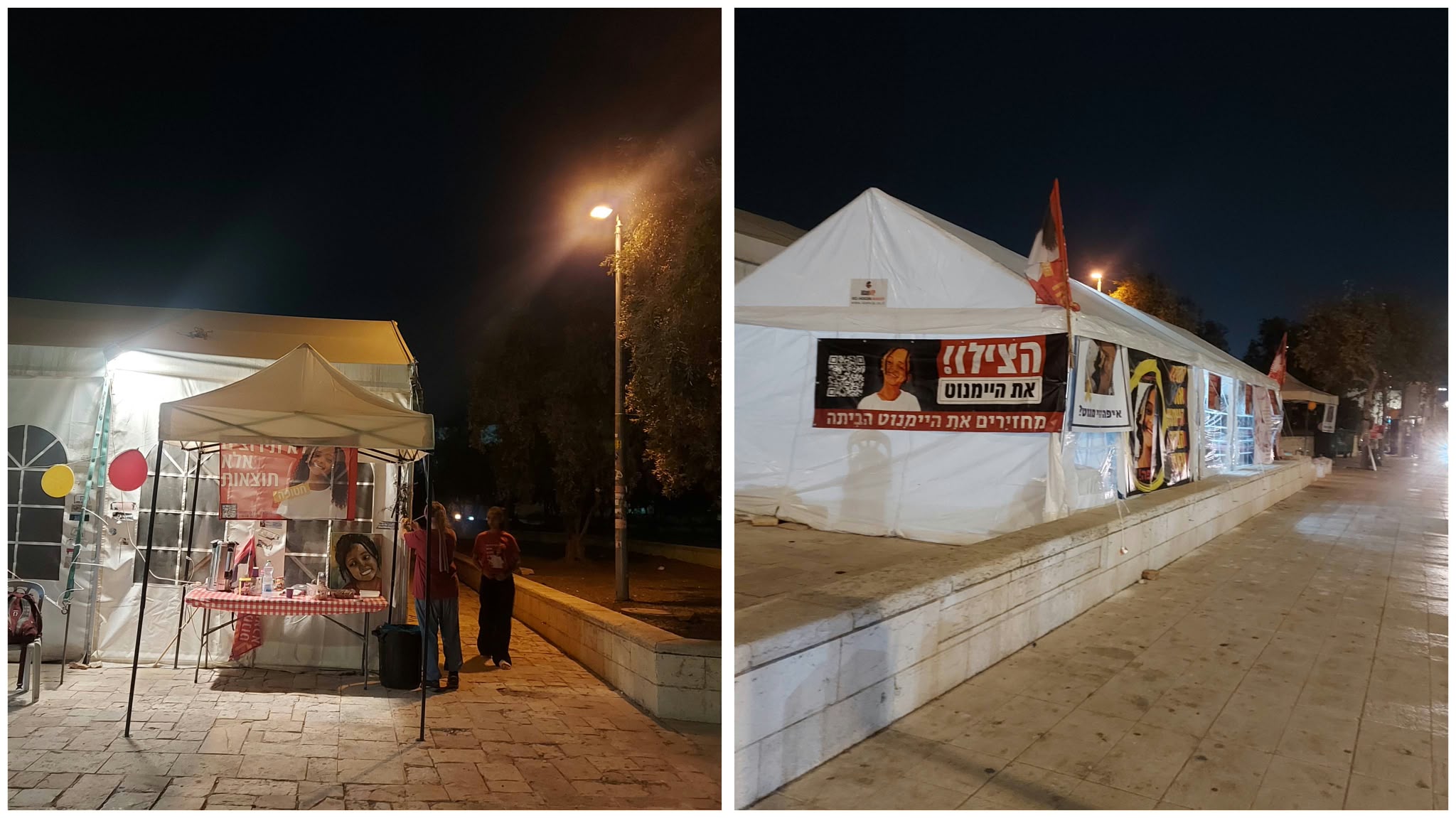
In the heart of Jerusalem, a short distance from the Supreme Court and the centers of government, stands a white protest tent, brightly lit and almost deserted. Photographs of a smiling little girl hang from its walls. Signs demand answers and posters call for her return, but the crowds are nowhere to be seen. There are no waves of demonstrators, no massive rallies, no sense of a national emergency. There is a tent, there is pain, and above all, there is silence. A terrible silence surrounding a missing child.
Her name is Haymanot Kasau. She disappeared on February 25, 2024, at the age of nine, near the absorption center in Safed where her family lived after immigrating from Ethiopia. Nearly two years and eight months have passed. The investigation was transferred to Lahav 433, Israel Police’s national investigative unit, in December 2025. New investigative leads have been examined, but the girl has not been found.
In a country that brought hundreds of thousands into the streets to demand the return of hostages held in Gaza, the contrast is impossible to ignore. That extraordinary capacity for public mobilization, solidarity, and perseverance is barely visible around Haymanot’s protest tent. The circumstances are obviously different, but does one family’s suffering deserve less attention? Does a child need a clearly identifiable enemy, a war, or a national security crisis to become a matter of national concern?
Why Is Haymanot Kasau’s Protest Tent in Jerusalem Almost Deserted?
Photographs of the protest tent in Jerusalem’s Agranat Square tell a disturbing story. White canvas walls, artificial lighting, pictures of Haymanot, and a surrounding public space almost entirely devoid of people. The photographs capture only a particular moment and cannot establish how many visitors arrive throughout the day. Yet they powerfully illustrate the isolation at the heart of this struggle.
The family was even forced to fight for the right to maintain the protest tent. After months of disagreement, a legal petition, and the intervention of Knesset member Pnina Tamano-Shata, the Jerusalem Municipality agreed to allow the encampment to remain until October 22, 2026.
And this raises an even more troubling question: Why must a family whose daughter has vanished also fight for the right to remind the state that she still exists?
Has Israeli Society Turned Haymanot Kasau’s Disappearance Into Something Normal?
Social psychology recognizes a phenomenon known as compassion fatigue, in which emotional responses to suffering gradually weaken and may no longer translate into action. Research suggests that people’s willingness to respond to distress is influenced by how suffering is presented, how strongly they identify with those affected, and the emotional burden they already carry.
But in Haymanot’s case, something else may also be happening: the normalization of disappearance. As the months pass, the fact that a child remains missing gradually loses its perceived urgency. What should constitute an ongoing national emergency becomes another news item, another parliamentary discussion, another photograph hanging from a tent.
Perhaps the militaristic character of Israeli society also plays a role. A society accustomed to defining crises through wars, enemies, and military operations knows how to mobilize when confronted with an unmistakable security threat. But what happens when there is no identified enemy, no battlefield, and no rescue operation for the public to follow? Does a girl who disappears during ordinary civilian life simply fail to fit the national narrative Israelis are accustomed to telling themselves?
Then there is the question of her background. Does the fact that Haymanot comes from an Ethiopian immigrant family affect the degree of public identification with her case? There is no basis for declaring this the sole or even the primary explanation. But in a country where different communities do not enjoy equal public influence or media visibility, the question is hardly unreasonable. It demands examination rather than avoidance.
The family is not entirely invisible. Members of the Knesset, activists, and concerned citizens have rallied to its cause, and parliamentary committees have repeatedly discussed the case. But there is an enormous distance between the determined efforts of a relatively small circle of supporters and the mobilization of an entire society.
In just a few days, the protest tent is expected to be removed from Agranat Square. The white tents may be folded away, the signs taken down, and the photographs removed from public view. Haymanot herself, however, remains missing.
And perhaps this is the cruelest consequence of normalization: Israeli society has not necessarily made a conscious decision to forget Haymanot Kasau. It has simply learned to carry on living without her.