This week, the annual hillula marking the anniversary of the death of Rabbi Chaim ben Attar, known as the “Or HaChaim,” is taking place at the Mount of Olives Cemetery in Jerusalem. He died on the 15th of Tammuz 283 years ago. During Tuesday and Wednesday, tens of thousands visited his burial site at an event organized by the Ministry of Religious Services together with the Cemeteries Council and secured by officers from the Jerusalem District Police.
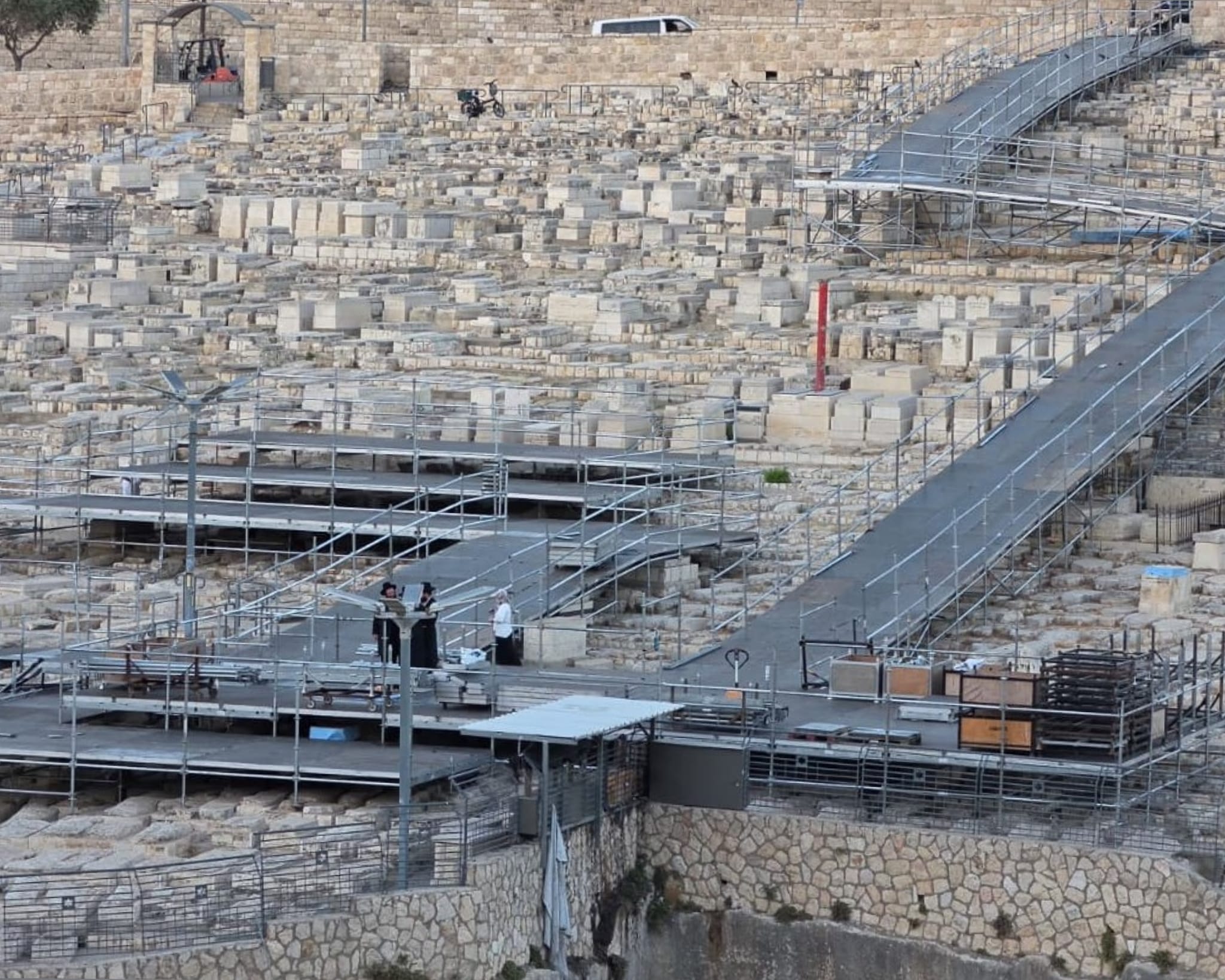
This year, a new measure was introduced with the construction of bridges stretching for dozens of meters across the cemetery. They were designed to allow the large crowds arriving at the grave of the revered “Or HaChaim” on the day of the hillula to reach the site safely, comfortably and with the respect appropriate to the location.
The bridges were built above burial areas to prevent visitors from walking between graves and to allow the public to reach the site without, Heaven forbid, stepping on hundreds of graves along the route. The measure was intended to address the heavy visitor traffic expected during the hillula while preserving the dignity of the dead and maintaining safety at the cemetery.
How many people attended the “Or HaChaim” Hillula in Jerusalem?
This year, apparently due to the relative security calm, a particularly heavy flow of visitors was recorded at the hillula. According to an estimate by Cemeteries Council Director General Tzuriel Krispel, around 112,000 people arrived during the first 24 hours. “We are preparing for thousands more to arrive later tonight and tomorrow,” he added.
As part of the police preparations, officers from the Shalem Station operated alongside uniformed and undercover police forces, Border Police troops, volunteers and emergency and rescue organizations. Their mission was to protect the safety and security of the thousands of participants, allow the event to proceed safely and properly, and maintain public order. Access to the cemetery was available only by public transportation. On the second day of the hillula, the Jerusalem District Police called on the public “to continue following the instructions of police officers and stewards, remain patient and avoid crowding, in order to allow the hillula to continue in a safe, orderly and proper manner.”
Who was Rabbi Chaim ben Attar, known as the “Or HaChaim”?
Rabbi Chaim ben Attar, known as the “Or HaChaim” after his book, was one of the leading biblical commentators of the Acharonim period, as well as a Talmudic commentator, Kabbalist and halachic authority. His best-known work is “Or HaChaim,” his commentary on the Torah. Rabbi Chaim ben Attar spent most of his life, around 40 years, in Morocco. At the age of 43, he immigrated to the Land of Israel. After a period of travel in northern Israel, he settled in Jerusalem and founded his yeshiva, “Midrash Knesset Yisrael.” He died about a year after arriving in Jerusalem at the age of 47 and was buried on the Mount of Olives.
Countless stories describe miracles experienced by Jews who prayed at his grave and committed themselves to studying his Torah commentary. One of the best-known stories concerns Rabbi Hillel Schlesinger, who remained childless for many years. A specialist doctor told him that he would have children “when hair grows on the palm of his hand,” meaning that there was no chance and that further efforts were pointless. In his sorrow, Rabbi Hillel immediately went to the grave of the revered “Or HaChaim” on the slopes of the Mount of Olives. There, in tears, he pledged to study from the book every week. Miraculously, one year later, he held his eldest daughter in his arms.