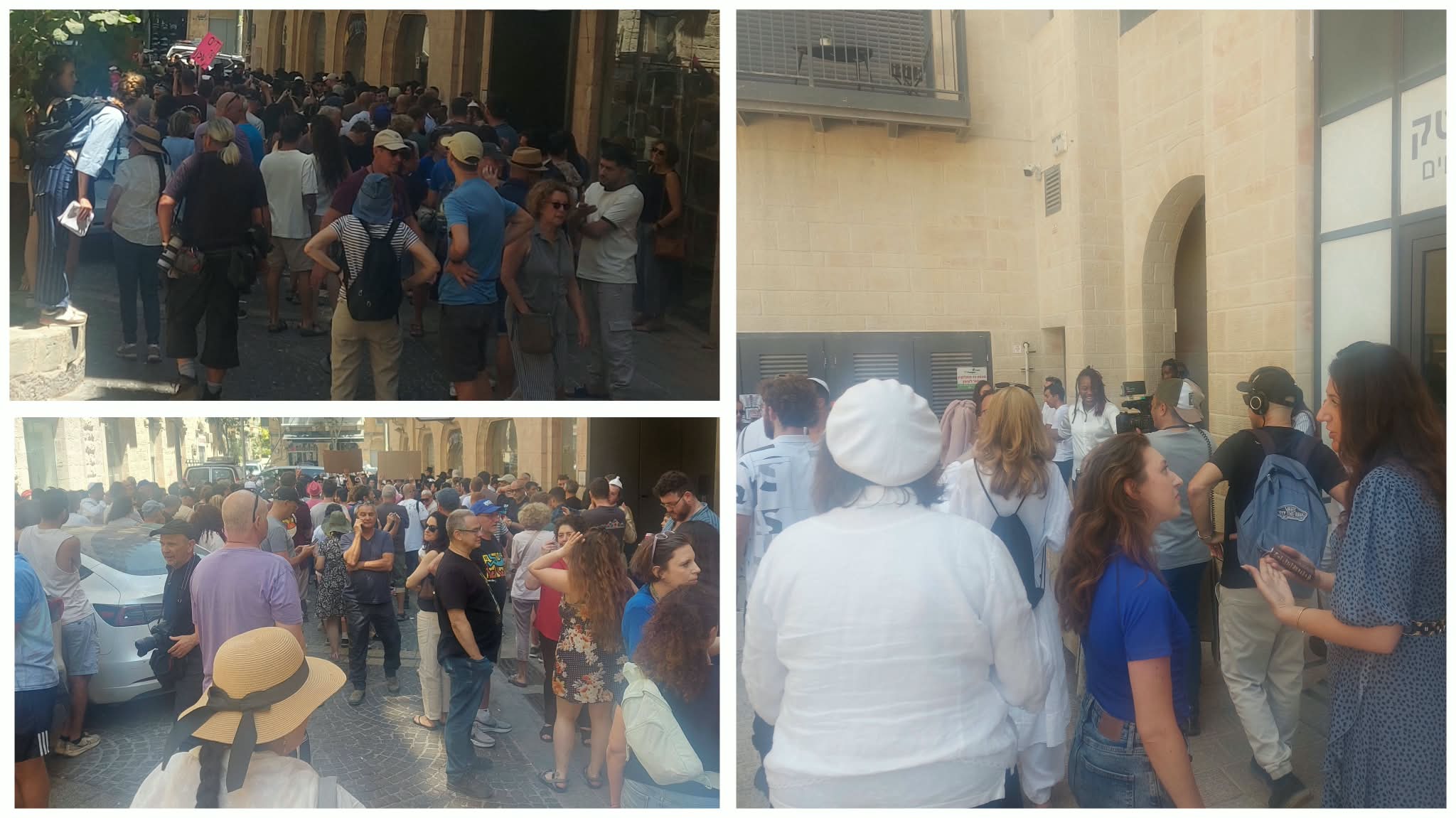
The image left behind by Saturday in Jerusalem is not simply that of a crowded café. It is the image of something beginning to move beneath the surface. On the narrow street outside Hasimta Café stood people who do not necessarily vote for the same party, pray in the same synagogue or observe Saturday in the same way. Secular Israelis, religious liberals, members of the Religious Zionist community, Jerusalem residents and supporters who came from the Tel Aviv area and central Israel all found themselves in the same place. Their common denominator was much simpler: they are tired of retreating.
A large crowd arrived in response to the ultra-Orthodox protest against the café’s opening on Saturday, filling the street and creating a long line at the entrance. Reporters, photographers and content creators also came to document what was happening, as a local dispute over a cup of coffee on Saturday quickly became a much broader picture of Jerusalem and Israel. Media figures and online creators were present as well, among them Asaf Gotthelf. And here too, the message is becoming sharper: there is less and less room for conservative, polite and overly gentle media that smooths over every confrontation and fears every strong formulation. When society is facing a genuine conflict, journalism cannot whisper forever. It has to say clearly what is happening.
Why is the struggle around Hasimta Café in Jerusalem no longer only about opening a business on Saturday?
Because the coffee is only the surface. Beneath it lies anger that has accumulated for years over the relationship between the ultra-Orthodox community and other parts of Israeli society. The struggle over ultra-Orthodox military service has made that frustration even more intense. Secular and religious Israelis who serve, send their children to the army, work and pay taxes are increasingly asking why shared responsibility seems to stop at the same point again and again.
Money is part of that frustration as well. The criticism is not only about military service, but about a system in which the state continues to fund institutions, allowances and services for communities in which significant groups resist full participation in civic obligations. The figures and solutions can be debated, but the anger itself is becoming harder to ignore. On Saturday, it acquired faces, bodies and a long line outside a Jerusalem café.
That is what makes the event so interesting. This is no longer simply a front of “secular Israelis against the ultra-Orthodox.” When Religious Zionists, religious liberals and secular Israelis stand on the same street, the story changes. It becomes an unofficial social coalition of people who may disagree on almost everything, but are beginning to agree on one boundary: rights cannot be discussed without also discussing responsibility.
Does Hasimta Café mark a deeper change in Jerusalem?
It is too early to declare a revolution, but places where revolutions begin rarely look revolutionary at first. Sometimes it is a university. Sometimes a square. And sometimes it is a small café in Jerusalem that decides to open its doors.
This is also a moment that is not meant for cowards. Not for politicians who tell every audience exactly what it wants to hear, not for those who change direction the moment the political price rises, and not for media that softens every confrontation until it loses its meaning. Anyone who believes Israeli society needs a new contract between its different communities will eventually have to say so without hesitation.
On Saturday, for at least a few hours, very different people said exactly that simply by showing up.