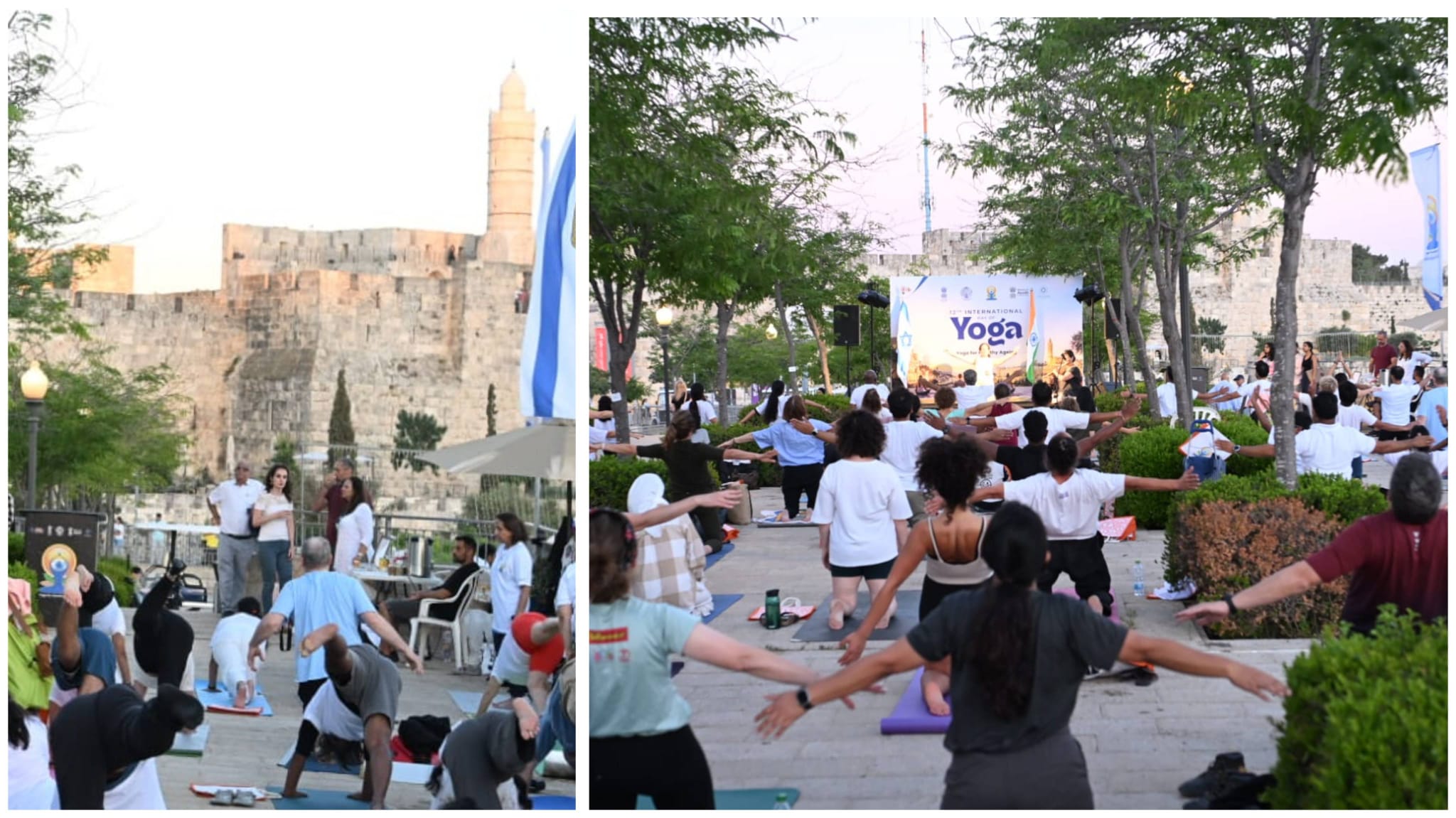
Hundreds of participants recently spread their mats across the Mamilla complex, facing the walls of Jerusalem’s Old City. The gathering, held as part of International Yoga Day, has already ended, but the striking scene raised a broader question: could Jerusalem become an international capital of yoga rather than merely host one major event each year?
The open-air session was led by Dr. Yael Yitzhak-Idan, accompanied by Ofra Avni playing the bansuri, a traditional Indian flute. Members of Israel’s diplomatic community joined residents and visitors, while the evening concluded with a classical Indian dance performance. The combination of yoga, live music, Indian culture and Jerusalem’s historic skyline demonstrated how a local event could acquire a distinctly international character.
Why is Jerusalem suited to becoming a global yoga destination?
Jerusalem offers an advantage that few cities can match: a spiritual identity recognized across the world. Visitors already arrive in search of meaning, reflection and a connection to ancient traditions. Yoga sessions overlooking the Old City walls, at the Haas Promenade, in the Jerusalem Botanical Gardens, the Gazelle Valley or the surrounding hills could become distinctive tourism experiences.
The city’s climate also allows outdoor activities during much of the year. Jerusalem has hotels, cultural institutions, international communities and a growing network of yoga instructors. Connecting these elements could support retreats, festivals, workshops and wellness packages for visitors from Israel and abroad.
Jerusalem Mayor Moshe Lion described the city as a place “that connects people, cultures and traditions.” He said International Yoga Day offers an opportunity “to pause for a moment, connect with body and mind, and strengthen the sense of community and partnership.”
What could prevent Jerusalem from becoming a yoga capital?
Potential alone is not enough. Security tensions and periods of war repeatedly damage incoming tourism and make it difficult to plan international events over the long term. High accommodation prices, complicated transportation and a shortage of large venues designed specifically for wellness activities may also discourage organizers and visitors.
A successful annual gathering does not automatically create a tourism industry. Jerusalem would need a permanent calendar of events, cooperation with hotels, yoga centers, tour operators and embassies, and consistent international promotion that does not depend on a single celebration.
The city’s religious and political sensitivities could create another challenge. Large outdoor events require careful coordination so that they remain accessible to different communities while respecting the character of the places in which they are held.
Could yoga also strengthen Jerusalem’s resilience?
India’s ambassador to Israel, J. P. Singh, said yoga can support healthy aging and improve the ability to cope with stress. He referred to research conducted at Hillel Yaffe Medical Center, where researchers described yoga as a “psychological Iron Dome” for medical professionals who practice regularly.
In a city that frequently experiences tension, yoga could become more than a tourism product. It may serve as a community tool that creates moments of calm and brings together residents from different backgrounds. Jerusalem already possesses the scenery, history and spiritual significance. The real question is whether it can turn those advantages into a lasting international vision.