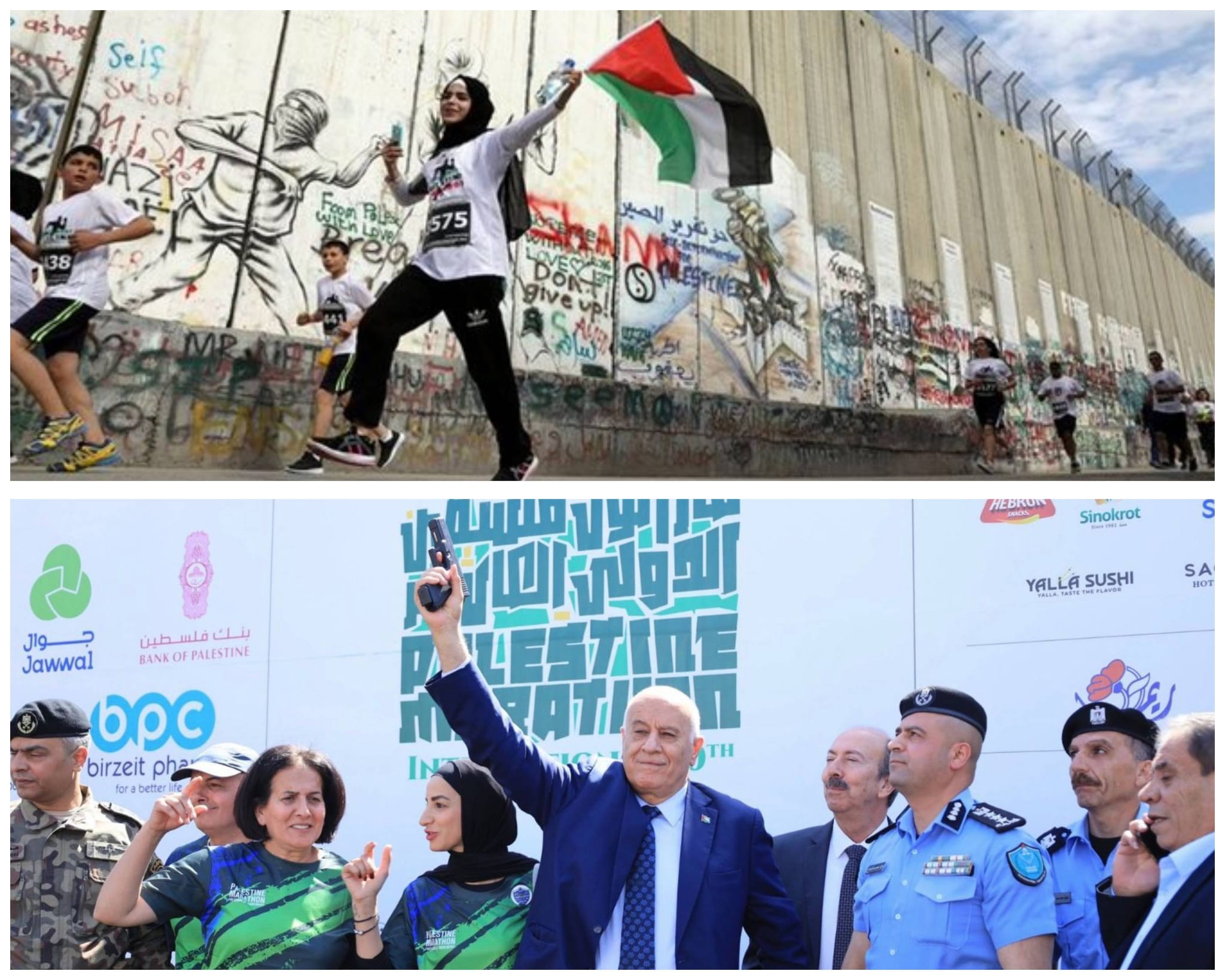
Yesterday, Friday, the 10th Palestinian Bethlehem Marathon took place. The race, seen as the Palestinian response to the Israeli Jerusalem Marathon, ran for large sections alongside the separation barrier, bordering Jerusalem neighborhoods on the other side. More than 10,000 runners participated in the event, including around 1,000 international runners from 75 countries worldwide. At the same time, a special marathon stage was held in the Gaza Strip.
This year’s race was held after a two-year suspension due to the war in Gaza. The event was organized by several official and municipal Palestinian bodies, led by the Higher Council for Youth and Sports headed by Jibril Rajoub, who also fired the starting gun for the race.
Why Did the Separation Barrier Become Part of the Marathon Route?
The marathon started and ended at Manger Square, near the Church of the Nativity in central Bethlehem. The 21-kilometer route passed through Monastery Street, alongside the separation barrier, through the Aida and Dheisheh refugee camps, and toward the town of Al-Khader, where runners turned back along the same path. The route was deliberately designed to illustrate the geopolitical reality in the area, with organizers arguing that there is no uninterrupted 42-kilometer Palestinian route without Israeli checkpoints. Full marathon runners therefore had to complete the same course twice.
The marathon was held under the slogans “Run for Freedom” and “Unity of the Homeland.” Along the other side of the barrier, the race route bordered Jerusalem’s Gilo neighborhood and southern city roads such as Hebron Road and the area near Checkpoint 300. From the course, runners could see the towers of Har Homa and the Rachel’s Tomb compound, surrounded by a high wall separating it from Bethlehem’s main street where participants were running.
Why Was the Bethlehem Marathon Created in Response to the Jerusalem Marathon?
The International Jerusalem Marathon was founded in 2011. Two years later, in 2013, the first Palestine Marathon was launched in Bethlehem. The Palestinian organizers, including two Danish women who founded the “Right to Movement” initiative, openly stated that the Bethlehem marathon was meant to present “the other side” of the story.
While the Jerusalem Marathon is promoted in Israel as a sports and tourism event uniting both parts of the city, Palestinians viewed it as a political tool reinforcing Israeli sovereignty in East Jerusalem. The Bethlehem Marathon was created as a counter-platform highlighting what organizers describe as the lack of Palestinian freedom of movement.
When Israel markets the Jerusalem Marathon internationally, it does so under the branding of “running through history.” Palestinians established the Bethlehem Marathon to send a different message to the world: “It is impossible to run a real marathon in the Palestinian territories without encountering a wall or a checkpoint.” Unlike the Jerusalem Marathon, which highlights open landscapes and mountainous scenery, the Bethlehem race was intentionally designed around refugee camps and the separation barrier to create a sharp visual contrast to the Israeli narrative.