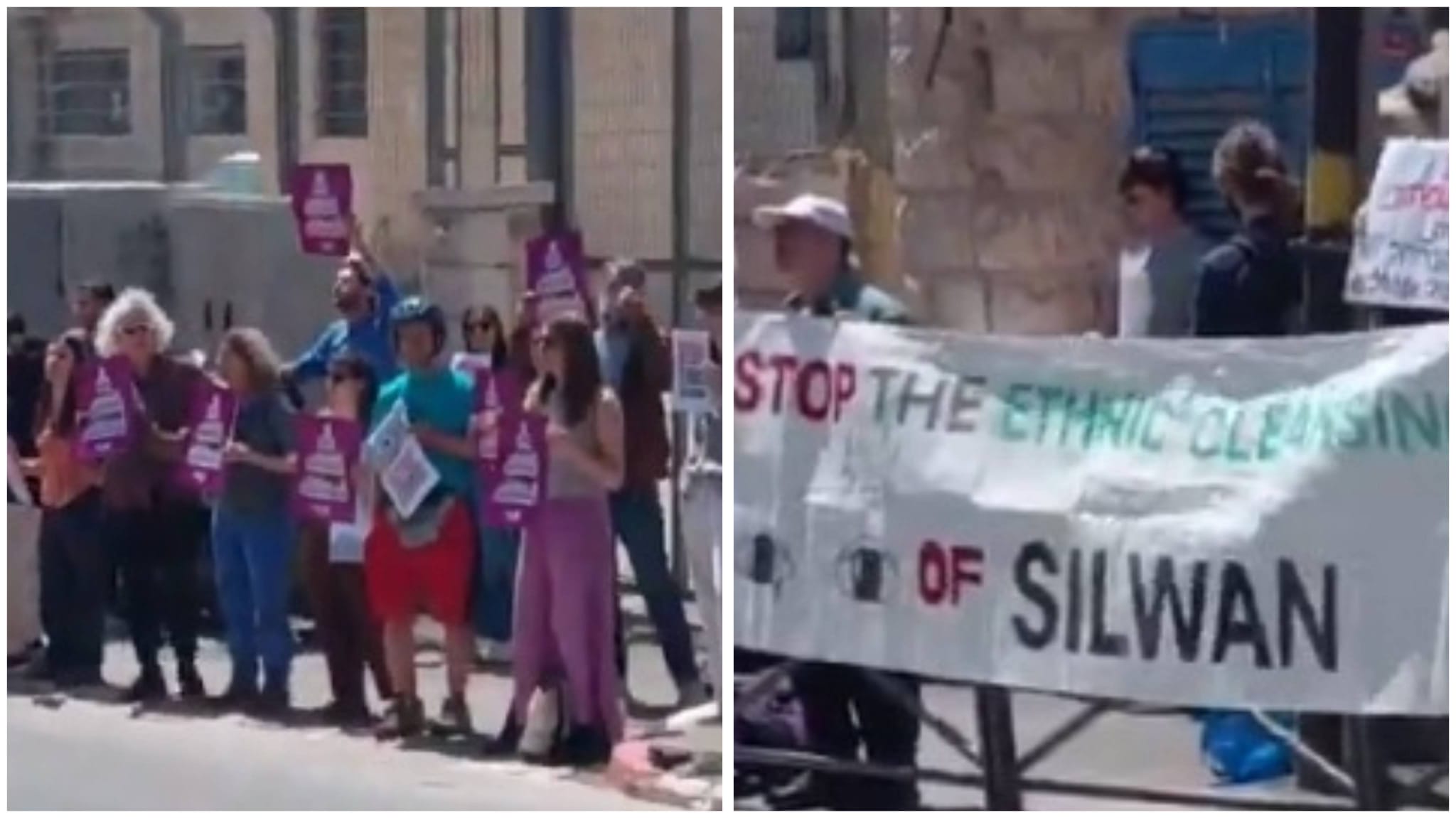
On Tuesday this week, a further hearing was held at the Jerusalem District Court regarding objections filed by residents of the Al-Bustan neighborhood in the Silwan area of East Jerusalem against demolition orders issued for their homes by the Jerusalem Municipality. At the same time, a protest vigil involving several dozen people took place outside the court under the slogan: “Stop the ethnic cleansing campaign in Silwan”.
The court has not yet issued a decision, but according to the residents’ attorney, Omar Samari, the judges expressed dissatisfaction over the fact that about two weeks ago the municipality demolished 13 homes without prior warning and without granting residents a right to a hearing. On Wednesday, the day after the hearing, the municipality returned and demolished another house in the neighborhood – the home of Saleh Dweik and his wife, “Um Kamal”, a couple in their 80s.
What is behind the struggle over Al-Bustan in Jerusalem?
This is another episode in a saga that has been ongoing for more than 15 years: on one side stands the Jerusalem Municipality, which seeks to establish the “King’s Garden” project and claims the homes were built without legal permits. This position is supported by right-wing groups. On the other side are neighborhood residents, joined by left-wing organizations, who view the demolitions as part of a broader effort to “Judaize” Jerusalem and push out its Palestinian residents.
אזור "גן המלך", סילוואן, ירושלים pic.twitter.com/6fjJBZ2BQb
— jerusalem online (@Jlmonline) April 15, 2026
What is the King’s Garden project planned for Jerusalem?
The King’s Garden project is a municipal plan to create a public archaeological, historical and tourism park in Silwan. First proposed in 2010, the plan aims to reconstruct the biblical gardens of the Kings of Judah in the Al-Bustan area, based on traditional identification of the site as the “King’s Garden” mentioned in the Books of Nehemiah and Kings. However, many archaeologists note that there is no conclusive evidence pinpointing the garden’s exact location here.
According to supporters, the project is intended to form a “tourism ring” around Jerusalem’s Old City, linking the City of David (managed by the Elad organization) with additional sites in Silwan, the Hinnom Valley, the Kidron Valley, the Mount of Olives, and the Armon Hanatziv promenade. Plans include open green areas, orchards, restaurants, commercial spaces, and traditional craft workshops.
Since the 1967 Six-Day War, the land has been designated as open space (Outline Plan 9), preventing Palestinians from obtaining building permits there. Residents and supporting left-wing groups argue that this designation is political, aimed at justifying the denial of permits to limit neighborhood expansion. In their view, the demolitions in Al-Bustan are not about planning enforcement but part of a systematic and ongoing displacement of a Palestinian community from its homes, as part of a broader policy of reshaping the demographic landscape in East Jerusalem. The municipality plans to establish a national park on the ruins of the Palestinian community of Al-Bustan – a move that would create territorial continuity for Israeli presence in Silwan, isolate Palestinian neighborhoods, and alter the character of the area.
Efforts to reach agreements between the municipality and residents have been ongoing since 2010, but both sides have rejected each other’s proposals. Dozens of structures in the area, including residential buildings, are currently slated for demolition.