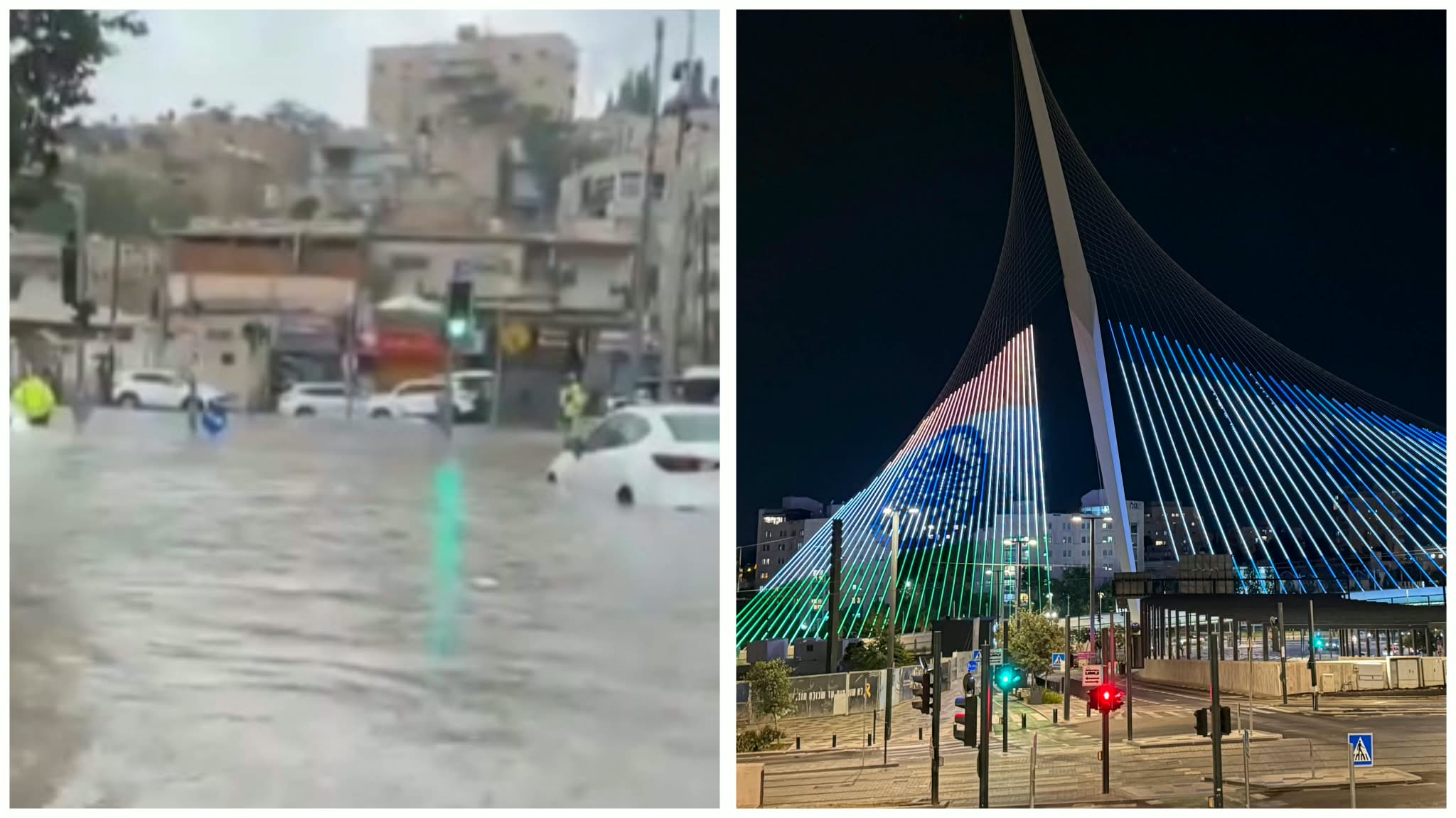
There are days when Jerusalem provides its own irony without any help. On Saturday night, the Jerusalem Municipality illuminated the Chords Bridge, one of the capital’s most recognizable landmarks, in the colors of the Israeli and Indian flags to mark 79 years of Indian independence. It was a festive, colorful and respectful gesture toward a country that has become one of Israel’s close partners in recent years.
But on that very same Saturday, a completely different Jerusalem was on display. Unexpected August rain hit the city, and in parts of East Jerusalem, flooded roads quickly became a scene difficult to reconcile with the phrase “Israel’s capital.” Cars tried to make their way through the water, streets disappeared beneath the flooding, and for a moment it was hard to tell whether the footage had been filmed in Jerusalem or in a city where basic infrastructure is still treated as optional.
Why Did August Rain Turn Streets in East Jerusalem Into Rivers?
The rain may have been unusual for the season, but the infrastructure gaps in East Jerusalem are nothing new. For years, parts of the eastern side of the city have dealt with outdated or missing infrastructure, poor road conditions, drainage problems and municipal systems that do not always cope well under pressure. Every strong burst of rain becomes an immediate stress test, and when the systems fail, the result becomes visible within minutes.
That is precisely what made the contrast on Saturday so striking. On one side, Jerusalem knows how to illuminate a bridge perfectly, send a diplomatic message and produce an impressive international gesture. On the other, only a short distance away, residents find themselves dealing with flooded streets and the feeling that they are living in an entirely different city.
How Can Jerusalem Be Dug Up Everywhere and Still See No Light at the End of the Tunnel?
The irony becomes even sharper when looking at the city as a whole. Jerusalem has become a massive construction zone in recent years. Roads open and close, routes change, lanes shift, major arteries are dug up and infrastructure is replaced almost everywhere. Anyone driving through the city knows the feeling that there is hardly a street untouched by a tractor, barrier or construction fence.
There is no doubt that much of this work is intended to solve real problems and improve the city in the long term. But for residents, Jerusalem still appears far from the point where everything finally comes together into a modern and functioning urban system. The city remains dug up, congested and dusty, and in some areas even a short spell of rain is enough to show just how long the road ahead still is.
Jerusalem Mayor Moshe Lion noted that “Jerusalem, the capital of Israel, is proud to mark India’s 79th Independence Day and to join the celebrations of an important ally and partner of the State of Israel. The close relations between Israel and India, and with its Prime Minister Narendra Modi, are based on deep friendship, shared values and a warm relationship that has continued to strengthen over the years. On behalf of Jerusalem and its residents, I wish India a happy Independence Day and hope that the strong bond between our countries and peoples will continue to grow for many years to come.”
A beautiful gesture, and the illumination was certainly impressive. But on the same day, Jerusalem produced another gesture, this time unintentionally: while the Chords Bridge wore the colors of India, only a few kilometers away parts of East Jerusalem looked like a third-world city of their own.