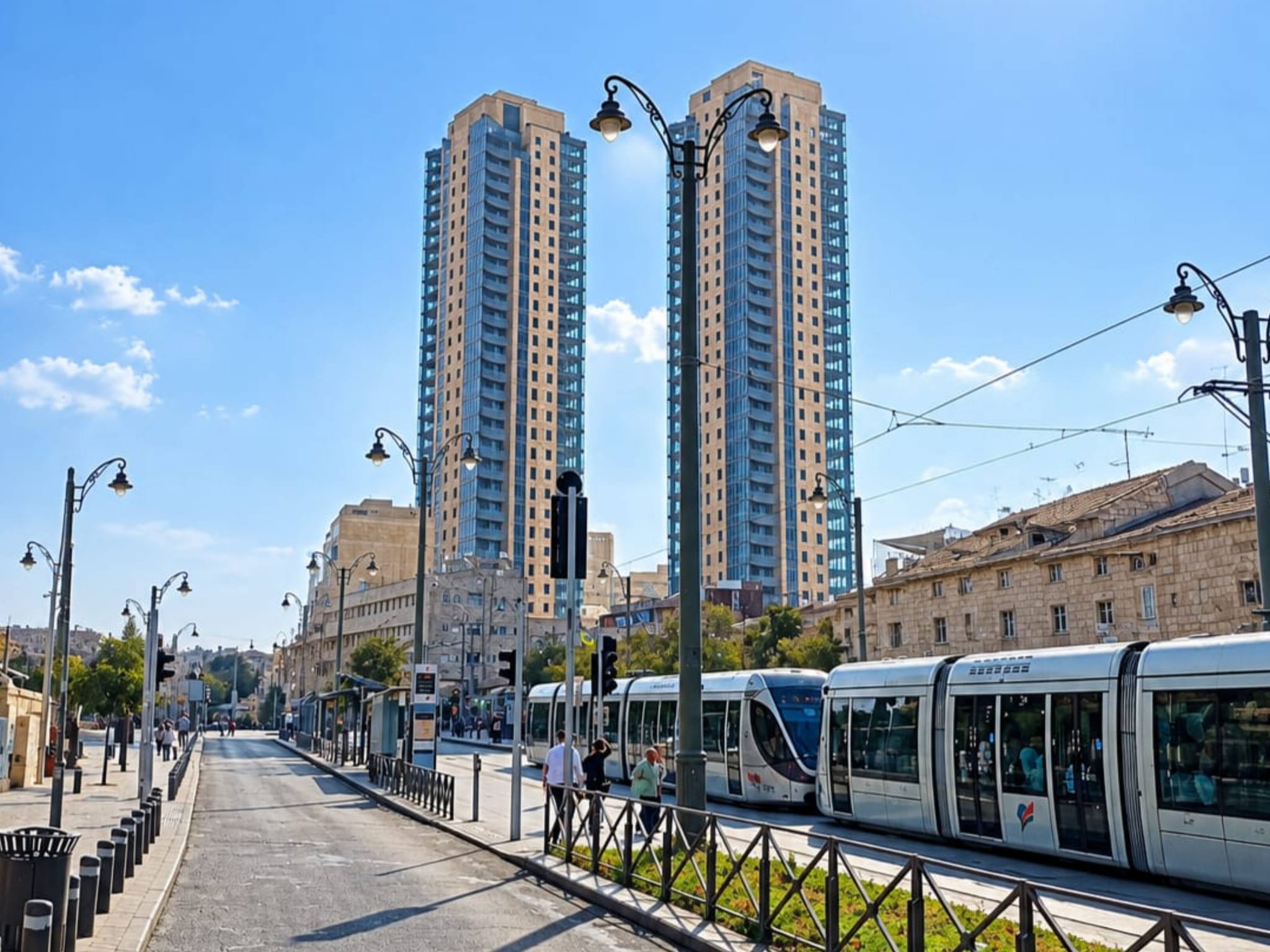
There is something deeply paradoxical about opposition to high-rise residential construction in central Jerusalem. On one hand, residents complain about soaring apartment prices, housing shortages and young people struggling to remain in the city. On the other, when hundreds of new homes are built in desirable neighborhoods, critics warn that the city’s character is being destroyed. Yet economic research suggests the opposite problem: restricting housing supply can make an already expensive housing market even less affordable.
The recently approved occupancy of the Etz Haim residential project, comprising two 30-story towers and 308 apartments near Mahane Yehuda Market, illustrates an alternative approach. Organized by the BSR Group and constructed by Ashtrom, the development includes two- to four-room apartments and penthouses. Its location beside Jerusalem’s light rail reinforces the urban planning logic of concentrating housing in established commercial centers with existing public transportation infrastructure.
Can Building More Residential Towers Actually Lower Housing Prices?
Economic research indicates that substantial additions to housing supply can reduce prices or slow their growth, even when newly constructed apartments are expensive.
A study by researchers Brian Asquith, Evan Mast and Davin Reed, published in The Review of Economics and Statistics, found that large new apartment developments reduced rents in nearby buildings by approximately 6% compared with the study’s control groups.
The underlying mechanism is relatively straightforward. Households moving into newly constructed apartments leave behind existing homes, making those properties available to other residents. This creates a chain of residential moves that expands housing opportunities beyond the new development itself.
Other studies support the broader conclusion that increasing housing supply can ease market pressures. Nevertheless, 308 apartments alone cannot be expected to make housing significantly cheaper across Jerusalem.
Why Does High-Rise Construction Make Sense in Central Jerusalem?
Transit-oriented development is an established urban planning approach that encourages residential density near rail stations, employment centers and commercial districts.
Such development can reduce dependence on private vehicles, improve land-use efficiency and limit urban expansion into undeveloped areas.
The OECD has also highlighted connections between restrictive construction regulations, constrained housing supply and higher property prices. Preserving an urban landscape through sweeping height restrictions therefore carries economic consequences. Restrictions intended to protect a city’s appearance can also make housing less accessible, particularly to lower-income households.
The Etz Haim project also demonstrates how large-scale residential construction can coexist with architectural preservation.
Two historic buildings were retained within the development: the former Etz Haim yeshiva building and an old kindergarten. The kindergarten structure, weighing approximately 3,000 tons, was raised using hydraulic jacks to allow underground parking construction while preserving the historic building.
Designed by architect Ian Bader in collaboration with Barely Levitzky Kassif Architects and Urban Planners, the project illustrates an approach that accommodates additional housing without necessarily erasing historical structures.
Jerusalem Mayor Moshe Lion noted that “adding housing units near Mahane Yehuda Market, alongside developing the urban environment and preserving historical heritage, helps strengthen the city center and make it an attractive place to live, work and spend leisure time.”
Ultimately, the debate over Jerusalem’s residential towers should be grounded in economic evidence rather than nostalgia alone.
Architectural design, building height and their effects on surrounding streets deserve scrutiny. But the economic costs of restricting construction cannot simply be ignored.
Making Jerusalem more affordable requires substantial housing development supported by adequate transportation, infrastructure and public services. The Etz Haim towers are not a miracle solution, but they represent a planning direction supported by economic and urban research.