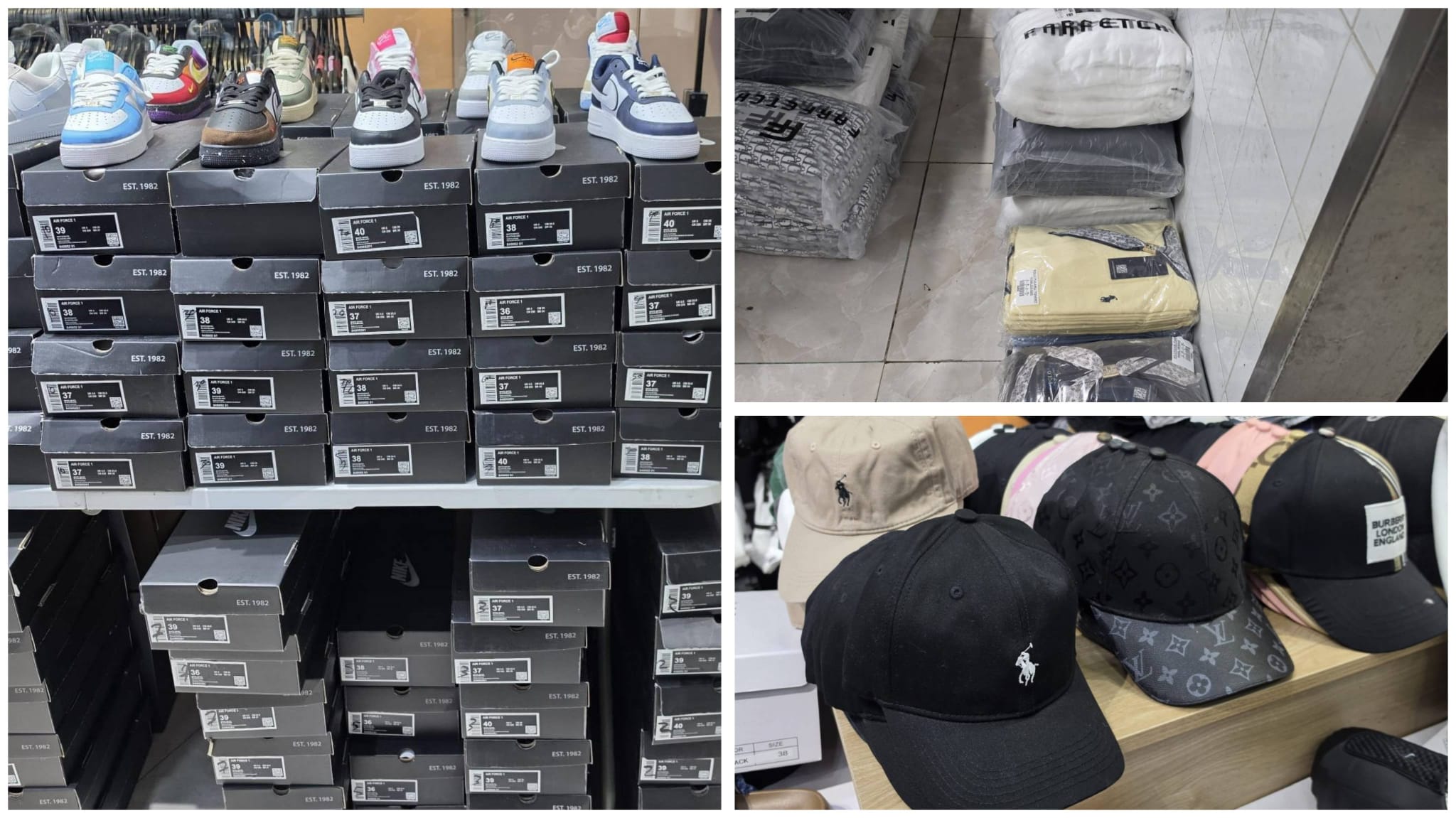
The store at Jerusalem’s Cinema City complex was familiar to many customers. They entered, examined clothing and accessories carrying the names and logos of international brands, paid and left believing they had found an unusually good bargain.
That is why some customers were surprised when police announced that suspected counterfeit merchandise worth an estimated NIS 250,000 had been seized during a joint operation with an intellectual property enforcement organization.
Others were far less surprised. In their view, the gap between the prices charged in the store and the normal prices of authentic branded products was too large to be explained by a sale, surplus stock or parallel imports. The unusually low prices, they argued, should already have raised doubts about whether the goods were genuine.
The question left behind by the seizure is not limited to one store. Has Jerusalem become a particularly convenient market for counterfeit brands, and does their alleged sale inside a major commercial complex suggest that the phenomenon is no longer confined to street stalls and hidden warehouses?
Nike, Adidas and Louis Vuitton: How Large Is the Global Counterfeit Market?
Counterfeit brands are neither a uniquely Jerusalem nor an exclusively Israeli phenomenon. The global trade in fake products is worth hundreds of billions of dollars and represents a significant share of international commerce.
Shoes, shirts, handbags, watches and perfumes carrying the logos of famous companies are sold in markets, stores, online marketplaces and through social media accounts around the world.
Counterfeiting is also no longer limited to fashion. Authorities regularly seize fake cosmetics, toys, vehicle parts, medicines and electrical products. When the item is clothing, the damage is often seen mainly as economic. In the case of skincare products, medicines or electrical components, however, counterfeiting can also pose health and safety risks.
A major change has taken place in distribution methods. Alongside traditional markets, tourist districts and commercial centers, a growing part of the trade has moved to online shops, social media and small postal shipments. A business may therefore appear local and ordinary even when its merchandise has traveled through a complex international supply chain.
Gucci, Chanel and Zara: Why Do Consumers Buy Counterfeit Brands?
Not every customer who buys a counterfeit product has necessarily been deceived. In some cases, the buyer knows, or at least suspects, that the item is not authentic but chooses not to ask too many questions.
The logo still offers part of the social experience associated with the brand, without the high price attached to the genuine product.
Brands have become a way to display status, success, taste and belonging. Yet exposure to luxury labels has expanded much faster than many consumers’ ability to afford them. Social media presents young shoppers with expensive wardrobes, constantly changing shoes and new accessories every season.
The counterfeit product appears to offer a solution to the gap between a person’s real standard of living and the lifestyle displayed on their screen.
The decision to buy a fake product is influenced not only by income, but also by price, product type, the perceived risk of being caught and society’s attitude toward counterfeiting. When the surrounding culture does not consider it a serious offense, the line between a bargain and deception becomes increasingly blurred.
In some parts of the world, buying a counterfeit item has become almost part of the experience of visiting a market. Elsewhere, the practice is hidden behind terms such as “inspired by,” “surplus,” “top grade” or “made in the same factory.”
The culture varies from one country to another, but the basic principle remains similar: Consumers want the symbol, even when they cannot or do not wish to pay the original price.
Counterfeit Brands in Jerusalem: Do Low Prices Reflect Economic Decline?
The presence of counterfeit goods does not, by itself, prove that a city is experiencing economic decline. Fake products are also sold in wealthy cities, global fashion capitals and popular tourist destinations.
In some cases, a large concentration of tourists, young shoppers and consumers seeking famous labels makes a city particularly attractive to counterfeit sellers.
Nevertheless, growing demand may reflect financial pressure. When housing, food and transportation costs rise, disposable income falls, but the desire to participate in consumer culture does not disappear.
Jerusalem contains modern shopping centers alongside economically weaker neighborhoods, a young population and many large households. This combination may create a natural market for products that offer a prestigious appearance at an affordable price, even when their authenticity is doubtful.
The more worrying sign is not the existence of a counterfeit item, but its transformation into an open and routine part of commerce. When shoppers become accustomed to seeing famous international logos sold at implausibly low prices, without asking where the merchandise came from, the counterfeit market gradually gains legitimacy.
Counterfeit Brands at Jerusalem Cinema City: Was This Only One Store?
Police said the operation was carried out as part of efforts to combat offenses that harm intellectual property rights and legitimate commerce. Yet one seizure, regardless of its size, is not enough to determine the full scale of the phenomenon in Jerusalem.
Establishing whether the city is truly flooded with counterfeit brands would require long-term figures, including the number of seizures, the value of the merchandise, the number of investigations and indictments, and information about stores, markets and shipments entering the city.
The location nevertheless matters. This was not a hidden warehouse in an industrial zone or a temporary street stall, but a store regularly visited by customers inside a major commercial complex.
That is precisely what turns the case from an isolated police report into a wider urban question.
Jerusalem may not have more counterfeit products than other cities. It is also possible that enforcement operations reveal only a small part of a market already embedded in local shopping habits.
Between those possibilities stands the consumer, looking at the low price, recognizing the famous logo and sometimes deciding not to investigate whether the product is real.