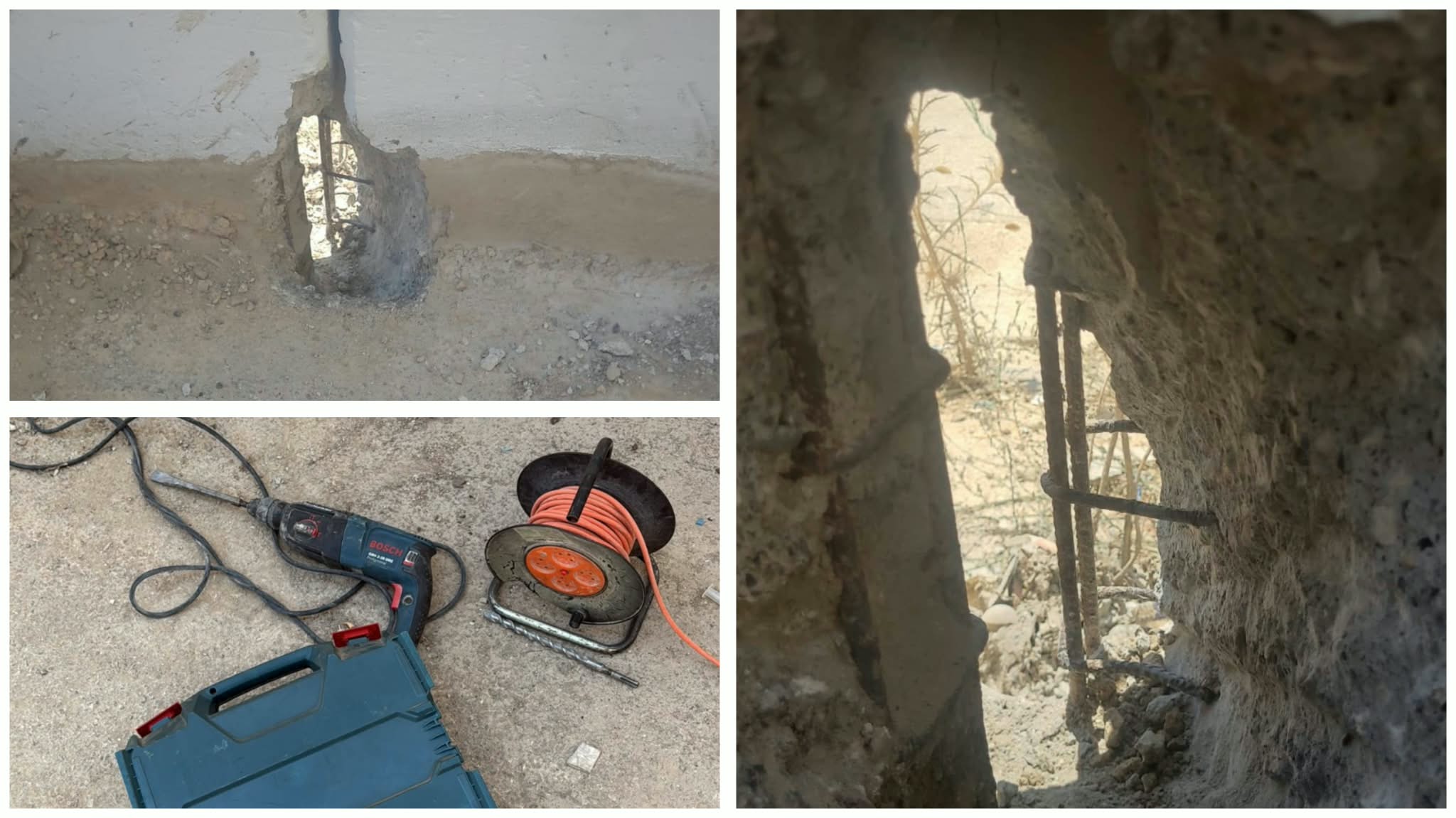
It can be described as an attempt to create an illegal passage. But it is also possible to look at the images and feel your stomach tighten. A separation wall meant to serve as a security barrier, a hole carved into its base, shattered concrete, exposed reinforcement bars and a large electric drill lying nearby. Especially after October 7, this is no longer an image that can easily be dismissed as just another routine incident.
Over the weekend, during an operational activity by Jerusalem Envelope Border Police officers along the seam-line sector in northern Jerusalem, in the Kafr Aqab area, the officers spotted two suspects attempting to dig beneath the separation wall using electric excavation tools. According to police, their aim was to create a passage for people from the Judea and Samaria area into Israeli territory.
After identifying the suspects, Jerusalem Envelope Border Police officers entered Kafr Aqab and surprised the two while they were carrying out the act. The suspects attempted to flee, but after a short pursuit they were located inside a nearby residential building and arrested.
How did the suspects try to create a passage beneath the separation wall near Jerusalem?
The tools allegedly used for the digging were seized at the scene, including a large drill and long electrical cables. The two suspects, residents of Kafr Aqab, were arrested and transferred for further questioning by the Jerusalem Envelope Border Police investigations unit.
The dry facts almost end there. Two suspects, work tools, an attempted excavation and an arrest. But in post-October 7 Jerusalem, it is difficult to leave an incident like this within the narrow boundaries of a brief police report. A wall designed to separate and block suddenly becomes something that someone is trying to get through from underneath.
Why does the sight of a breach in the separation wall trigger fear in Jerusalem?
Police have provided no indication that the suspects were planning an attack or any act of terrorism, and there is therefore no basis for claiming that they were. But that does not erase the sense of threat that the image itself can provoke.
Since the October 7 attack, fences and walls are no longer viewed by many Israelis as abstract symbols of security. Israelis learned in the hardest possible way that a physical barrier is not necessarily an impassable line, and that complacency around border weak points can end in disaster.
In Jerusalem, that feeling is particularly intense. The seam line, checkpoints, neighborhoods on both sides of the barrier and friction zones are all located relatively close to densely populated residential areas. When an image emerges of a hole being carved through concrete, the public imagination does the rest.
Does the separation wall around Jerusalem really provide the security it promises?
In this case, the forces spotted what was happening in time, entered the area and arrested the suspects. From an operational standpoint, the system worked.
But that success itself leaves behind the more troubling question: what would have happened if the digging had not been detected at that stage? Are there other points along the seam line where similar attempts are taking place, and are all of them under sufficient surveillance?
In Jerusalem after October 7, even a small hole at the bottom of a wall is no longer just a hole in concrete. Within seconds, it can become a deeply uncomfortable reminder of how quickly a sense of security can crack.