Jerusalem’s holidays have a beautiful side: crowded streets, families, music, tradition and thousands of visitors filling the city. But there is another side, far less flattering. It appears when celebration stops being a shared experience and becomes an excuse to take over the public space.
It is a familiar kind of ugly Israeli behavior: the assumption that “it’s only for a few minutes” makes blocking a road acceptable; that if there is a hilula, wedding or holiday celebration, everyone else should simply wait; and that, at times, excessive alcohol consumption can blur the line even further between joy and aggressive behavior. The street becomes a private living room. The driver stuck behind you becomes someone else’s problem.
The events that unfolded in the early morning hours during a hilula in Jerusalem illustrated just how quickly that line can disappear. During Sukkot 2026, when the city is already packed with visitors, events and heavy traffic, every additional blockage can have a much wider impact.
What happened at the Jerusalem hilula on Haim Bar-Lev and Zaks streets?
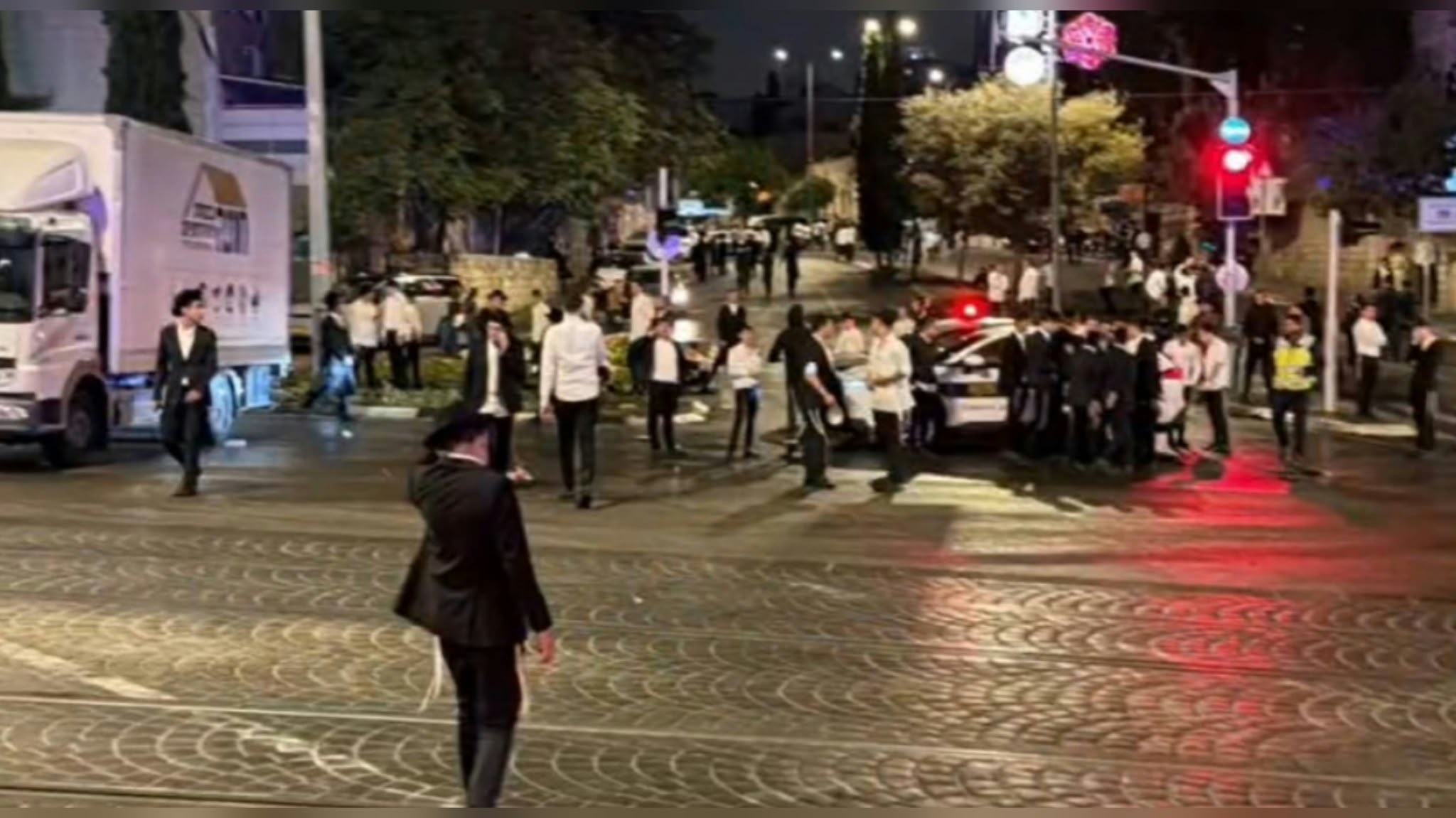
According to the Jerusalem District Police, at around 3:00 a.m. a public disturbance began in the area of Haim Bar-Lev and Zaks streets. Dozens of people blocked the light rail route while train cars were being moved along the tracks, obstructed civilian vehicles and threw stones and other objects at police officers.
A dispersal order was issued at the scene. After those involved failed to comply, Jerusalem District officers, Border Police fighters and Yasam riot-control units moved to disperse the crowd using crowd-control measures, including a water cannon and stun grenades.
At the same time, police received a report of a separate violent incident inside the hilula compound involving several people. Five suspects were arrested over their alleged involvement in the disturbances and violence and were taken for questioning.
The Jerusalem District Police stated: “As part of the public disturbance, dozens of people blocked the light rail route and civilian vehicles, and threw stones and objects at police forces operating at the scene. The forces continue to operate in order to restore public order and protect the safety of the public.”
Why do celebrations in Jerusalem lead to roadblocks and disruption of public space?
The real issue is not another arrest or another disturbance. The problem is broader and cultural. Celebrating in public is a right. Turning the public space into a hostage of the celebration is not.
That is particularly visible in Jerusalem. A city already burdened by events, infrastructure works, traffic jams, road closures and crowded hotspots cannot afford to have every celebration turn into another confrontation with people who are simply trying to get home.
The problem is not music, dancing or joy. The problem is the belief that your celebration gives you a temporary exemption from considering everyone else. That you may block a lane, delay a train, stop drivers, shout deep into the night or drag strangers into a confrontation simply because “it’s a holiday.”
And when excessive drinking is added to the equation, as sometimes happens at large events, things can deteriorate quickly. What starts as a celebration can turn into noise, pushing, violence or blocked roads, while people who never chose to participate are forced to become part of it.
How are Sukkot events in Jerusalem affecting traffic and the public?
Holiday congestion makes incidents like these especially disruptive. During Sukkot 2026, Jerusalem is filled with visitors, events and large numbers of passengers, meaning even a localized roadblock can affect an entire street, a public transport route or hundreds of drivers.
Yet consideration for others is often the first thing to disappear once the celebration gets going. Anyone who wants to pass is expected to wait. Anyone who wants to sleep is expected to tolerate the noise. Anyone stuck in a car is told, in effect, to accept that “there’s an event.” That is precisely the point where celebration turns into arrogance.
It is possible to celebrate without taking over the road. It is possible to have fun without turning neighbors into a captive audience. And it is possible to preserve tradition without using it as an excuse for behavior that nobody would accept outside their own home.
The holiday is not the problem. The problem begins when someone decides that the holiday gives them permission to do whatever they want.