Jerusalem knows how to vote. Election after election, the city gives enormous strength to Likud, the ultra-Orthodox parties and the broader right, repeatedly placing its trust in a political camp that promises security, governance and a tough response to terrorism. In large parts of Jerusalem, support for Benjamin Netanyahu and his political partners has become almost automatic.
But between one election and the next, Jerusalem keeps producing something else: another scene of a terrorist attack, more bereaved families, another layer of fear, and now another memorial plaque.
There is, of course, no simple direct line between a ballot cast at the polls and every security incident on the street. Yet the contrast is difficult to ignore. Jerusalem residents have lived for years alongside shootings, stabbings, attempted ramming attacks and other acts of terrorism, while also confronting serious criminal violence. In a city where political discourse so often revolves around security, everyday reality repeatedly shows how fragile that security can be.
Why was a new memorial plaque unveiled near Jerusalem’s Ramot neighborhood?
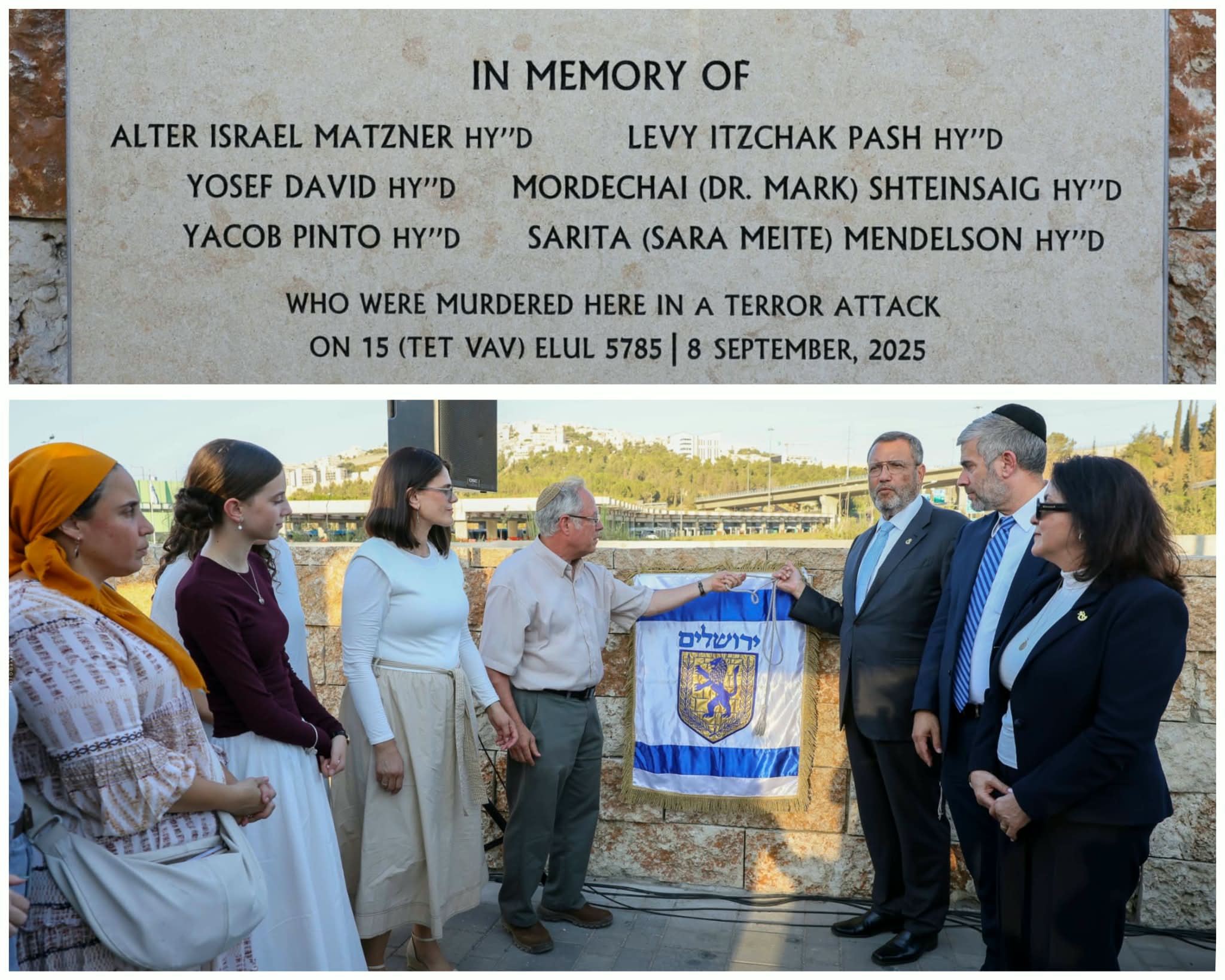
On Golda Meir Boulevard, near the HaArazim terminal at the entrance to Ramot, the Jerusalem Municipality unveiled a memorial plaque honoring the six people murdered in the terrorist attack that took place there on September 8, 2025.
During the attack, terrorists opened fire on civilians waiting at bus stops. The killing spree was stopped after a soldier and an armed civilian at the scene used their personal weapons to shoot and kill the attackers.
The plaque commemorates Jacob Pinto, 25; Yosef David, 43; Alter Israel Matzner, 31; Mordechai, Dr. Mark Shteinsajg, 79; Sarita, Sara Meita Mendelson, 57; and Levy Yitzchak Pash. Six people from very different backgrounds who arrived at the same Jerusalem junction that morning and never returned home.
Who were the six victims of the Ramot terrorist attack?
Pinto immigrated to Israel alone from Spain to study Torah at the Derech Emunah yeshiva in Lod. He had married only a short time before the attack and was a beloved counselor at the yeshiva’s dormitory. Yosef David, a Ramot resident, was a Torah scholar remembered for his warmth and was murdered on his way to study, carrying his religious books.
Alter Israel Matzner, also from Ramot, was described by the municipality as an outstanding Torah scholar devoted to his family. His fourth son, born about a month after his murder, was named after him. Dr. Mark Shteinsajg was a trained cardiologist who immigrated from the United States more than three decades ago, founded a health-bread bakery and pioneered the use of healthier flours in Israel.
Sarita Mendelson immigrated from Argentina at the age of six and served as director of municipal relations at the national headquarters of the Bnei Akiva movement, where she was known as “the mother of the movement.” Levy Yitzchak Pash, a resident of Tel Zion, worked at the Kol Torah yeshiva and was remembered as a caring and widely loved man.
Jerusalem Mayor Moshe Lion addressed the victims’ families during the ceremony: “We gather today, on the eve of the new year, to commemorate your six loved ones who were murdered in cold blood by evildoers in the murderous terrorist attack that took place at this junction nearly a year ago. These six precious people represent a remarkable human mosaic of good qualities and diverse accomplishments. Beautiful and inspiring faces, each in their own way. From now on, they will be commemorated on this memorial plaque, before the eyes of the many passersby, ‘as an everlasting remembrance.’ The Jerusalem Municipality and the residents of the city send a warm embrace and sincere condolences to all of you, the dear families. We pray that these days of mercy and forgiveness will bring good news, salvation and comfort.”
The ceremony will end, the guests will leave and the plaque will remain at the junction. And in Jerusalem, a city that repeatedly votes for politicians who promise security, one uncomfortable question remains: how many more memorial plaques will have to be unveiled before that promise is also felt at the bus stop?